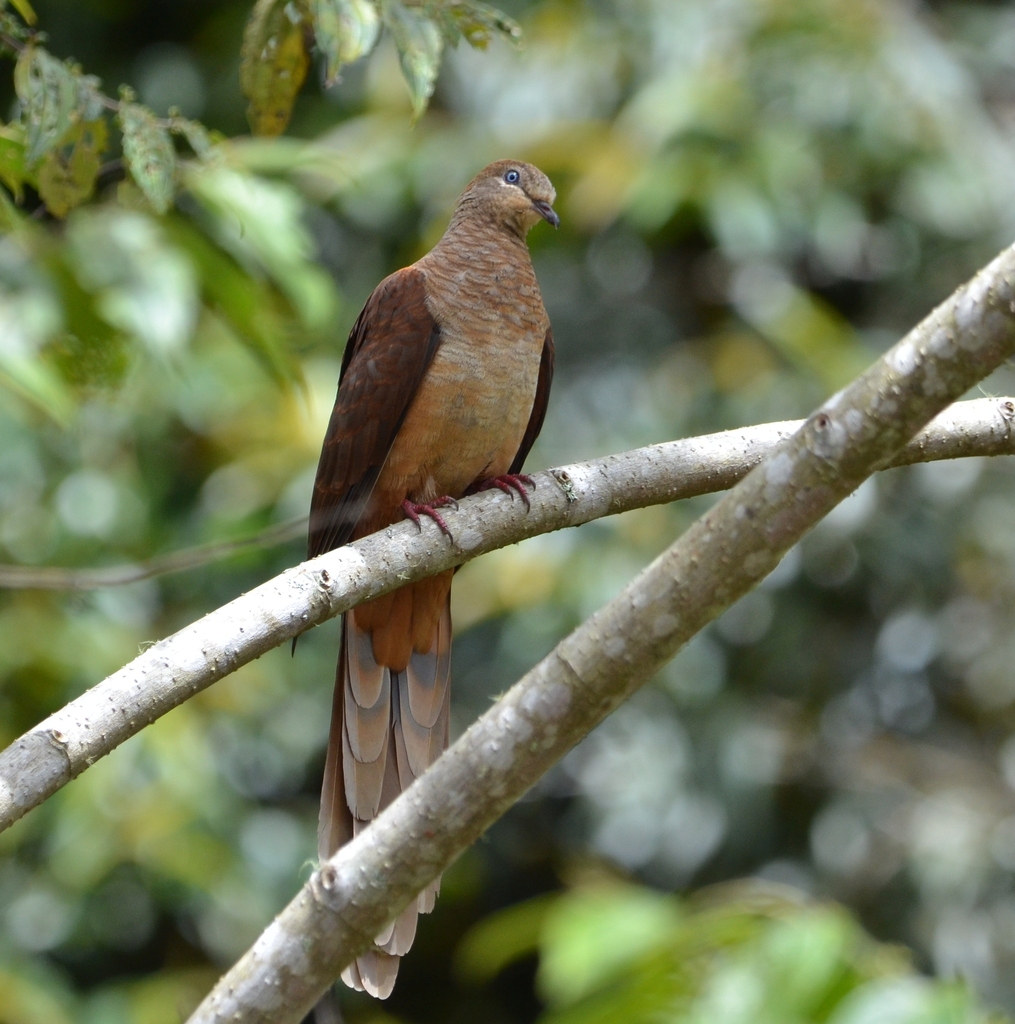
Amboyna Cuckoo-Dove
Photo © Micha Baum
Photo © Micha Baum — CC BY-SA 4.0 — Source: iNaturalist photo #391679262Identification
The Amboyna cuckoo-dove is a medium-sized dove measuring 35–37 centimetres in length. Males display a distinctive rose or green colouration on the nape and neck. Depending on the subspecies, many birds show whitish underparts with fine dark barring below and a whitish cap. The species is most readily identified by its unmistakable call: a very loud "whoop-a whoop" that varies slightly between subspecies.
Range & Habitat
This dove is endemic to the Indo-Pacific region, with a range spanning the Moluccas, New Guinea, and various island archipelagos including the Admiralty Islands, Bismarck Archipelago, Kai Islands, D'Entrecasteaux Islands, and the Louisiade Archipelago. Nine subspecies are recognized across this broad distribution. The Amboyna cuckoo-dove inhabits rainforest, woodland, scrubland, and regenerating rainforest areas, showing flexibility in its habitat requirements.
Behaviour & Diet
These doves are often encountered in pairs or small groups and can be nomadic, moving in response to food availability. They feed primarily on berries from both native plants and introduced weed species. In flight, they characteristically move short distances low to the ground with powerful, swift wingbeats. Breeding takes place during spring and summer, with pairs constructing a simple flat platform nest made of sticks and vines in a tree fork or atop low trees. A single creamy white egg is laid per clutch.
Best Time & Places to See It
The species is most active during spring and summer breeding season, when vocalisations increase. Throughout its range in the Moluccas and New Guinea, this dove can be found in suitable rainforest and woodland habitats year-round, though nomadic movements mean sightings are most reliable when fruiting plants are abundant. Early morning often provides the best viewing opportunities when the birds are most vocal and active.
Photography Tips
Patient observers positioned near fruiting trees at dawn will have the best chance of obtaining quality images. The rose or green iridescence on males' napes and necks is best captured in soft, directional light. The bird's habit of flying low through dense vegetation makes photography challenging; focus on perched birds rather than attempting flight shots. The distinctive whitish cap and fine barring of underparts are key field marks to emphasise in documentation. A long lens is essential given the species' preference for remaining in woodland and scrubland cover.
No community photos yet. Log in to add the first one.
No community observations of this species yet.