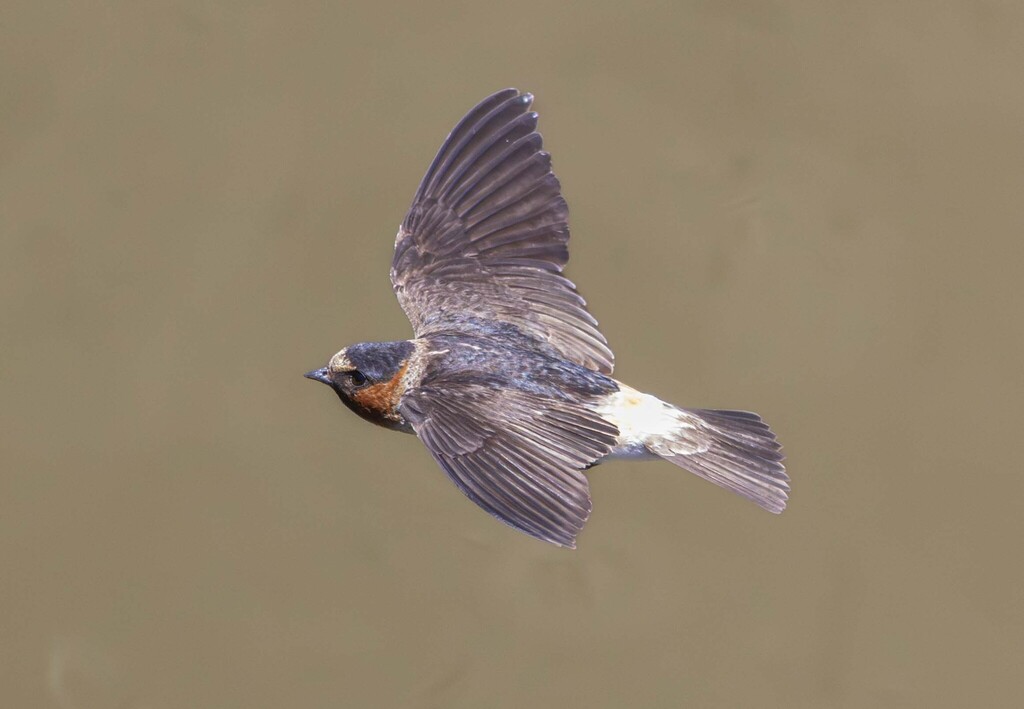
American Cliff Swallow
Photo © Brooke J.
Photo © Brooke J. — CC BY 4.0 — Source: iNaturalist photo #681385221Identification
The cliff swallow is a compact songbird measuring 13 cm in length, with short legs, a small bill, and characteristically long pointed wings built for agile aerial maneuvers. Adults display distinctive plumage: dark brownish back and wings, a striking white forehead, rich red cheeks, dark throat, pale underparts, and a buffy rump. In strong light, the crown and mantle feathers show iridescent sheen. The square-shaped tail distinguishes cliff swallows from their close relatives, the barn swallows, which have a forked tail. Sexual dimorphism in plumage is absent, making visual sexing impossible in the field. Northern populations are slightly larger and show different facial markings than their Mexican counterparts, which have chocolate-brown foreheads. Juveniles resemble adults but with paler, duller plumage and speckled white foreheads and throats that vary notably between individuals—a trait that may help parents locate their chicks in large colonies.
Range & Habitat
Historically, cliff swallows nested exclusively on mountain cliffs along western North America's coasts. Today, this adaptable species has expanded dramatically across Canada and the United States (excluding extreme southern and northern regions), now building mud nests on concrete bridges, highway overpasses, and buildings. Breeding colonies cluster near fields, ponds, and wetlands rich in flying insects. The species undertakes remarkable long-distance migrations, wintering in South America including southern Brazil, Uruguay, and parts of Argentina. Eastern populations migrate through Florida while western birds travel via Mexico and Central America.
Behaviour & Diet
Cliff swallows are extremely social aerial insectivores that forage gracefully over open terrain, catching flying insects on the wing. They live in massive breeding colonies exceeding 2,000 nests, building distinctive gourd-shaped mud nests with small entrance holes constructed tightly together on cliff faces, bridges, and buildings. These highly vocal birds use extensive calls to communicate warnings and food discoveries throughout their colonies. During migration, they congregate in large flocks, often perching shoulder-to-shoulder on wires to preen and rest.
Best Time & Places to See It
Look for cliff swallows during breeding season in areas with suitable nesting infrastructure—under bridges, on canyon walls, and on building eaves near open fields and water bodies. Migration periods offer spectacular viewing opportunities as large flocks move through North America, particularly along coastlines. Spring and early summer are prime seasons to observe them at active colonies engaged in nest-building, feeding, and social behaviors.
Photography Tips
Photograph cliff swallows perched on wires or branches to capture their distinctive facial markings—the white forehead, red cheeks, and dark throat. Backlighting reveals the iridescent sheen on crown and mantle feathers. Fast shutter speeds (1/1000s or faster) are essential to freeze their rapid, agile flight during foraging. Capture the characteristic square tail in flight to distinguish them from barn swallows. Colony photographs show dramatic stacked mud nests and the birds' highly social nature.
Tombstone Territorial Park
Acadia National Park
Alaska Maritime National Wildlife Refuge
Algonquin Provincial Park
Alligator River National Wildlife Refuge
Amacayacu National Park
Arches National Park
Arctic National Wildlife Refuge
Arenal Volcano National Park
Nothing matches these filters.
No community photos yet. Log in to add the first one.
No community observations of this species yet.