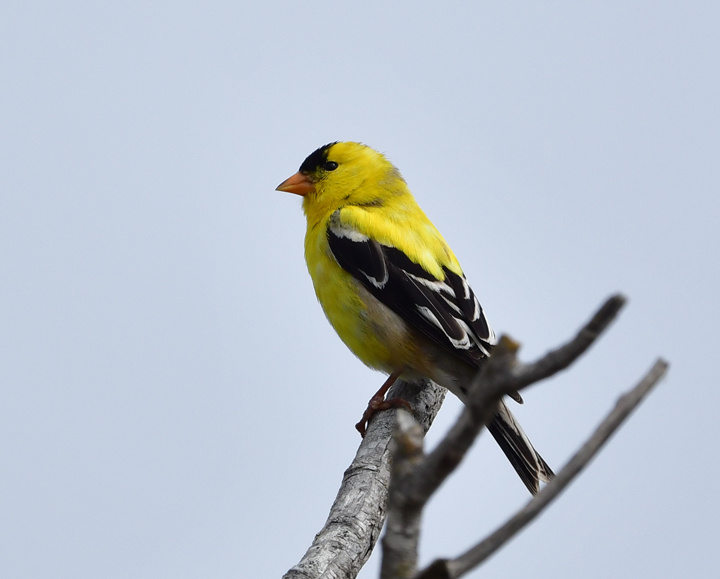
American Goldfinch
Photo © Pat Farris
Photo © Pat Farris — CC BY 4.0 — Source: iNaturalist photo #122467058Identification
The American goldfinch is a small finch, measuring 11–14 cm in length with a wingspan of 19–22 cm. Its most striking feature is extreme sexual dichromatism—the male's plumage changes dramatically with the seasons. In breeding season, males display brilliant lemon-yellow bodies with a jet-black cap and white rump, colors produced by carotenoid pigments from their diet. Females are considerably duller, appearing mostly brown with a yellowish bib. After the autumn molt, both sexes adopt olive-brown and buff plumage, though males retain yellow shoulder patches. The American goldfinch is the only finch in its subfamily to undergo a complete molt twice yearly: a full molt in autumn and a partial molt in spring that preserves dark wing and tail feathers. The small, conical pink beak turns bright orange during spring molt in both sexes.
Immature birds resemble females with dull brown backs and pale yellow undersides. In flight, look for the white rump patch on males and the white markings on dark wings and tail. The species produces a musical warbling song, and gives a distinctive tsee-tsi-tsi-tsit call in flight, sometimes rendered as per-chic-o-ree.
Range & Habitat
The American goldfinch is a migratory species found across North America. During breeding season, it ranges from mid-Alberta east to North Carolina. In winter, the population shifts southward from just below the Canada–United States border to Mexico. Four recognized subspecies show variation in size, coloration, and specific range, with the eastern goldfinch being the most common. The species is attracted to open, weedy areas and meadows—habitats naturally created and expanded by human deforestation and land management.
American goldfinches have benefited from human activity, frequently inhabiting residential gardens and yards where they are drawn to bird feeders, which significantly increase their survival rates in developed areas.
Behaviour & Diet
The American goldfinch is a granivore specially adapted for extracting seeds from seedheads of thistles, sunflowers, and other plants. Its conical beak and agile feet allow it to grip and feed from delicate plant stems. This species is highly social, gathering in large flocks during feeding and migration. Breeding behavior differs from territorial aggression shown during nest construction, though this aggression is short-lived. The species is generally monogamous and produces one brood annually.
Uniquely among finches, the American goldfinch's breeding season begins in late July—relatively late in the year—timed to coincide with the peak availability of seed food. While incubating eggs, females call to returning mates with a soft, continuous tee-tee-tee sound. Young birds develop chick-kee or chick-wee calls shortly before fledging.
Best Time & Places to See It
The best opportunities to observe American goldfinches come during migration periods and in open meadow habitats where thistles and other seed-bearing plants flourish. In breeding season, look in weedy fields and natural areas from mid-Alberta to North Carolina. Residential areas with bird feeders reliably attract them year-round, particularly in winter when natural food becomes scarce. Large flocking behavior makes them easier to locate when they gather together.
Late summer and autumn offer excellent viewing as birds prepare for or undertake migration. Winter visitors to southern regions provide opportunities to observe the dramatic plumage contrast between molted males and females.
Photography Tips
Photograph males in breeding plumage during late spring and early summer to capture the brilliant yellow coloration and striking black cap. The white rump patch is most visible during flight, so anticipate takeoff moments. Use a faster shutter speed when birds are feeding on seedheads, as they move constantly while gripping delicate stems with their agile feet. The dramatic seasonal molt offers opportunities to document plumage transitions—capture both bright and dull phases to illustrate sexual dichromatism and seasonal variation.
Social flocking behavior presents challenges and opportunities; position yourself to isolate individual birds from crowded feeding groups. Backlighting during golden hour emphasizes the yellow coloration and highlights the carotenoid pigments in the plumage. Include thistle or sunflower seedheads in composition to provide ecological context and demonstrate their specialized feeding behavior.
Acadia National Park
Algonquin Provincial Park
Alligator River National Wildlife Refuge
Arches National Park
Badlands National Park
Banff National Park
Bear River Migratory Bird Refuge
Bic National Park
Big Bend National Park
Nothing matches these filters.
No community photos yet. Log in to add the first one.
No community observations of this species yet.