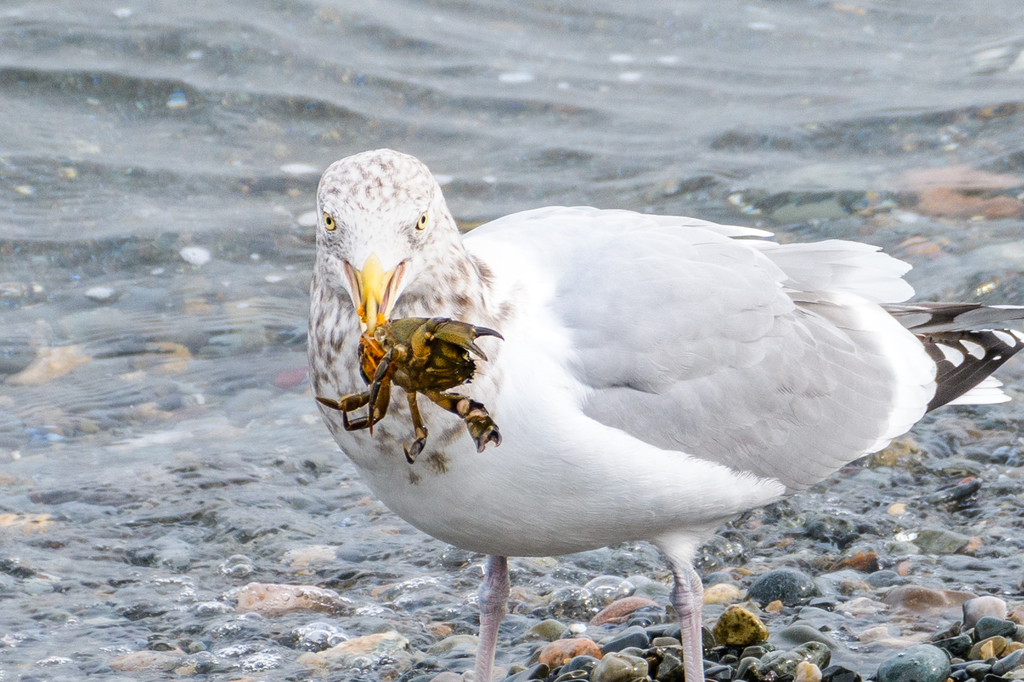
American Herring Gull
Photo © Andrew Hrycyna
Photo © Andrew Hrycyna — CC BY 4.0 — Source: iNaturalist photo #110859687Identification
The American herring gull is a heavily built large gull with a long powerful bill, full chest and sloping forehead. Breeding adults are unmistakable: white head, rump, tail, and underparts contrast sharply with a pale gray back and upperwings. The wingtips are black with distinctive white spots called "mirrors," and the trailing edge of the wing is white. The legs and feet are normally pink, and the bill is yellow with a red spot on the lower mandible. The eye is bright yellow with a bare yellow or orange ring around it. In winter, the head and neck become streaked with brown.
Immature birds are considerably more challenging to identify. Young birds take four years to reach fully adult plumage, progressing through several distinct stages. First-winter birds are gray-brown overall with a dark tail, brown rump with dark bars, and a dark bill that usually develops a paler base through winter. Second-winter birds show pale eyes, a pale bill with black tip, and pale head with emerging gray feathers on the back. Third-winter birds closely resemble adults but retain some black on the bill, brown on body and wings, and a black band on the tail.
Range & Habitat
The American herring gull breeds across the northern part of North America from central and southern Alaska to the Great Lakes and along the northeast coast of the United States from Maine south to North Carolina, with breeding populations across most of Canada except the southwest and Arctic regions. Birds are present year-round in southern Alaska, the Great Lakes, and the northeast USA, but most migrate south in winter, reaching as far as Mexico with small numbers occasionally reaching Hawaii, Central America, and the West Indies.
These highly adaptable gulls occur in a remarkable variety of habitats including coasts, lakes, rivers, parking lots, and garbage dumps. They usually nest near water, laying around three eggs in a scrape on the ground, making them equally at home in wild coastal regions and urban environments.
Behaviour & Diet
American herring gulls are vocal birds with no true song but a diverse repertoire of calls and cries. Their initial response to threats is a quick "hahaha," while the more-intense "keow" serves as a loud, short alarm call. The "long call" consists of a series of loud notes accompanied by head dipping and raising. During courtship, nest construction, or territorial disputes, they produce a "choking" call while rapidly bobbing their head. The "mew" call with an extended downturned neck serves multiple functions including mate calling and nest defense. Juvenile birds emit high-pitched plaintive cries to beg for food from parents.
American herring gulls are opportunistic omnivores with a broad diet that includes invertebrates, fish, and many other items. This dietary flexibility contributes significantly to their success in diverse habitats ranging from pristine coastlines to urban centers.
Best Time & Places to See It
Year-round residents are easiest to find in southern Alaska, around the Great Lakes, and along the northeast USA coast. For photographers and travelers visiting other regions, winter months offer the best opportunities to observe these gulls as birds migrate south from their breeding grounds. Coastal areas, large lakes, major river systems, and urban waterfronts are all reliable locations. Garbage dumps and parking lots near water bodies, while less aesthetically appealing, consistently attract feeding birds.
Photography Tips
Photographing American herring gulls offers excellent opportunities at all seasons. Breeding adults are stunning subjects with their crisp white and gray plumage, particularly in strong light that emphasizes the contrast between their pale body and black wingtips. Capture the distinctive red spot on the lower mandible and the yellow eye-ring, which are key identification features. The birds' varied vocalizations provide opportunities for behavior photography during territorial displays and courtship, when head-bobbing and the "choking" call create dynamic compositions. Remember to include contextual habitat shots showing their adaptability to diverse environments from rocky coastlines to urban settings.
Tombstone Territorial Park
Acadia National Park
Alaska Maritime National Wildlife Refuge
Algonquin Provincial Park
Alligator River National Wildlife Refuge
Arctic National Wildlife Refuge
Banff National Park
Barra del Colorado National Wildlife Refuge
Bear River Migratory Bird Refuge
Nothing matches these filters.
No community photos yet. Log in to add the first one.
No community observations of this species yet.