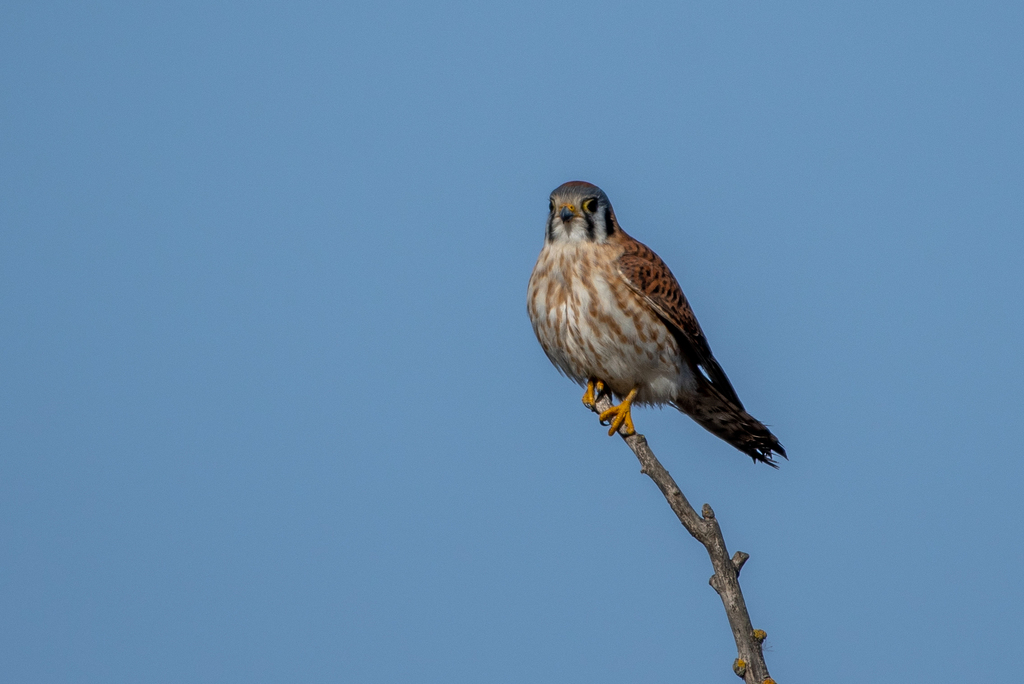
American Kestrel
Photo © Jonathan Eisen
Photo © Jonathan Eisen — CC BY 4.0 — Source: iNaturalist photo #111241169Identification
The American kestrel is the smallest and most common falcon in the Americas. Both sexes display a distinctive rufous back with noticeable barring and colorful plumage, though they differ in size and coloration—females are moderately larger than males. Ranging from about the weight of a blue jay to a mourning dove, these compact raptors measure 22 to 31 centimeters in length with a wingspan of 51–61 centimeters. Juveniles resemble adults in plumage, making them relatively straightforward to identify across their range.
Range & Habitat
The American kestrel occurs almost throughout North and South America, absent only from the Arctic fringes of North America and the densest tropical Amazon rainforest areas. Its breeding range extends from central and western Alaska across northern Canada to Nova Scotia, and south throughout North America into central Mexico and the Caribbean. The species is a local breeder in Central America and is widely distributed throughout South America, with most birds breeding in Canada and the northern United States migrating south for winter. It is an occasional vagrant to Western Europe.
This adaptability across diverse environments has led to the evolution of 17 subspecies, each adapted to different regional conditions. The species nests in cavities within trees, cliffs, buildings, and other structures, demonstrating its flexibility in selecting breeding sites across its extensive range.
Behaviour & Diet
American kestrels employ an energy-conserving hunting strategy, typically perching and scanning the ground for prey to ambush, though they also hunt from the air. They sometimes hover with rapid wing beats while homing in on targets. Their diet is notably broad, consisting of grasshoppers and other insects, lizards, mice, and small birds such as sparrows—a dietary flexibility that has contributed significantly to the species' wide success.
Breeding females lay three to seven eggs, with both sexes participating in incubation. The less muscular body type of American kestrels is specifically adapted to their energy-conserving ambush hunting style rather than sustained high-energy flight.
Best Time & Places to See It
As the most common falcon in the Americas, the American kestrel is relatively accessible to observers throughout its range. Year-round residents can be found in southern portions of North America and throughout Central and South America. During breeding season, look for them from central and western Alaska across northern Canada to Nova Scotia and southward. Winter visitors arrive in northern regions as southern-breeding populations migrate, making autumn and winter excellent times to observe them in their wintering grounds.
Photography Tips
The American kestrel's colorful plumage and small size make it an engaging photographic subject. Its habit of perching openly while hunting provides excellent opportunities for portrait photography. The hovering hunting behavior, though energy-intensive, offers dynamic flight shots. Look for the distinctive rufous back and barring in your compositions. Sexual dimorphism and size variation across subspecies provide additional compositional interest for those documenting regional variations within your travels.
Tombstone Territorial Park
Acadia National Park
Alaska Maritime National Wildlife Refuge
Algonquin Provincial Park
Antisana National Park
Araucárias National Park
Arches National Park
Archipiélago Juan Fernández National Park
Arctic National Wildlife Refuge
Nothing matches these filters.
No community photos yet. Log in to add the first one.
No community observations of this species yet.