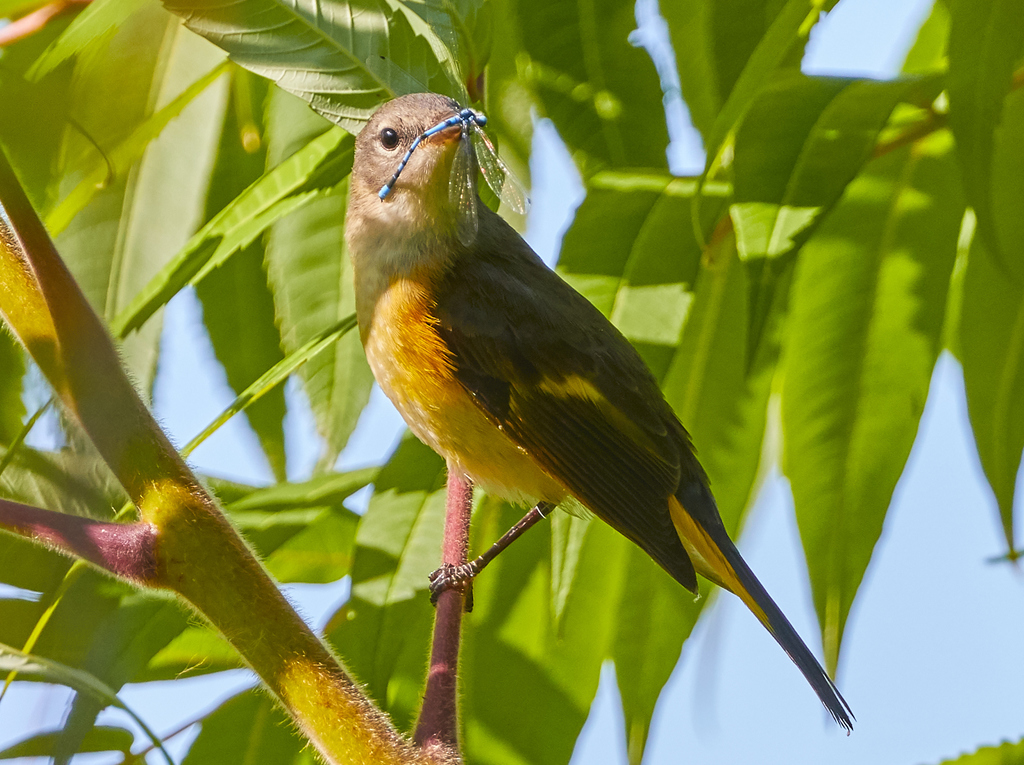
American Redstart
Photo © David Bird
Photo © David Bird — CC0 1.0 — Source: iNaturalist photo #154868013Identification
The American Redstart is a small warbler measuring 11 to 14 cm in length with a wingspan of 16 to 23 cm. Its relatively long tail makes it one of the most elegant warblers to observe. Breeding males are unmistakable: jet black upperparts contrasted with large orange-red patches on wings and tail, orange-red on the breast sides, and white underparts. Females and young birds display green upperparts with black central tails, grey heads, and yellow (rather than orange) patches—the yellow coloration replacing the males' brilliant orange. This sexual dimorphism in plumage color reflects differences in carotenoid pigments: males possess red canthaxanthin and yellow canary xanthophylls, while females have only the yellow carotenoids.
The species is highly active in movement. Males produce a series of musical see notes for their song, with a soft chip call. Despite their small size, American Redstarts are remarkably long-lived and energetic foragers, making them exciting subjects for birders and photographers.
Range & Habitat
American Redstarts breed across southern Canada and the eastern United States. They are long-distance migrants, wintering in Central America, the West Indies, and northern South America, where they are rare vagrants to western Europe. During breeding season, they favor open-canopy deciduous forests, second growth, and forest edges. On wintering grounds, they occupy nearly all woody habitats, frequently found in shade-grown coffee plantations that retain native trees and shrubs. They avoid open agricultural areas. Elevations vary by location: redstarts reach 3,000 m in South America but only 1,500 m in Jamaica.
Behaviour & Diet
American Redstarts are almost exclusively insectivorous, feeding by flycatching to capture prey in flight and by gleaning insects from foliage. They are highly active foragers, typically feeding in the mid to lower regions of trees and shrubs, often sharing these habitats with other warbler species. During breeding, they nest in open woodlands near water, building neat cup-shaped nests in the lower parts of bushes and laying 2–5 eggs. The female incubates for 10 to 13 days, and young fledge after 9 days.
Redstarts display a mixed mating system: predominantly monogamous, though approximately 25% of males maintain multiple territories and are polygynous. Interestingly, first-year males in female-like plumage show lower reproductive success (less than 50%) compared to first-year females. Male coloration intensity predicts territorial success on wintering grounds and paternity rates. Males are intensely territorial, with dominant males occupying superior habitats such as moist mangroves, while subordinate males occupy secondary dry scrub forests.
Best Time & Places to See It
Spring and fall migrations offer excellent opportunities to observe American Redstarts as they move between breeding grounds in eastern North America and wintering grounds in the Caribbean and Central America. During breeding season, they are most active and visible in open deciduous forests and second growth woodlands of eastern North America. Winter birders should seek them in shade-grown coffee plantations and mixed woody habitats throughout Central America and the West Indies, where they maintain territories for several months.
Photography Tips
The striking plumage of breeding males—black with brilliant orange-red accents—provides excellent contrast and color saturation in photographs. Their active foraging behavior in mid-story vegetation often provides close viewing opportunities. Capture their characteristic flycatching movements and tail displays, which showcase the distinctive patches that give the species its name. Winter birds in their yellow and green plumage are more subtle but equally photogenic in dappled woodland light. Early morning light on Caribbean wintering grounds will enhance the vibrant colors of males that retained their breeding plumage.
Acadia National Park
Alaska Maritime National Wildlife Refuge
Algonquin Provincial Park
Alligator River National Wildlife Refuge
Antisana National Park
Arenal Volcano National Park
Arrecifes de Cozumel National Park
Badlands National Park
Banff National Park
Nothing matches these filters.
No community photos yet. Log in to add the first one.
No community observations of this species yet.