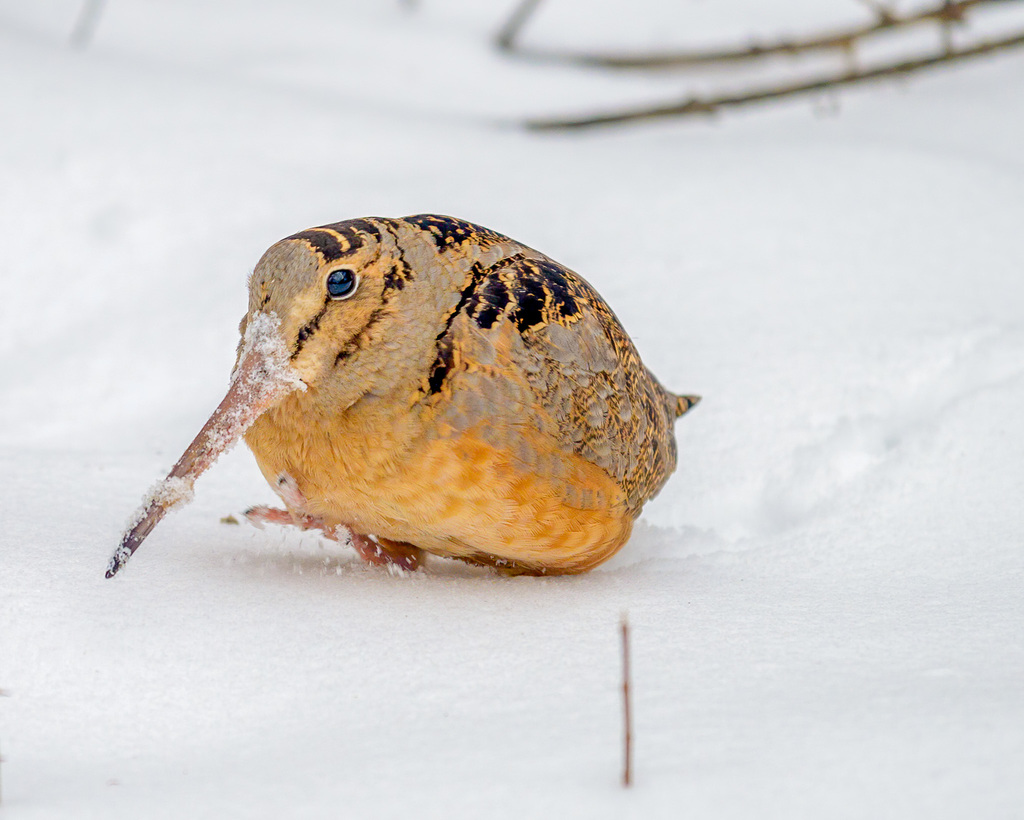
American Woodcock
Photo © Shiva Shenoy
Photo © Shiva Shenoy — CC BY 4.0 — Source: iNaturalist photo #113257158Identification
The American woodcock is a plump, compact shorebird measuring 10 to 12 inches long with a wingspan of 16.5 to 18.9 inches. One of its most striking features is its exceptionally long, straight bill—measuring 2.5 to 2.8 inches—which it uses to probe the ground for food. Females are considerably larger than males, weighing 5 to 8 ounces overall. The bird's most remarkable sensory adaptation is its visual field, the largest of any bird species: 360 degrees in the horizontal plane and 180 degrees in the vertical plane, with large eyes positioned high on the head.
The plumage is a cryptic masterpiece of camouflage, featuring a mottled mix of browns, grays, and blacks that blends seamlessly with leaf litter and soil. The chest and sides range from yellowish-white to rich tan, while the nape is black with three or four crossbars of deep buff or rufous coloring. The bill itself is a marvel of engineering: a unique bone-and-muscle arrangement allows the woodcock to open and close just the tip of its upper mandible while probing underground, and both the mandible underside and rough tongue are specialized for grasping slippery prey.
Range & Habitat
The American woodcock is the only woodcock species inhabiting North America and is found primarily in the eastern half of the continent, east of the 98th meridian. The breeding range extends from Atlantic Canada—including Newfoundland, Nova Scotia, Prince Edward Island, and New Brunswick—west to southeastern Manitoba, and south to northern Virginia, western North Carolina, Kentucky, northern Tennessee, northern Illinois, Missouri, and eastern Kansas. Limited breeding populations occur as far south as Florida and Texas, and the species may be expanding northward and westward. In winter, woodcocks migrate south to the Gulf Coast and southeastern Atlantic Coast states, with the core wintering range centered on Louisiana, Mississippi, Alabama, and Georgia.
These birds favor wet thickets, moist woods, and brushy swamps, particularly in early successional habitat and abandoned farmland mixed with forest. Feeding habitats require moist soil with densely growing young trees such as aspen, birch, and mixed hardwoods less than 20 years old, along with shrubs like alder. Breeding and courtship take place in forest openings, roadsides, pastures, and old fields, while nesting occurs in thickets, shrubland, and young to middle-aged forest with openings. For roosting, woodcocks prefer semiopen sites with short, sparse vegetation such as blueberry barrens and recently logged forest stands.
Behaviour & Diet
The American woodcock spends most of its time on the ground, where its cryptic plumage provides excellent camouflage. The bird is primarily a ground feeder, using its remarkable long bill to probe soil for invertebrates, especially earthworms. Its diet consists mainly of these soil-dwelling creatures, which it extracts using its specialized bill anatomy and rough-surfaced tongue designed for gripping slippery prey. Woodcocks migrate at night, flying at low altitudes either individually or in small, loose flocks, typically orienting themselves visually using major physiographic features such as coastlines and broad river valleys. Migration flights are leisurely compared to many other bird species, with recorded speeds ranging from 5 to 28 mph. Most woodcocks begin migrating south in October, with the major push occurring from mid-October to early November, and most arrive on their wintering grounds by mid-December. Return migration to northern breeding grounds begins in February.
Best Time & Places to See It
Spring is the prime season for observing American woodcocks, as males return to their breeding grounds in February and engage in spectacular courtship displays in forest openings, pastures, and old fields. The breeding range across Atlantic Canada and throughout the eastern United States offers numerous opportunities, particularly in areas with suitable early successional habitat. In winter, concentrations are highest in the northern half of Alabama and throughout the Gulf Coast and southeastern Atlantic Coast states, making this region ideal for winter birding. The species' nickname, "timberdoodle," reflects its association with brushy woodland edges and young forest habitats.
Photography Tips
Photographing American woodcocks presents unique challenges due to their cryptic plumage and ground-dwelling habits. The bird's exceptional camouflage of browns, grays, and blacks makes it difficult to spot among leaf litter and vegetation, so patience and careful scanning of suitable habitat are essential. Spring courtship displays, when males call and launch flight displays in more open settings, offer the best photography opportunities. Early morning or late afternoon visits to forest openings, pastures, and old fields during the breeding season will maximize your chances. The bird's small stature and preference for ground-based activities mean that low angles and wide habitat context often work better than close-up portraits, particularly when capturing the bird in its natural setting.
Cape Breton Highlands National Park
Cape Breton Highlands National Park, Canada
+215 birds+18 mammals
Where the Atlantic coast of Nova Scotia rises in weathered cliffs and glacially carved valleys, Cape Breton Highlands National Park spans a landscape where boreal and…
VIEW NATIONAL PARKFrontenac National Park
Sainte-Praxède, Canada
+178 birds+11 mammals
Where the Canadian Shield's ancient granite ridges meet coniferous forest and freshwater lakes, Frontenac National Park embraces a landscape carved by millennia of glacial movement. The…
VIEW NATIONAL PARKL’Île-Bonaventure-Et-Du-Rocher-Percé National Park
Le Rocher-Percé, Canada
+214 birds+3 mammals
A dramatic thrust of russet sandstone pierces the Gulf of Saint Lawrence, its weathered arch framing a seascape where cool Atlantic currents sweep past cliffs alive…
VIEW NATIONAL PARKMont-Saint-Bruno National Park
Saint-Bruno-de-Montarville, Canada
+200 birds+13 mammals
Hardwood forests rise steeply from the suburbs of Montreal to crown a distinctive peak in the Monterégian Hills, their ancient geology pushing through mixed deciduous woodland…
VIEW NATIONAL PARKPointe-Taillon National Park
Lac-Saint-Jean-Est, Canada
+157 birds+10 mammals
Where boreal forest meets the shores of Lac-Saint-Jean, Pointe-Taillon National Park unfolds across a landscape shaped by glacial legacy and water. Sandy peninsulas and islands rise…
VIEW NATIONAL PARKMauricie National Park
Shawinigan, Canada
+184 birds+12 mammals
Where the Canadian Shield meets boreal forest, Mauricie National Park unfolds across a landscape of granite ridges, crystalline lakes, and dense coniferous woodland that defines the…
VIEW NATIONAL PARKNew River Gorge National Park
Fayette County, United States
+183 birds+13 mammals
Where the New River carves its ancient path through the Appalachian plateau, a landscape of towering sandstone cliffs and dense deciduous forest creates one of the…
VIEW NATIONAL PARKBig Bend National Park
Brewster County, United States
+345 birds+34 mammals
Where the Chisos Mountains rise abruptly from the Sonoran Desert floor, Big Bend National Park spans over 7,300 square kilometers of one of North America's most…
VIEW NATIONAL PARKVoyageurs National Park
Northwest Saint Louis, United States
+198 birds+13 mammals
Where the boreal forest meets the glacially sculpted lakes of northwestern Minnesota, Voyageurs National Park sprawls across nearly two thousand square kilometres of a landscape shaped…
VIEW NATIONAL PARKMammoth Cave National Park
Edmonson County, United States
+179 birds+13 mammals
Beneath the rolling hills of central Kentucky lies one of North America's most extensive cave systems, where limestone passages descend through a landscape shaped by water…
VIEW NATIONAL PARKIndiana Dunes National Park
Porter, United States
+304 birds+15 mammals
Along the southern shore of Lake Michigan, where glacial geology meets temperate woodland and open water, sprawls a landscape of extraordinary ecological complexity. The dunes themselves—massive…
VIEW NATIONAL PARKEverglades National Park
Monroe County, United States
+345 birds+22 mammals
Where freshwater marsh meets subtropical sky, the Everglades sprawls across southwestern Florida as one of North America's most expansive wetland ecosystems. Spanning over 13,000 square kilometers,…
VIEW NATIONAL PARKGreat Smoky Mountains National Park
Sevier County, United States
+244 birds+40 mammals
Where the southern Appalachian ridgeline reaches its most densely forested expression, over 4,200 square kilometres of temperate woodland rise and fall across Tennessee and North Carolina,…
VIEW NATIONAL PARKMonts-Valin National Park
Mont-Valin, Canada
+133 birds+6 mammals
Where the boreal forest meets the Canadian Shield, Monts-Valin National Park sprawls across 405 square kilometers of Québec's rugged interior, its landscape carved by glaciation into…
VIEW NATIONAL PARKHautes-Gorges-De-La-Rivière-Malbaie National Park
Mont-Élie, Canada
+140 birds+8 mammals
Where the Rivière-Malbaie carves through the Laurentian highlands, steep-sided gorges rise dramatically above Quebec's coastal hinterland, their ancient bedrock sculpted by millennia of water and ice.…
VIEW NATIONAL PARKGrands-Jardins National Park
Lac-Pikauba, Canada
+166 birds+10 mammals
Where the boreal forest transitions into the subalpine plateaus of Quebec's Laurentian highlands, Grands-Jardins National Park sprawls across nearly 690 square kilometers of wild terrain that…
VIEW NATIONAL PARKLac-Témiscouata National Park
Témiscouata, Canada
+176 birds+4 mammals
Where the boreal forests of eastern Quebec embrace a sprawling freshwater lake, Lac-Témiscouata National Park unfolds across 509 square kilometres of pristine landscape that bridges two…
VIEW NATIONAL PARKFundy National Park of Canada
Alma Parish, Canada
+217 birds+24 mammals
Where the Bay of Fundy's tidal rhythms sculpt a landscape of dramatic cliffs, forested valleys, and boulder-strewn shorelines, Fundy National Park rises across approximately 345 square…
VIEW NATIONAL PARKMont-Tremblant National Park
Lac-des-Dix-Milles, Canada
+200 birds+12 mammals
Where the Laurentian plateau rises in central Quebec, a landscape of boreal forest and glacially carved lakes unfolds across nearly 3,100 square kilometres of protected wilderness.…
VIEW NATIONAL PARKÎles-De-Boucherville National Park
Boucherville, Canada
+243 birds+8 mammals
Where the Saint Lawrence River braids into a labyrinth of islands and channels, Îles-de-Boucherville National Park sprawls across approximately 18 square kilometres of riverine wilderness just…
VIEW NATIONAL PARKGros Morne National Park
Canada
+180 birds+19 mammals
Where glacier-carved fjords pierce the interior of Newfoundland, Gros Morne National Park unfolds across nearly four thousand square kilometres of some of Canada's most dramatic coastal…
VIEW NATIONAL PARKBic National Park
Rimouski, Canada
+250 birds+9 mammals
Where the St. Lawrence River meets the Gaspé Peninsula, a rugged coastline of forests, wetlands, and rocky shores unfolds across nearly 95 square kilometres of protected…
VIEW NATIONAL PARKMont-Mégantic National Park
La Patrie, Canada
+136 birds+8 mammals
Granite peaks and boreal forest define the rugged terrain of this 115-square-kilometre national park in Quebec's Eastern Townships, where the landscape rises sharply above the surrounding…
VIEW NATIONAL PARKKouchibouguac National Park of Canada
Carleton Parish, Canada
+207 birds+14 mammals
Where the Maritime provinces meet the Atlantic, 591 square kilometres of coastal forest and wetland unfold across New Brunswick's eastern shoulder, a mosaic of boreal woodland,…
VIEW NATIONAL PARKForillon National Park
Gaspé, Canada
+258 birds+16 mammals
Where the Gaspésie Peninsula juts into the Gulf of Saint Lawrence, granite cliffs and coastal headlands frame one of eastern Canada's most dramatic marine-terrestrial boundaries. Forillon…
VIEW NATIONAL PARKPoint Pelee National Park
Leamington, Canada
+296 birds+14 mammals
Where Lake Erie's shallow waters meet the Ontario shoreline, a slender sandy peninsula juts into the Great Lakes like a natural funnel for migrating wildlife. This…
VIEW NATIONAL PARKAcadia National Park
Bar Harbor, United States
+291 birds+27 mammals
Where the Maine coast rises in granite cliffs and spruce-clad headlands, Acadia National Park unfolds across Mount Desert Island and its surrounding waters, a landscape carved…
VIEW NATIONAL PARKCongaree National Park
Richland County, United States
+205 birds+12 mammals
Where the Congaree River winds through the lowlands of South Carolina, an old-growth bottomland forest of extraordinary character rises from a landscape shaped by seasonal floods…
VIEW NATIONAL PARKCuyahoga Valley National Park
Brecksville, United States
+255 birds+27 mammals
Where the Cuyahoga River carves through a glaciated landscape of Ohio, the valley reveals a temperate deciduous forest ecosystem shaped by four distinct seasons and reliable…
VIEW NATIONAL PARKIsle Royale National Park
Keweenaw County, United States
+197 birds+9 mammals
Across Lake Superior's cold waters lies an island wilderness where boreal forest meets rocky shoreline, a place where the climate refuses to yield easy comfort. Isle…
VIEW NATIONAL PARKShenandoah National Park
Page County, United States
+243 birds+31 mammals
Ridges of ancient quartzite rise above the Shenandoah Valley floor, their slopes dressed in a mosaic of oak and hickory forest that yields to cove hardwoods…
VIEW NATIONAL PARKMerritt Island National Wildlife Refuge
Brevard County, United States
+341 birds+19 mammals
Brackish marshes and palmetto scrub define this wildlife sanctuary spanning the coastal lowlands of central Florida, where the Atlantic tide meets freshwater systems in a dynamic…
VIEW WILDLIFE SANCTUARYOkefenokee National Wildlife Refuge
Charlton County, United States
+206 birds+14 mammals
Vast wetlands of cypress and blackwater creeks define this wildlife sanctuary straddling the Georgia–Florida border, where the landscape shifts between open marsh, dense swamp forest, and…
VIEW WILDLIFE SANCTUARYChincoteague National Wildlife Refuge
Chincoteague, United States
+362 birds+16 mammals
Across the barrier islands and salt marshes of Virginia's Eastern Shore, where Atlantic tides sculpt an intricate mosaic of sandy spits and tidal flats, lies one…
VIEW WILDLIFE SANCTUARYLaguna Atascosa National Wildlife Refuge
Cameron County, United States
+365 birds+19 mammals
Where coastal prairie meets shallow lagoon along the southernmost tip of Texas, Laguna Atascosa National Wildlife Sanctuary sprawls across a landscape sculpted by salt spray and…
VIEW WILDLIFE SANCTUARYSanta Ana National Wildlife Refuge
Hidalgo County, United States
+349 birds+12 mammals
Where the Rio Grande delta meets the semi-arid scrublands of South Texas, Santa Ana National Wildlife Sanctuary preserves a rare mosaic of wetland and thornforest habitat…
VIEW WILDLIFE SANCTUARYWheeler National Wildlife Refuge
Triana, United States
+268 birds+10 mammals
Shallow impoundments and meandering channels spread across northern Alabama's humid subtropical landscape, where Wheeler National Wildlife Sanctuary anchors a critical junction of wetland and woodland habitat.…
VIEW WILDLIFE SANCTUARYBombay Hook National Wildlife Refuge
Kent County, United States
+323 birds+15 mammals
Tidal marshes and brackish shallows define this sanctuary on Delaware's Atlantic coast, where the meeting of freshwater and salt creates some of the Mid-Atlantic's most dynamic…
VIEW WILDLIFE SANCTUARYBlackwater National Wildlife Refuge
Fishing Creek, United States
+293 birds+15 mammals
Tidal marshes and brackish waterways define this wildlife sanctuary where the Chesapeake Bay's influence reshapes the landscape with every rise and fall of the water. Shallow…
VIEW WILDLIFE SANCTUARYAlligator River National Wildlife Refuge
Dare County, United States
+288 birds+17 mammals
Where the coastal plain of North Carolina meets the Albemarle Peninsula, a sprawling mosaic of freshwater marshes, pocosins, and swamp forest creates one of the Atlantic…
VIEW WILDLIFE SANCTUARYPea Island National Wildlife Refuge
Dare County, United States
+356 birds+15 mammals
Where the Outer Banks taper toward the Atlantic, a sliver of barrier island creates a microcosm of coastal ecology. Pea Island National Wildlife Sanctuary spans over…
VIEW WILDLIFE SANCTUARYSt. Marks National Wildlife Refuge
Saint Marks, United States
+324 birds+16 mammals
Where the Apalachee Bay begins to define the Florida coastline, salt marshes and freshwater impoundments merge into one of the southeastern United States' most productive wildlife…
VIEW WILDLIFE SANCTUARYCedar Keys National Wildlife Refuge
Levy County, United States
+268 birds+8 mammals
Where the Florida Gulf Coast transitions from mainland to archipelago, Cedar Keys National Wildlife Sanctuary protects a mosaic of salt marshes, shallow estuaries, and maritime hammocks…
VIEW WILDLIFE SANCTUARYChassahowitzka National Wildlife Refuge
Homosassa, United States
+299 birds+14 mammals
Where the Gulf of Mexico's coastal marshes dissolve into brackish tidal flats and mangrove thickets, the Chassahowitzka National Wildlife Sanctuary near Homosassa represents one of Florida's…
VIEW WILDLIFE SANCTUARYNo community photos yet. Log in to add the first one.
No community observations of this species yet.