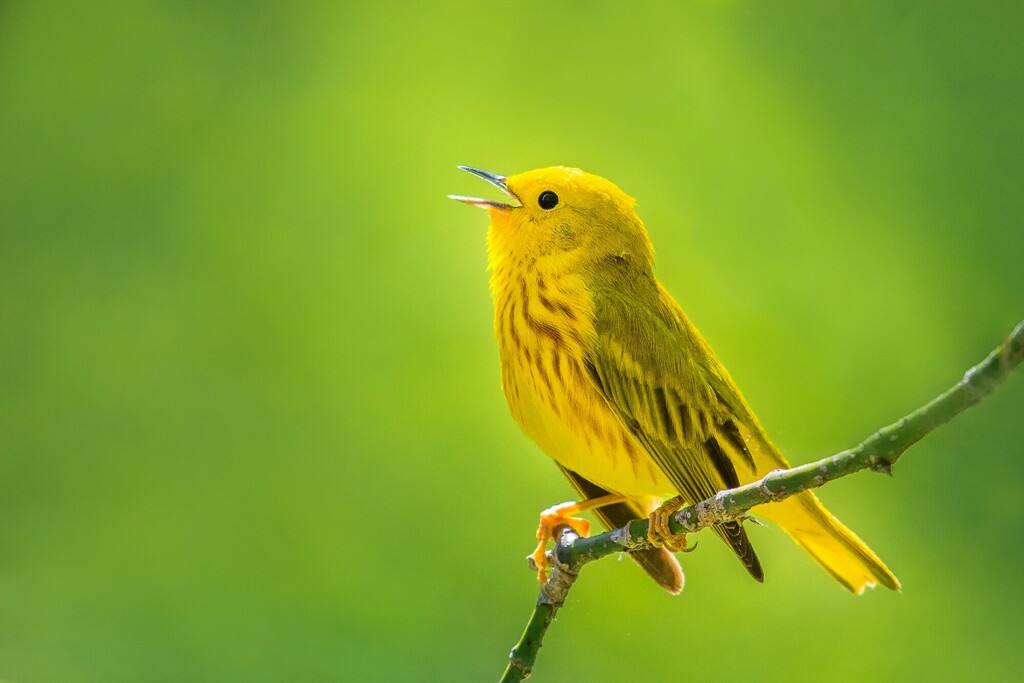
American Yellow Warbler
Photo © Adam Jackson
Photo © Adam Jackson — CC0 1.0 — Source: iNaturalist photo #339455453Identification
The American Yellow Warbler is a small, compact warbler measuring 10–18 cm in length with a wingspan of 16–22 cm. Breeding males are brilliant yellow below and greenish-gold above, making them among the yellowest warblers in North America. They typically display rusty-red streaks on the breast and flanks. Females and non-breeding birds are duller, with greenish-yellow uppersides and pale yellow underparts. All plumages show blackish-olive remiges and rectrices edged with yellow. The species has dark eyes, a short thin bill, and olive-buff feet.
The song is a musical strophe often rendered as "sweet sweet sweet, I'm so sweet," though it varies between populations. Birds give soft or harder chip and ship calls, with females particularly vocal after males finish singing. Hissing calls are used in territorial defense.
Range & Habitat
A widespread migratory species, the American Yellow Warbler breeds across most of North America from the tundra southwards, excluding the far Southwest and Gulf of Mexico coast. Nine subspecies are recognized, with breeding ranges spanning from southern Alaska and northern Canada to central Mexico. The species winters from southern California through the Amazon region, Bolivia, and Peru, representing one of the longest migrations of any warbler species.
Birds arrive on breeding grounds in late spring, typically April–May, and depart beginning in July once young fledge. Most populations have moved south by late August, though some linger into early fall. The breeding habitat consists of riparian and moist lowland areas with dense shrubby growth.
Behaviour & Diet
American Yellow Warblers are insectivorous birds that actively forage in shrubby vegetation. They are vocal year-round, with complex repertoires including song, alarm calls, cowbird alerts, and pair-communication vocalizations. Young birds beg with specialized calls, and the species also employs postures and possibly tactile communication.
These warblers are notably hosts to Brown-headed Cowbirds, which parasitize their nests. The species name petechia refers to the rusty breast streaks, roughly translating to "liver spotted." Subspecific variation occurs primarily in size and plumage brightness, following Bergmann's and Gloger's Rules across their broad range.
Best Time & Places to See It
Spring migration (April–May) offers prime viewing opportunities as birds return to breeding grounds across North America. Riparian corridors, willow thickets, and shrubby wetland edges are reliable habitats. Early morning is best for locating singing males during breeding season. Fall migration (July–August) can also yield sightings, though birds are less vocal and more inconspicuous.
For year-round viewing, winter grounds in Central and South America offer opportunities, though birds are less conspicuous in their non-breeding plumage. Breeding populations across Canada and the northern and central United States are most accessible and active in late spring and early summer.
Photography Tips
Breeding males in their brilliant yellow plumage are the most photogenic. Shoot in early morning light when males are actively singing and perched in open shrubby growth. Use fast shutter speeds to capture their active foraging movements through dense vegetation. The bright yellow coloration of spring males provides excellent contrast and saturation in images.
During migration, photograph birds in riparian habitats where they concentrate. Patient waiting near thickets will yield opportunities as birds move through cover. Capture diagnostic features: the facial pattern, breast streaking, and yellow wing edgings. Avoid overexposure of the bright yellow plumage by metering carefully on the bird's back.
Tombstone Territorial Park
Acadia National Park
Alaska Maritime National Wildlife Refuge
Algonquin Provincial Park
Arches National Park
Arenal Volcano National Park
Banff National Park
Barbilla National Park
Barra del Colorado National Wildlife Refuge
Nothing matches these filters.
No community photos yet. Log in to add the first one.
No community observations of this species yet.