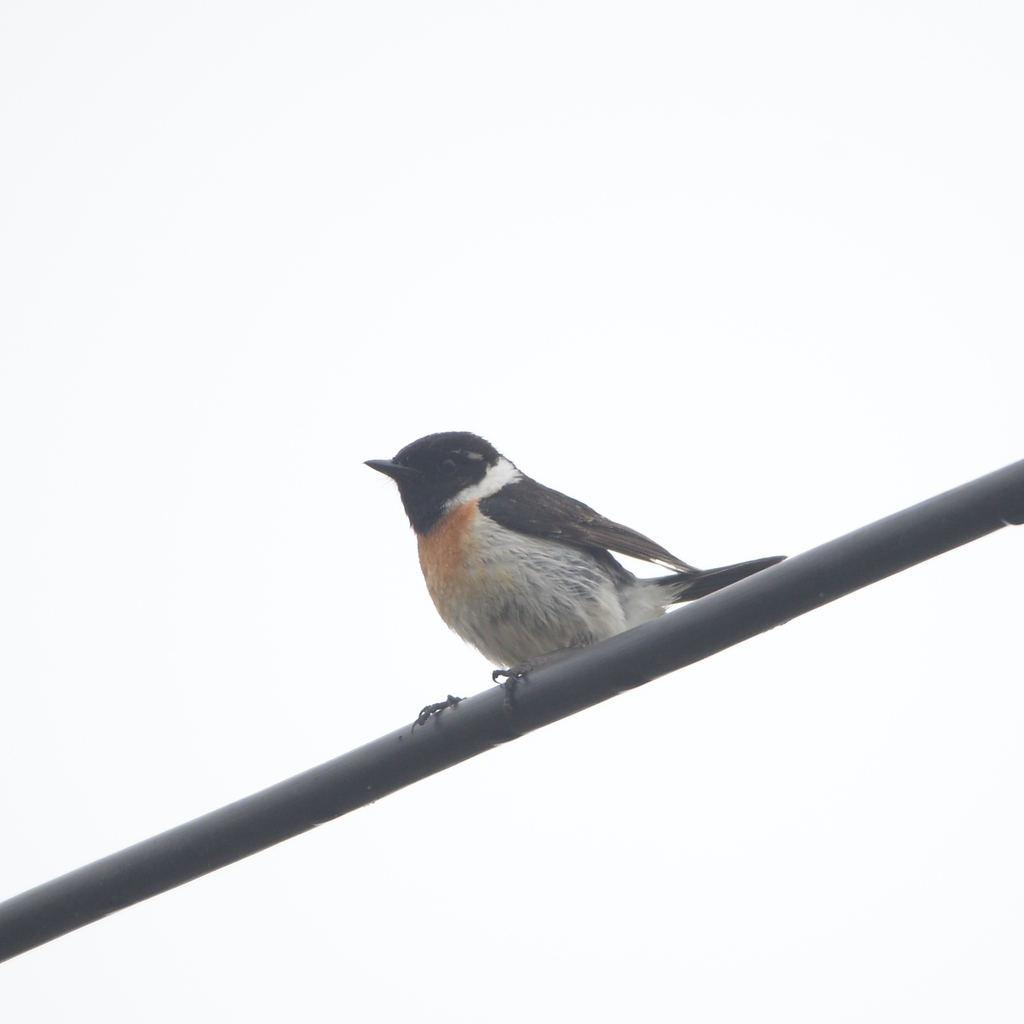
Amur Stonechat
Photo © Валерия Ковалева
Photo © Валерия Ковалева — CC BY 4.0 — Source: iNaturalist #118917186Identification
The Amur stonechat is a compact flycatcher that closely resembles the European stonechat but appears typically darker above and paler below. Males in breeding plumage are striking, with black upperparts and head, a conspicuous white collar, scapular patch and rump, and orange restricted to the throat area. Females are considerably duller, displaying pale brown upperparts and head with white neck patches (rather than a full collar) and a pale, unstreaked pinkish-yellow rump. Winter males are intermediate between summer males and females, featuring a supercilium that may resemble a whinchat, though the full white collar distinguishes them from that species. A useful field mark is the distinctly longer primary remiges compared to the European stonechat—an adaptation shared with the whinchat that reflects this bird's long-distance migratory lifestyle.
In the field, listen for a distinctive clicking call like two pebbles knocked together, and a high, twittering song reminiscent of a dunnock. These vocalizations can help confirm identification, particularly in challenging light conditions or at distance.
Range & Habitat
The Amur stonechat breeds across a vast range spanning temperate Asia from approximately 71°N in Siberia south to the Himalayas and southwest China, and west to eastern Turkey and the Caspian Sea region. It also breeds in far northeast Europe, primarily in Russia but occasionally reaching as far west as Finland. This is a highly migratory species, wintering across a similarly broad range from southern Japan south to Thailand and India, and west to northeast Africa. During migration, small numbers occasionally reach western Europe, with exceptional vagrants recorded as far east as Alaska.
The species favors open rough scrubland or rough grassland with scattered shrubs, ranging from sea level to approximately 4,000 m elevation or higher. Birds avoid even cool temperate conditions and remain in northern breeding grounds only during the hot continental summer, moving south to tropical regions for winter.
Behaviour & Diet
The Amur stonechat is insectivorous, foraging actively in open habitats for small invertebrate prey. During migration, birds can occasionally be seen foraging in fields and pastures at elevations exceeding 2,000 m in montane regions, though most individuals continue further south and downslope to winter in tropical lowlands. The species is widespread and common throughout its range and is not considered threatened.
Best Time & Places to See It
Timing depends on your location. In breeding areas across Siberia, Mongolia, and northeastern Asia, the best season is the hot continental summer months. For wintering birds, southern Japan, Thailand, India, and Myanmar offer reliable opportunities. During migration periods, the species may appear in unexpected locations across Eurasia, making it an exciting find for birders in western Europe and occasionally far beyond its typical range.
Photography Tips
Males in breeding plumage offer the most striking photographic opportunities, with their bold black and white contrast and orange throat patch. Position yourself in open scrubland habitats where these birds typically perch on low shrubs or rocks, making them relatively accessible for photography. The white collar, scapular patches, and rump are key diagnostic features to capture. Winter plumage males and females are more subdued but still photographable; ensure your images clearly show the white collar and rump to aid identification. Early morning and late afternoon light will enhance the contrast in male plumage.
Phou Khao Khouay National Protected Area
Thaphabath District, Thailand
+113 birds
Where the Annamite Mountains descend into central Thailand's monsoon forests, Phou Khao Khouay National Protected Area sprawls across rugged limestone terrain interlaced with river valleys and…
VIEW NATIONAL PARKKhao Yai National Park
Prachantakham District, Thailand
+377 birds+46 mammals
Evergreen dipterocarp forest blankets the rolling terrain of this national park in eastern Thailand, where limestone hills rise abruptly from the forest floor and seasonal streams…
VIEW NATIONAL PARKKhao Laem Ya-Mu Ko Samet National Park
Mueang Rayong District, Thailand
+159 birds+3 mammals
Where limestone hills meet the Gulf of Thailand, Khao Laem Ya–Mu Ko Samet National Park stitches together a mosaic of terrestrial and marine worlds that few…
VIEW NATIONAL PARKKhao Laem National Park
Sangkhla Buri District, Thailand
+197 birds
Where the Vajiralongkorn Reservoir sprawls across the forested valleys of Kanchanaburi's northern borderlands, Khao Laem National Park protects a landscape where limestone ridges rise dramatically from…
VIEW NATIONAL PARKBaikal National Park
Ольхонский район, Russia
+184 birds+11 mammals
Where the world's deepest freshwater lake meets ancient Siberian taiga, Baikal National Park sprawls across 66,203 square kilometers of one of Earth's most singular ecosystems. The…
VIEW NATIONAL PARKGiant Panda National Park
Mianyang, China
+447 birds+47 mammals
Where the eastern slopes of China's Sichuan plateau descend into cloud-wrapped valleys, one of Asia's most biodiverse landscapes unfolds across more than 350,000 square kilometres. This…
VIEW NATIONAL PARKMount Nanling Forest Park
Ruyang Forest Farm, China
+179 birds+3 mammals
Granite ridges and weathered peaks rise through a canopy of subtropical montane forest where Ruyang Forest Farm anchors one of southern China's most biodiverse landscapes. Across…
VIEW FOREST & JUNGLEGorkhi-Terelj National Park
Ulaanbaatar, Mongolia
+137 birds+5 mammals
Where granite monoliths rise abruptly from rolling steppe grasslands, Gorkhi-Terelj National Park unfolds across the landscape north of Ulaanbaatar, a sanctuary where forest and alpine meadow…
VIEW NATIONAL PARKHustai National Park
Altanbulag, Mongolia
+198 birds+16 mammals
Where the steppe rolls endlessly beneath vast Mongolian skies, Hustai National Park preserves one of Central Asia's most dynamic grassland ecosystems. Rolling hills and open prairie…
VIEW NATIONAL PARKLand of the Leopard National Park
Khasansky District, Russia
+83 birds+11 mammals
Where coniferous and mixed forests sweep across the rolling terrain of Russia's Far East, Land of the Leopard National Park embraces a landscape shaped by the…
VIEW NATIONAL PARKNortheast China Tiger and Leopard National Park
Mu Dan Jiang Shi, China
+202 birds+19 mammals
Across the temperate forests of northeastern China, where winters grip the landscape in subzero silence and summers remain cool and brief, the Mudanjiang region supports a…
VIEW NATIONAL PARKHainan Tropical Rainforest National Park
Haikou, China
+69 birds+1 mammals
Tropical forests blanket the volcanic slopes of central Hainan, where moisture-laden winds from the South China Sea collide with mountainous terrain to create some of China's…
VIEW NATIONAL PARKWuyishan National Park
Yanshan County, China
+141 birds+2 mammals
Where subtropical monsoon rains sustain a perpetually humid landscape, Wuyishan National Park rises from Fujian's eastern plateau as a realm of forested ridges, cascading streams, and…
VIEW NATIONAL PARKWolong National Nature Reserve
Wenchuan County, China
+333 birds+17 mammals
Where the Qingyi River cuts through the eastern flanks of the Minshan Range, a temperate montane forest cloaks steep valleys in dense canopy that thins dramatically…
VIEW NATURE RESERVEYancheng National Nature Reserve
Yancheng, China
+208 birds+4 mammals
Where the East China Sea's tidal rhythms sculpt the Jiangsu coast, Yancheng National Nature Reserve sprawls across one of Asia's most dynamic wetland complexes. This vast…
VIEW NATURE RESERVEZhalong National Nature Reserve
Qiqihar, China
+78 birds
Across the wetlands of northeastern China, where the Heilongjiang climate swings between brutal winters and warm summers, lies one of East Asia's most vital refuges for…
VIEW NATURE RESERVEPoyang Lake National Nature Reserve
Shangrao, China
+270 birds+7 mammals
Where the Yangtze River's massive floodplain spreads across central China, Poyang Lake National Nature Reserve encompasses one of the continent's most dynamic and water-rich wetland systems.…
VIEW NATURE RESERVEGaoligong Mountain National Nature Reserve
Nujiang Lisu Autonomous Prefecture, China
+443 birds+13 mammals
VIEW NATURE RESERVEAlaska Maritime National Wildlife Refuge
Alaska, United States
+391 birds+58 mammals
Where the North Pacific collides with Alaska's rugged coastline, a sprawling archipelago of islands, rocky outcrops, and coastal headlands forms one of North America's most remote…
VIEW WILDLIFE SANCTUARYNo community photos yet. Log in to add the first one.
No community observations of this species yet.