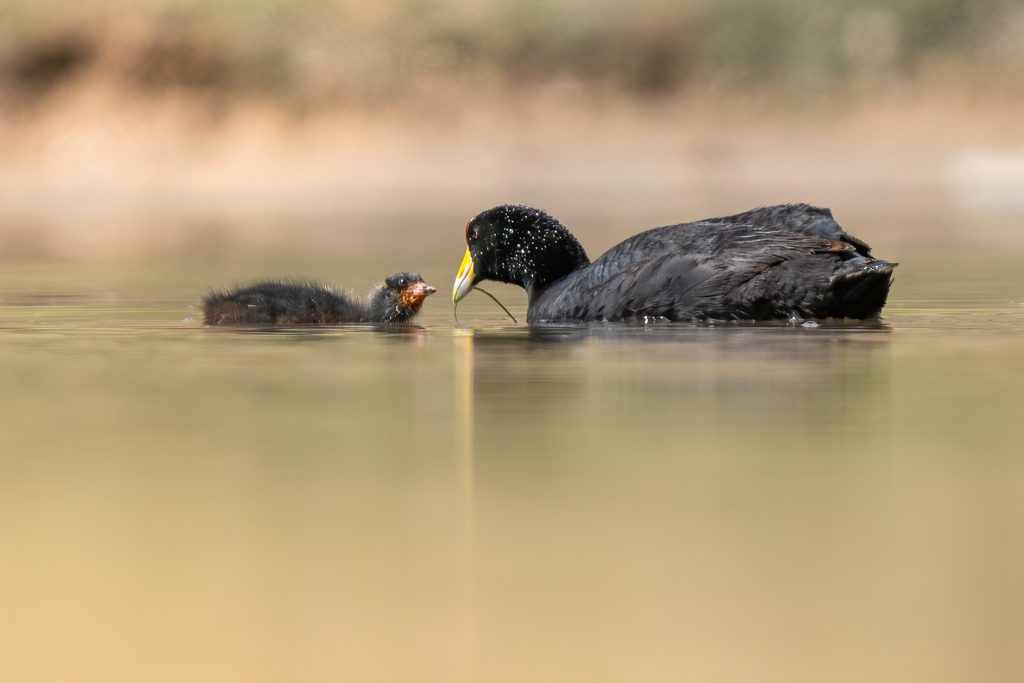
Andean Coot
Photo © Luciano Massa
Photo © Luciano Massa — CC BY 4.0 — Source: iNaturalist photo #171995595The Andean coot (Fulica ardesiaca), also known as the slate-colored coot, is a species of bird in subfamily Rallinae of family Rallidae, the rails, gallinules, and coots. It is found in Argentina, Bolivia, Chile, Colombia, Ecuador, and Peru. == Taxonomy and systematics == The Andean coot has two subspecies, the nominate F. a. ardesiaca and F. a. atrura. They have a somewhat tortuous taxonomic history. The nominate was at one time treated as a subspecies of the American coot (F. americana) and the other as a separate species. Later they were both included as subspecies of the American coot. The current treatment has been widely accepted since the 1980s, but there is some speculation that the subspecies might be full species. == Description == The Andean coot is 40 to 43 cm (16 to 17 in) long. It has two color morphs that are present in both subspecies. Both morphs are mostly slaty gray that is blacker on the head and neck. Their secondaries usually have white tips. One morph has a chrome yellow bill that is paler yellow and sometimes green on the tip, a deep chesnut frontal shield, and green legs and feet. The other has a white…
Sangay National Park
Cebadas, Ecuador
+320 birds+10 mammals
High in Ecuador's Andean spine, where the Western Cordillera rises to touch perpetual snow, a landscape of volcanic drama and ecological intensity unfolds across Sangay National…
VIEW NATIONAL PARKAntisana National Park
Quijos, Ecuador
+432 birds+21 mammals
Where the eastern Andean slopes descend into the Amazon basin, Antisana National Park sprawls across roughly 2,500 square kilometers of some of South America's most dramatic…
VIEW NATIONAL PARKCotopaxi National Park
Mulaló, Ecuador
+211 birds+6 mammals
High in Ecuador's volcanic corridor, where the páramo transitions into cloud forest along the slopes of Cotopaxi volcano, the national park unfolds across nearly 500 square…
VIEW NATIONAL PARKLlanganates National Park
Tena, Ecuador
+239 birds+8 mammals
Where the eastern slopes of the Andes plunge toward the Amazon basin, Llanganates National Park sprawls across nearly 3,500 square kilometers of montane wilderness, its terrain…
VIEW NATIONAL PARKCajas National Park
Cuenca, Ecuador
+190 birds+7 mammals
High in the Andes above Cuenca, where elevation ranges from 3,100 to 4,200 metres, the páramo landscape dominates—a windswept realm of cushion plants, alpine grasses, and…
VIEW NATIONAL PARKBahuaja Sonene National Park
San Pedro de Putina Punco, Peru
+602 birds+8 mammals
Where the Madre de Dios and Heath rivers converge in southeastern Peru rises one of South America's most biodiverse wilderness regions: a vast protected realm of…
VIEW NATIONAL PARKHuascarán National Park
Independencia, Peru
+201 birds+5 mammals
Where granite peaks pierce the Andean sky above 6,000 metres, Huascarán National Park sprawls across more than 11,500 square kilometres of Peru's Cordillera Blanca, a landscape…
VIEW NATIONAL PARKSalar del Huasco National Park
Pica, Chile
+75 birds+2 mammals
High above the Atacama's shimmering flats, where the Andes grip the sky, lies a landscape of stark geological drama and surprising biological richness. Salar del Huasco…
VIEW NATIONAL PARKLauca National Park
Putre, Chile
+139 birds+17 mammals
Where the Andes rise toward the altiplano in Chile's far north, Lauca National Park sprawls across more than 3,000 square kilometres of some of South America's…
VIEW NATIONAL PARKReserva Nacional las Vicuñas
Putre, Chile
+87 birds+6 mammals
High desert plateaus interlace with volcanic ridges across this 4,204-square-kilometre expanse at the border between Chile and Bolivia, where altitudes exceed 3,500 metres and the climate…
VIEW NATIONAL PARKLos Cardones National Park
Argentina
+193 birds+6 mammals
Where the Andes descend into northwestern Argentina, Los Cardones National Park sprawls across nearly 1,200 square kilometres of one of South America's most distinctive high-altitude desert…
VIEW NATIONAL PARKNo community photos yet. Log in to add the first one.
No community observations of this species yet.