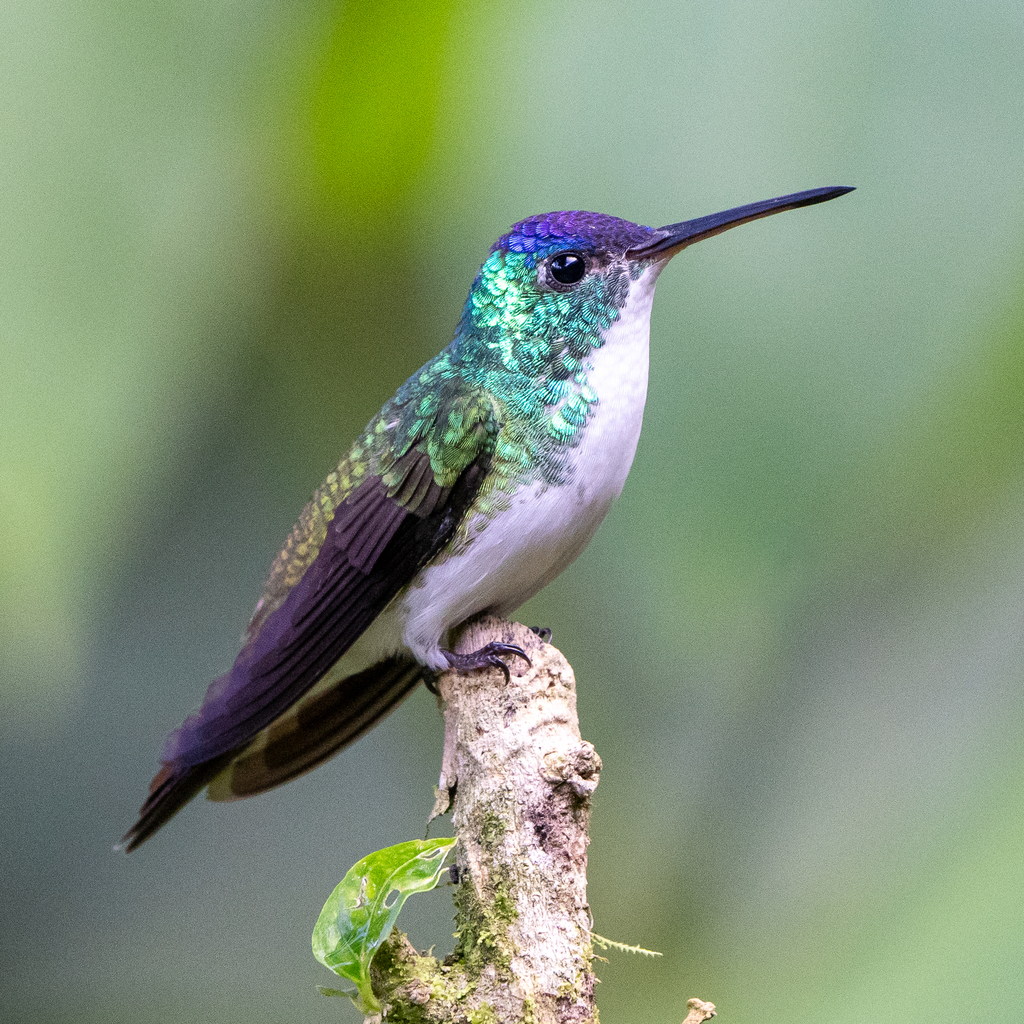
Andean Emerald
Photo © Anthony Batista
Photo © Anthony Batista — CC BY 4.0 — Source: iNaturalist #199312149Identification
The Andean emerald is a small hummingbird, measuring 9 to 11 cm in length and weighing around 5–6 grams. Both sexes possess a straight to slightly curved bill with a blackish upper mandible and coral-red lower mandible. Males of the nominate subspecies are particularly striking, displaying a glittering violet-blue crown contrasted with glittering golden-to-emerald green cheeks and neck. Their upperparts are light to golden-green with a coppery tinge on the tail coverts, the center of the underparts is white, and the tail is bronze-green to coppery. Females are similar but duller, with a turquoise-blue to greenish crown that lacks the male's brilliant glitter, brownish feather edges on the upperparts, and grayish-brown flanks. The two other recognized subspecies show subtle variations: U. f. viridiceps has a shorter tail and green crown, while U. f. cyanocollis is distinguished by blue extending from the crown to the nape.
Range & Habitat
The Andean emerald inhabits the Andes of Colombia, Ecuador, and Peru, with three subspecies distributed across this range: U. f. franciae in northwestern and central Colombia; U. f. viridiceps from southwestern Colombia through western Ecuador to Loja Province; and U. f. cyanocollis in southeastern Ecuador and northern Peru south to La Libertad Province. The species occupies secondary forest and the edges and clearings of wet primary forest, with drier shrublands in Peru. Elevationally, it ranges between 600 and 2,100 meters, though it is most common above 1,000 meters.
Behaviour & Diet
The Andean emerald forages for nectar at various flowering herbs, vines, and trees, typically in the middle to upper forest strata, employing a trap-lining strategy to visit a circuit of nectar sources. It also supplements its diet by hawking insects from a perch. Though sometimes observed at shared flower patches, it is subordinate to territorial hummingbird species. The bird makes variable seasonal elevational movements that remain not well defined.
Breeding occurs almost year-round, with females constructing small cup nests of treefern scales and plant fibers bound with spiderweb and decorated with lichen, typically placing them 1.4 to 2.3 meters above the ground. Females incubate clutches of two eggs for 19 to 24 days, with fledging occurring 16 to 22 days after hatching. The species produces a highly variable song of high-pitched squeaky whistles, trills, and scratchy notes, along with sharp calls and squeaky chatters during social interactions.
Best Time & Places to See It
The Andean emerald is uncommon to fairly common throughout its range and occurs in at least one protected area. Its year-round breeding activity suggests that sightings are possible in any season, though the poorly defined seasonal elevational movements mean optimal viewing times may vary by location. Travelers should focus on forest edges, clearings, and secondary growth at elevations above 1,000 meters across the Colombian, Ecuadorian, and Peruvian Andes.
Photography Tips
Photographing this small emerald requires patience and attention to light. The male's glittering violet-blue crown and golden-green cheeks are best captured in bright, direct sunlight that reveals these iridescent colors. Focus on flowering plants and nectar sources where the bird trap-lines, and watch for the moment it hovers or perches to feed. The species' preference for the middle to upper forest strata means shooting in dappled forest light; use a fast shutter speed to freeze wing motion and a telephoto lens to maintain distance without disturbing the bird.
Guided Birding Tour
Podocarpus National Park
Zamora, Ecuador
+496 birds+6 mammals
Where the Andes descend toward the Amazon basin, Podocarpus National Park sprawls across nearly 2,800 square kilometres of the most biodiverse terrain in Ecuador's southern highlands.…
VIEW NATIONAL PARKNatural Serranía de los Yariguíes National Park
El Carmen de Chucurí, Colombia
+320 birds+3 mammals
Where the northern cordilleras of Colombia rise toward cloud forest, the Serranía de los Yariguíes unfolds across nearly 1,820 square kilometers of some of the most…
VIEW NATIONAL PARKNatural Farallones de Cali National Park
Buenaventura, Colombia
+733 birds+27 mammals
Where the Pacific coastal plain meets the western slopes of the Andes, Farallones de Cali National Park sprawls across nearly 3,500 square kilometers of dramatic topography…
VIEW NATIONAL PARKNatural Chingaza National Park
Junín, Colombia
+285 birds+6 mammals
Where the Andes rise above three thousand metres in the Cundinamarca region, high-altitude grasslands and cloud forests converge in a landscape shaped by both geology and…
VIEW NATIONAL PARKPuracé National Natural Park
Puracé, Colombia
+327 birds+2 mammals
Where the Andes thrust upward across southwestern Colombia, Puracé National Natural Park spans nearly 2,631 square kilometers of some of South America's most dramatic montane terrain.…
VIEW NATIONAL PARKGuácharos Cave National Natural Park
Acevedo, Colombia
+359 birds
High in the Andean foothills of southern Huila, where mist-laden slopes rise above 1,600 metres, lies a landscape carved by underground rivers and crowned by karst…
VIEW NATIONAL PARKNatural Nevado del Huila National Park
Planadas, Colombia
+117 birds
Where the Colombian Andes rise above 5,000 metres, tropical cloud forest yields to páramo and glaciated peaks, and the Planadas region of Tolima contains one of…
VIEW NATIONAL PARKNo community photos yet. Log in to add the first one.
No community observations of this species yet.