Andean Gull
Photo © Esteban Poveda
Photo © Esteban Poveda — CC BY 4.0 — Source: iNaturalist #103662087Identification
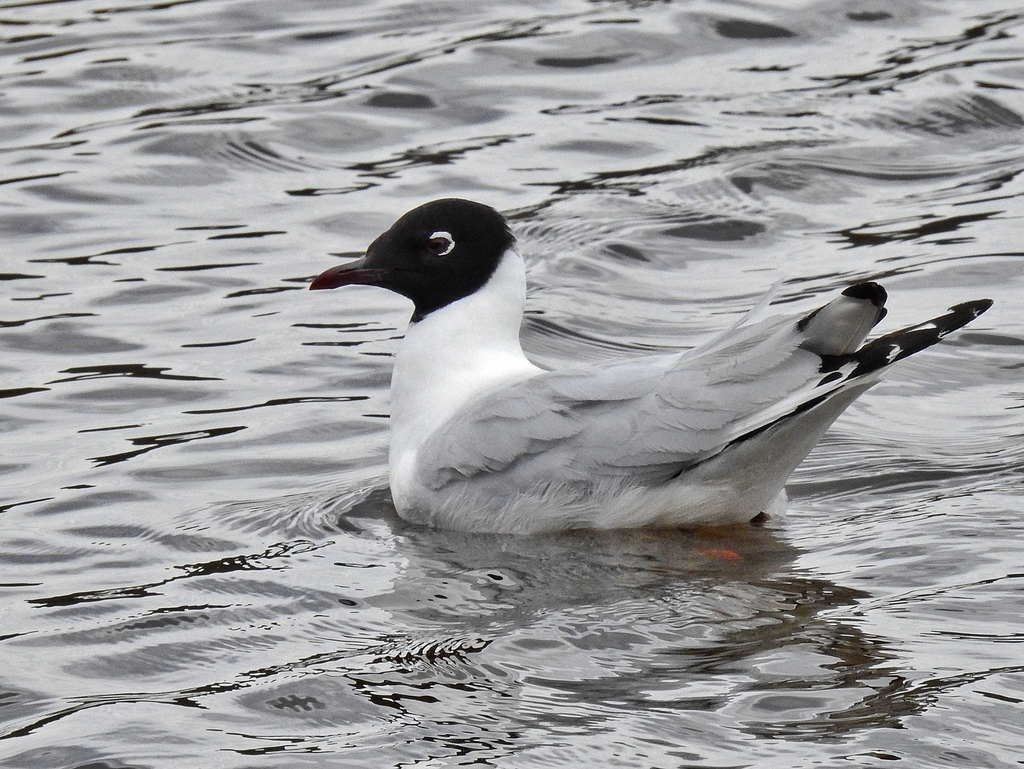
The Andean gull is one of the larger members of its genus, measuring 42 to 48 cm in length and weighing around 480 g. Adults in breeding plumage are striking and unmistakable: they display a glossy black hood with a distinctive white crescent behind the eye, a mostly white body with gray back, and a white tail. Some individuals show a pink flush on their underparts. The upper wing surface is predominantly gray with an alternating white-black-white-black pattern on the primaries, while the underside of the wing is pale gray with a blackish outer half interrupted by large white "mirrors" on the three outermost primaries. The bill, legs, and feet are blackish brown with a reddish tinge, and the iris is brown. Non-breeding adults are quite different, with a white head and blackish legs. Sexes are alike in plumage. Young birds take two years to attain adult plumage, with first-year birds showing mottled black on the head, complex black and white patterns on the wings, and a black band near the tail's end.
Range & Habitat
The Andean gull is found year-round in the Andes, with its range extending from far southwestern Colombia south through central Ecuador and Peru, western Bolivia, and eastern Chile and western Argentina to approximately the latitude of the north of Chile's Aysén Region. Many individuals migrate to coastal areas during winter, particularly from central Peru southward into northern Chile, though the origin of these wintering birds remains uncertain.
This species inhabits high-altitude environments characteristic of the Altiplano during breeding season, favoring lakes, bogs, marshes, and fields in puna and páramo zones. Elevations typically range from 3,000 to 5,300 m, though in the southern part of its range it descends to as low as 1,200 m. In winter, coastal birds are typically found at river mouths and sand beaches.
Behaviour & Diet
The Andean gull is an opportunistic and versatile forager. In mountain habitats, it feeds on earthworms, insects, amphibians, small fish, and occasionally the eggs and chicks of waterbirds. The species has also been recorded scavenging at ski resorts during winter months. Along the coast, diet shifts to offal, fish, and marine invertebrates. It seeks food by walking, swimming, and flying.
Breeding occurs mostly during July and August. This species is sometimes solitary but more usually nests in small colonies along riverbanks and on islands in rivers and lakes. Clutch size typically consists of two or three eggs, though one or four eggs are sometimes laid. Vocalizations are distinctive and energetic, including "agitated, sometimes tremulous 'yeeer' calls" and "hoarse 'raggh-aggh-keeaagh' and other low raspy notes."
Best Time & Places to See It
The Andean gull is present year-round throughout the Andes, making it accessible to travelers any season. However, breeding birds in their mountain habitat are most abundant during July and August in the puna and páramo zones of the Altiplano, particularly at high-altitude lakes between 3,000 and 5,300 m. Those seeking to observe the species during winter may have better success at coastal locations, particularly at river mouths and sand beaches from central Peru southward into northern Chile. The species has been recorded as a vagrant in Amazonian Peru and far southern Argentina, though such sightings are exceptional.
Photography Tips
The Andean gull's striking breeding plumage—with its glossy black hood contrasting sharply with the white crescent behind the eye and pale body—makes it a rewarding photographic subject during the breeding season. The characteristic pattern on the primaries, visible both from above and below the wing, provides distinctive field marks worth capturing. Non-breeding birds present a different challenge, with their white heads requiring careful exposure management to preserve detail. The species' high-altitude habitat offers dramatic landscape photography opportunities, though the thin air and extreme UV exposure at elevation demand appropriate precautions. Coastal wintering birds at river mouths and beaches may be more approachable for close photography than their mountain-dwelling counterparts.
Sangay National Park
Cebadas, Ecuador
+320 birds+10 mammals
High in Ecuador's Andean spine, where the Western Cordillera rises to touch perpetual snow, a landscape of volcanic drama and ecological intensity unfolds across Sangay National…
VIEW NATIONAL PARKPodocarpus National Park
Zamora, Ecuador
+496 birds+6 mammals
Where the Andes descend toward the Amazon basin, Podocarpus National Park sprawls across nearly 2,800 square kilometres of the most biodiverse terrain in Ecuador's southern highlands.…
VIEW NATIONAL PARKYacuri National Park
Las Juntas, Ecuador
+166 birds+1 mammals
Where the eastern slopes of the Andes descend into Ecuador's southern frontier, Yacuri National Park unfolds across nearly 1,300 square kilometers of montane cloud forest and…
VIEW NATIONAL PARKAntisana National Park
Quijos, Ecuador
+432 birds+21 mammals
Where the eastern Andean slopes descend into the Amazon basin, Antisana National Park sprawls across roughly 2,500 square kilometers of some of South America's most dramatic…
VIEW NATIONAL PARKCotopaxi National Park
Mulaló, Ecuador
+211 birds+6 mammals
High in Ecuador's volcanic corridor, where the páramo transitions into cloud forest along the slopes of Cotopaxi volcano, the national park unfolds across nearly 500 square…
VIEW NATIONAL PARKLlanganates National Park
Tena, Ecuador
+239 birds+8 mammals
Where the eastern slopes of the Andes plunge toward the Amazon basin, Llanganates National Park sprawls across nearly 3,500 square kilometers of montane wilderness, its terrain…
VIEW NATIONAL PARKCajas National Park
Cuenca, Ecuador
+190 birds+7 mammals
High in the Andes above Cuenca, where elevation ranges from 3,100 to 4,200 metres, the páramo landscape dominates—a windswept realm of cushion plants, alpine grasses, and…
VIEW NATIONAL PARKYanachaga–chemillén National Park
Palcazu, Peru
+639 birds+6 mammals
Where the eastern slopes of Peru's central cordillera plunge into cloud forest, Yanachaga–Chemillén National Park protects nearly three thousand square kilometres of montane wilderness that few…
VIEW NATIONAL PARKManu National Park
Manu, Peru
+892 birds+26 mammals
Across the eastern slopes of the Peruvian Andes, tropical rainforest descends into the Amazon basin with a complexity that few terrestrial ecosystems match. Manu National Park…
VIEW NATIONAL PARKHuascarán National Park
Independencia, Peru
+201 birds+5 mammals
Where granite peaks pierce the Andean sky above 6,000 metres, Huascarán National Park sprawls across more than 11,500 square kilometres of Peru's Cordillera Blanca, a landscape…
VIEW NATIONAL PARKSalar del Huasco National Park
Pica, Chile
+75 birds+2 mammals
High above the Atacama's shimmering flats, where the Andes grip the sky, lies a landscape of stark geological drama and surprising biological richness. Salar del Huasco…
VIEW NATIONAL PARKLaja National Park Lagoon
Antuco, Chile
+123 birds+1 mammals
Where the Andes descend into the Biobío Region's temperate forests, a vast lagoon fills the caldera of the extinct Antuco volcano, cradled by steep native woodland…
VIEW NATIONAL PARKLauca National Park
Putre, Chile
+139 birds+17 mammals
Where the Andes rise toward the altiplano in Chile's far north, Lauca National Park sprawls across more than 3,000 square kilometres of some of South America's…
VIEW NATIONAL PARKReserva Nacional las Vicuñas
Putre, Chile
+87 birds+6 mammals
High desert plateaus interlace with volcanic ridges across this 4,204-square-kilometre expanse at the border between Chile and Bolivia, where altitudes exceed 3,500 metres and the climate…
VIEW NATIONAL PARKSalar de Surire Natural Monument
Putre, Chile
+61 birds
High across the Altiplano of northern Chile, where the Andes push toward 4,300 metres and the air thins to a crystalline clarity, lies a vast shallow…
VIEW NATURAL MONUMENTLos Cardones National Park
Argentina
+193 birds+6 mammals
Where the Andes descend into northwestern Argentina, Los Cardones National Park sprawls across nearly 1,200 square kilometres of one of South America's most distinctive high-altitude desert…
VIEW NATIONAL PARKLanín National Park
Argentina
+128 birds+7 mammals
Where the volcanic spine of the Andes plunges into Patagonian steppe, Lanín National Park sprawls across nearly 4,700 square kilometers of one of Argentina's most visually…
VIEW NATIONAL PARKNo community photos yet. Log in to add the first one.
No community observations of this species yet.