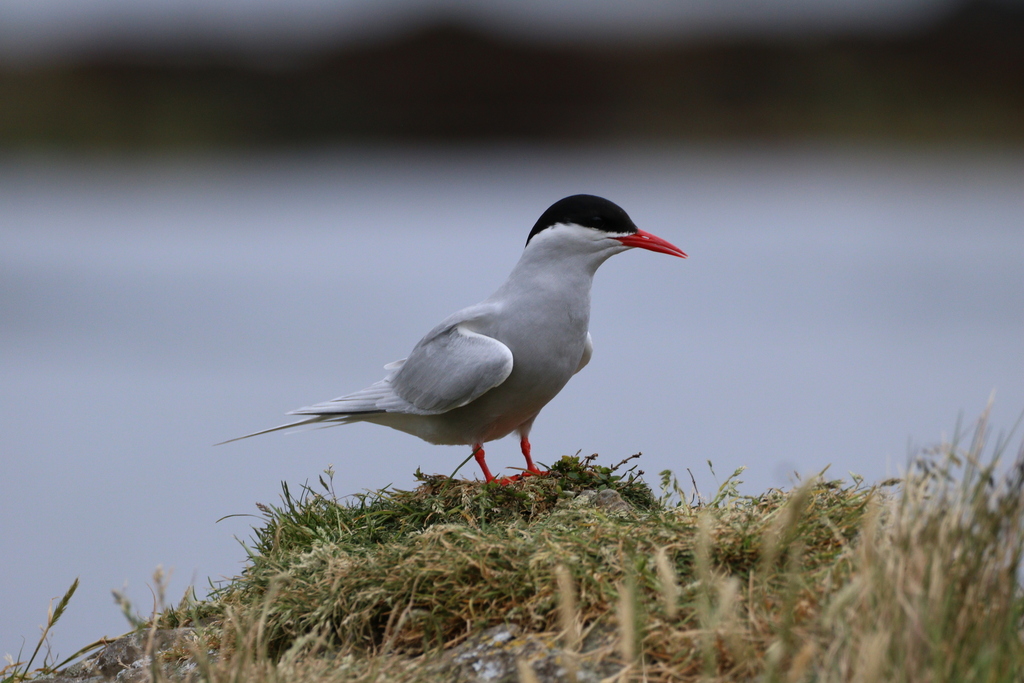
Antarctic Tern
Photo © Julia Palmer
Photo © Julia Palmer — CC BY 4.0 — Source: iNaturalist photo #463012304Identification
The Antarctic tern is a medium-sized tern measuring 35 to 40 cm in length with a wingspan of 74 to 79 cm and weighing between 150 and 180 g. In breeding plumage, it displays a light grey body and wings, a deeply forked white tail, and a distinctive black cap extending from the nape to the bill. The eye is brownish-black, while the bill, legs, and feet are bright red. In non-breeding plumage, the black cap reduces to just the area behind the eyes, underparts become lighter, and the bill dulls to a reddish-black colour. Juveniles show yellowish-brown, grey, and white spots on their backs with a yellowish-brown belly.
The Antarctic tern closely resembles the Arctic tern, but is stockier with longer legs and less prominent black margins on its primary feathers. A key distinction is that Antarctic terns wear breeding plumage during the southern summer, precisely when migrating Arctic terns display non-breeding plumage. The white-fronted tern is also similar but larger, lighter in colour, and possesses a longer black bill. The six recognized subspecies vary in size and plumage tone but are often difficult to distinguish from one another in the field.
Range & Habitat
The Antarctic tern ranges throughout the southern oceans and is found on small islands around Antarctica as well as on the mainland shores. Its breeding territory encompasses the Antarctic continent, Bouvet Island, the French Southern Territories, Saint Helena, Ascension, Tristan da Cunha, South Africa, South Georgia, and the South Sandwich Islands. Recently, some populations have begun nesting on newly ice-free terrain on the north-eastern Antarctic Peninsula. Each of the six subspecies occupies specific breeding islands, from Tristan da Cunha and Gough Island in the Atlantic to the islands south of New Zealand in the Pacific.
This tern prefers rocky areas such as islets with or without vegetation, often nesting among other seabird species on cliffs, rocky beaches, and places inaccessible to introduced predators like cats and rats. It avoids beaches occupied by sea lions. Outside the breeding season, Antarctic terns search for ice edges in Antarctica and visit South Africa's beaches and rocky cliffs. Unlike the Arctic tern, the Antarctic tern does not undertake a long migration to the opposite pole; instead, it typically remains close to breeding islands year-round, though southern populations migrate slightly further north during winter. The global population is estimated at around 140,000 individuals.
Behaviour & Diet
The Antarctic tern feeds primarily on small fish and crustaceans, which it captures through active foraging. The species is quite vocal around roost sites, producing a distinctive "trr-trr-kriah" call in flight or while fishing. A sharp "chrrrr" vocalization serves defensive purposes against intruders and predators near nesting sites, while higher-pitched calls attract the attention of mates. These vocal displays reflect the tern's active and social nature during the breeding season.
Gulls, skuas, and jaegers are the primary predators of Antarctic tern eggs and chicks, presenting a significant threat during the vulnerable breeding period. This predation pressure influences habitat selection, with Antarctic terns preferring isolated rocky islands and cliff-nesting sites that offer some protection from ground predators.
Best Time & Places to See It
The Antarctic tern is best observed during the southern summer breeding season (the austral spring and summer months), when birds are in their striking breeding plumage with bright red bills and feet and distinctive black caps. At this time, Antarctic terns can be found at their breeding colonies on sub-Antarctic islands and the Antarctic mainland. Key locations include South Georgia, the South Sandwich Islands, Tristan da Cunha, the Kerguelen Islands, and increasingly along the Antarctic Peninsula. During the non-breeding season, birds remain relatively close to these breeding areas, though some populations venture slightly further north, and they may be spotted at ice edges around Antarctica and along South African coasts.
Photography Tips
The Antarctic tern's breeding plumage offers striking photographic opportunities, with the contrast between light grey upperparts, white underparts, and bright red bill and legs creating distinctive images. The bird's deeply forked tail is a particularly elegant feature to capture in flight. Photograph during calm conditions when the tern is perched on rocky outcrops or nesting sites, as this allows for sharp detail of the facial markings and black cap. The noisy, active behaviour around breeding colonies provides good opportunities for action photography of birds in flight as they fish or defend territories.
Distinguish your images from Arctic tern photographs by noting the Antarctic tern's heavier build, breeding plumage, and the southern hemisphere context. When photographing at breeding colonies, be mindful of nesting sites and approach with care to avoid disturbing this relatively modest population of 140,000 individuals globally. Early morning or late afternoon light enhances the tern's red coloration and highlights the sleek lines of this graceful seabird.
Garden Route National Park
George, South Africa
+353 birds+54 mammals
Sweeping across the Western Cape's coastal and mountainous terrain, this sprawling national park encompasses over five thousand square kilometers of extraordinarily diverse landscape—from coastal limestone cliffs…
VIEW NATIONAL PARKAddo Elephant National Park
Sundays River Valley Local Municipality, South Africa
+388 birds+55 mammals
Where the Eastern Cape's semi-arid scrublands meet transitional woodland, Addo sprawls across 13,478 square kilometres of one of southern Africa's most biodiverse landscapes. The terrain rises…
VIEW NATIONAL PARKDeception Island
Gabriel de Castilla Base, Antarctica
+26 birds+10 mammals
Steaming geothermal vents pierce a landscape of blackened volcanic sand and ice, where the earth's raw power still trembles beneath your feet. This horseshoe-shaped caldera, flooded…
VIEW ISLAND & ARCHIPELAGOCuverville Island
Cuverville Island, Antarctica
+19 birds+10 mammals
Granite peaks and sculpted ice define this windswept archipelago off the Antarctic Peninsula, where steep rocky shores plunge into waters thick with drifting brash ice. Cuverville…
VIEW ISLAND & ARCHIPELAGONeko Harbour
Neko Harbour, Antarctica
+18 birds+10 mammals
Towering peaks of fractured ice rise abruptly from gunmetal waters, their faces scarred by millennia of glacial advance and retreat. This pocket of the Antarctic Peninsula…
VIEW PROTECTED LANDSCAPEParadise Bay
Brown Station, Antarctica
+18 birds+9 mammals
Where the Antarctic Peninsula's rugged coastline meets the Southern Ocean, Brown Station stands sentinel over Paradise Bay—a protected landscape of ice-carved inlets, towering glacial faces, and…
VIEW PROTECTED LANDSCAPEBrown Bluff
Brown Bluff, Antarctica
+23 birds+9 mammals
Where rust-colored volcanic peaks pierce the Antarctic Peninsula's icy realm, a geologist's dreamscape unfolds beneath towering cliffs of iron oxide and ancient lava. Brown Bluff rises…
VIEW PROTECTED LANDSCAPEPort Lockroy
Port Lockroy, Antarctica
+19 birds+9 mammals
Towering peaks of black rock pierce through Antarctic pack ice on the Gerlache Strait, where one of the continent's most accessible harbors cradles a living microcosm…
VIEW PROTECTED LANDSCAPEPetermann Island
Petermann Island, Antarctica
+16 birds+9 mammals
Icebound cliffs rise dramatically from the Bellingshausen Sea, their weathered faces sculpted by millennia of Antarctic wind and tide. This slender wedge of rock and ice,…
VIEW ISLAND & ARCHIPELAGOPaulet Island
Paulet Island, Antarctica
+20 birds+6 mammals
Windswept ice and weathered rock converge at this remote Antarctic outcrop, where jagged peaks pierce through perpetual pack ice and glacial moraines descend toward cobalt waters.…
VIEW ISLAND & ARCHIPELAGODanco Island
Danco Island, Antarctica
+17 birds+10 mammals
Dramatic black rock pierces the Antarctic Peninsula's icy waters, crowned with permanent snow and ringed by calving glaciers that thunder into the sea. This volcanic outcrop…
VIEW ISLAND & ARCHIPELAGOWilhelmina Bay
Wilhelmina Bay, Antarctica
+20 birds+10 mammals
Sheer cliffs of black volcanic rock plunge into waters so pristine they reflect the Antarctic sky like polished obsidian. This remote western Antarctic inlet, ringed by…
VIEW PROTECTED LANDSCAPELemaire Channel
Orne Harbour, Antarctica
+25 birds+13 mammals
Where granite peaks plunge into steel-grey waters, the Lemaire Channel carves one of Antarctica's most dramatic passages. This narrow strait, squeezed between the Antarctic Peninsula and…
VIEW PROTECTED LANDSCAPESalisbury Plain
South Georgia, South Georgia and the South Sandwich Islands
+33 birds+4 mammals
Where tussock grasses bow to relentless Antarctic winds and glacial meltwater carves braided channels through obsidian volcanic soil, one of Earth's most remote wildlife sanctuaries reveals…
VIEW PROTECTED LANDSCAPESt. Andrews Bay
South Georgia, South Georgia and the South Sandwich Islands
+34 birds+6 mammals
Where windswept tundra dissolves into obsidian beaches, one of the planet's most extraordinary wildlife theaters unfolds across St. Andrews Bay. This remote corner of South Georgia…
VIEW PROTECTED LANDSCAPEFortuna Bay
Stromness, South Georgia and the South Sandwich Islands
+37 birds+5 mammals
Where tussock grasslands sweep down to black-sand beaches and elephant seals haul out in thunderous colonies, the raw sub-Antarctic landscape reveals itself in its most dramatic…
VIEW PROTECTED LANDSCAPEPrion Island
Prince Olav Harbour, South Georgia and the South Sandwich Islands
+36 birds+2 mammals
Windswept tussock grasslands rise sharply from boulder-strewn beaches where the Southern Ocean hurls its grey swells against black volcanic rock. This remote speck in South Georgia's…
VIEW ISLAND & ARCHIPELAGOCooper Bay
Cooper Bay, South Georgia and the South Sandwich Islands
+28 birds+5 mammals
Where black-sand beaches meet towering cliffs striped with cascading meltwater, one of the Southern Ocean's most dramatic amphitheaters reveals itself. Cooper Bay cuts a deep indent…
VIEW PROTECTED LANDSCAPENo community photos yet. Log in to add the first one.
No community observations of this species yet.