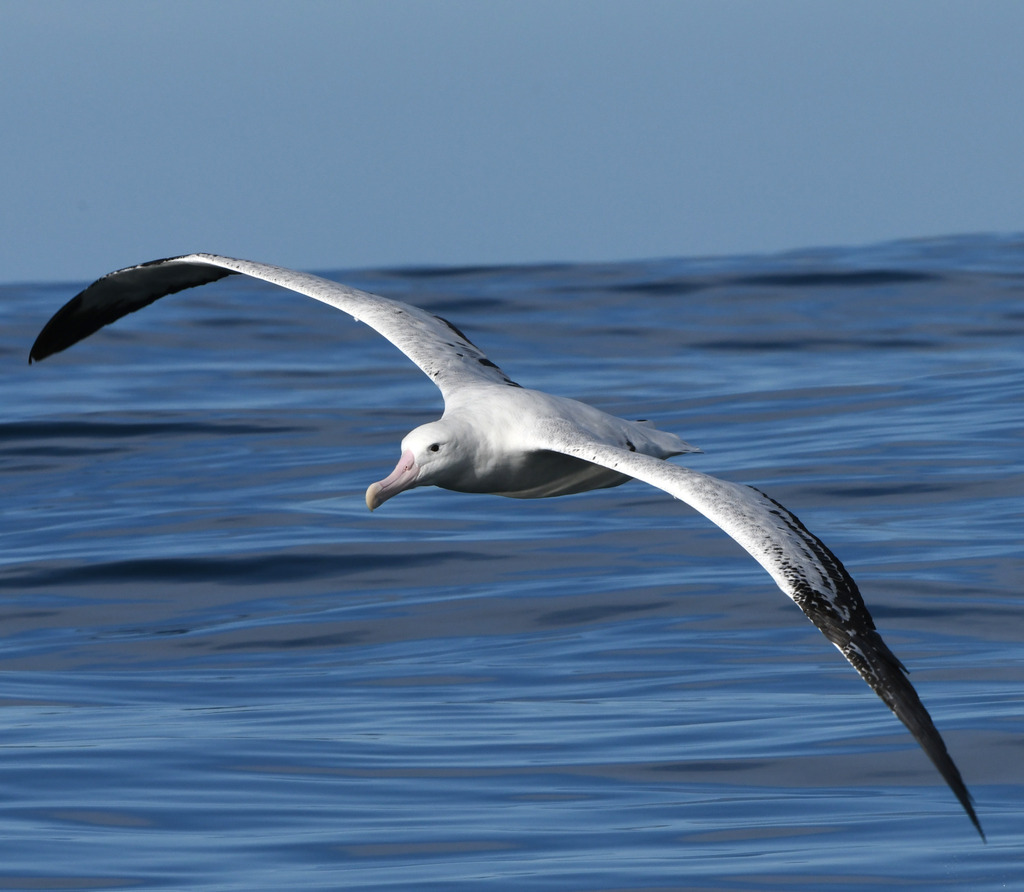
Antipodean Albatross
Photo © Ben Keen
Photo © Ben Keen — CC0 1.0 — Source: iNaturalist #318360269Identification
The Antipodean albatross is a large seabird measuring 110 cm (43 inches) in length. Its recognition as a distinct species separate from the wandering albatross is relatively recent and not universally accepted among scientists, though genetic studies have supported the split. Antipodean albatrosses are smaller than snowy albatrosses and breed in predominantly brown and white plumage that can make them difficult to distinguish from young snowy albatrosses. However, while snowy albatrosses grow lighter with age, Antipodean albatrosses retain their darker coloration.
Breeding females display brown upper parts with white vermiculations on the back, white face and throat, and white lower breast and belly, with brown undertail coverts and white underwings tipped with dark. Breeding males are whiter than females but lack the pure white of snowy albatrosses. Both sexes have pink bills, though some individuals—particularly immatures and females—may show a dusky tip to the lower mandible. Like all members of the order Procellariiformes, they possess distinctive tubular nasal passages on their bill.
Range & Habitat
Antipodean albatrosses breed on the Auckland Islands, Antipodes Islands, and Campbell Island in the southwestern Pacific Ocean. At sea, they range widely across the South Pacific from Australia to South America, traveling as far as Chile, from the Tropic of Capricorn southward. The two subspecies have slightly different ranges, with gibsonii appearing to stay east of Auckland Island while the nominate race ranges further east toward Chile.
On land, they nest on ridges, slopes, and plateaus in open areas or within patchy vegetation such as tussock grassland. The breeding range is remarkably small at only 670 km² despite their vast oceanic range of 37,400,000 km², making them highly vulnerable to threats concentrated in these few island locations.
Behaviour & Diet
Unlike most albatross species, Antipodean albatrosses feed predominantly on cephalopods, with fish comprising a lesser portion of their diet. Notably, they are not recorded eating any crustaceans, distinguishing them from other albatross species. They have been recorded visiting the spawning grounds of giant cuttlefish off New South Wales, demonstrating their specialization in cephalopod predation.
Best Time & Places to See It
The best opportunities to observe Antipodean albatrosses are during their breeding season on the Auckland Islands, Antipodes Islands, and Campbell Island, all of which are now World Heritage Sites and nature preserves. These remote locations require dedicated seabird-watching trips, typically organized from New Zealand. At sea, chances of encountering them are possible throughout their range in the South Pacific, particularly in waters off Australia, New Zealand, and extending toward South America.
Photography Tips
Photographers should note that Antipodean albatrosses breed in brown and white plumage, making them visually distinct from the lighter snowy albatrosses. The subtle differences between the sexes—with males appearing whiter and females showing a dark brown breast band—provide interesting compositional opportunities. Photography on the breeding islands should be conducted with minimal disturbance, respecting their status as endangered birds. The species' large wingspan and graceful posture on land and in flight offer excellent subject matter for wildlife photographers visiting these remote island sanctuaries.
Sydney Harbour National Park
Sydney, Australia
+203 birds+26 mammals
Where Sydney Harbour's sheltered waters meet the sandstone headlands of New South Wales, a mosaic of coastal heathland, eucalyptus woodland and rocky shores creates one of…
VIEW NATIONAL PARKRoyal National Park
Sydney, Australia
+296 birds+46 mammals
Where sandstone ridges plunge toward the Tasman Sea, Royal National Park unfolds across 343 square kilometres of southeastern Australian coastal wilderness. The park's defining character emerges…
VIEW NATIONAL PARKCabo de Hornos National Park
Cape Horn, Chile
+88 birds+9 mammals
Where the Andes plunge into the Southern Ocean and the Drake Passage churns between two continents, Cabo de Hornos National Park sprawls across one of Earth's…
VIEW NATIONAL PARKNo community photos yet. Log in to add the first one.
No community observations of this species yet.