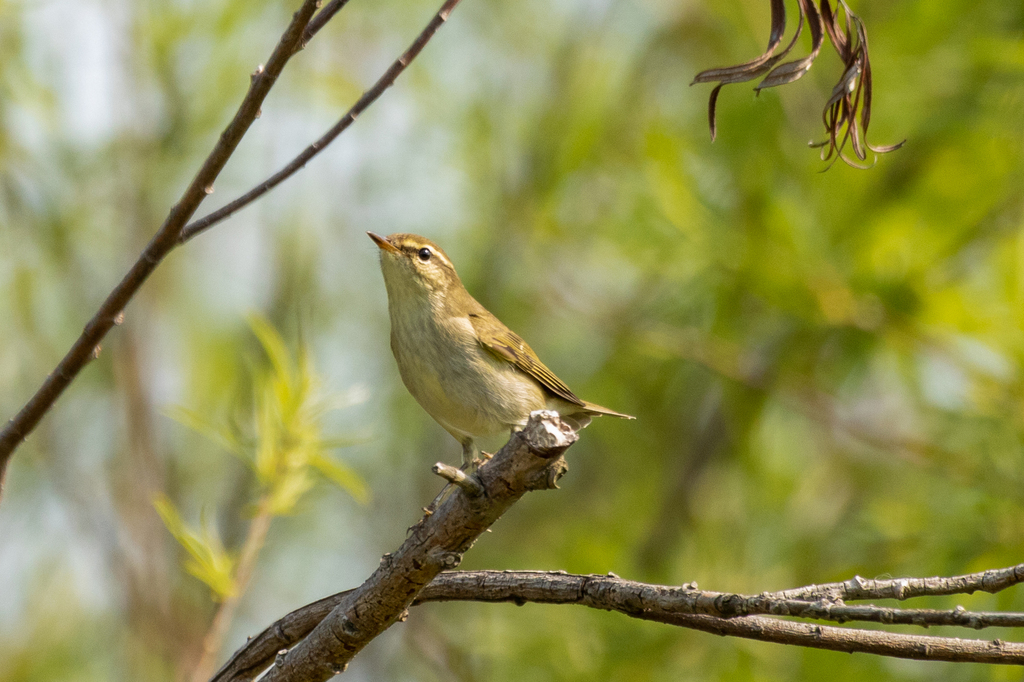
Arctic Warbler
Photo © Константин Шатилов
Photo © Константин Шатилов — CC BY 4.0 — Source: iNaturalist photo #514506077Identification
The Arctic Warbler is a small, understated leaf warbler with greyish-green upperparts and off-white underparts. Its most distinctive feature is a single pale wing bar, which sets it apart from most similar species. The most reliable distinction from its closest relative, the Greenish Warbler, is size: the Arctic Warbler is noticeably larger and possesses a heavier, dagger-like bill with a characteristically dark tip on the lower mandible. Its song is a fast, energetic trill that carries well through its boreal habitat.
Range & Habitat
This warbler breeds widely across the northern Palearctic, with its stronghold in Fennoscandia and birch or mixed birch forest near water. It has also established breeding populations in Alaska, making it one of the few Old World warblers to colonize North America. The species is extraordinarily migratory: the entire global population winters in southeast Asia, giving the Arctic Warbler one of the longest migration routes of any Old World insectivorous bird. This epic journey makes it a truly transcontinental traveller.
The species formerly included populations from Kamchatka, the Kuril Islands, and Japan, but genetic and vocal analysis has led taxonomists to recognize these as separate species: the Kamchatka Leaf Warbler and the Japanese Leaf Warbler respectively.
Behaviour & Diet
Like all leaf warblers, the Arctic Warbler is strictly insectivorous, foraging actively among foliage for small arthropods. It nests on the ground, typically in or beneath a low shrub, reflecting the sparse vegetation of its boreal breeding grounds. The species is intensely migratory, with no populations remaining year-round in their breeding areas.
Best Time & Places to See It
Breeders should focus on the Arctic Warbler's breeding season in Fennoscandia and Alaska, where it favours birch forests adjacent to water. However, the species is more likely to be encountered as a migrant or vagrant outside this range. It occurs regularly as an autumn vagrant in western Europe and is an annual visitor to Great Britain, where between 1958 and 2001 there were 225 confirmed sightings. Autumn migration offers the best opportunity for European birdwatchers to observe this elusive traveller, particularly along coastal headlands and in coastal scrub where migrants concentrate.
Photography Tips
The Arctic Warbler's subtle plumage demands patience and good light to appreciate. Its small size and preference for dense vegetation make it challenging to photograph in its breeding habitat. Focus on capturing the diagnostic single wing bar and the heavy, dagger-like bill in profile to confirm identification. During migration, individuals may be more approachable in coastal habitats, where they sometimes rest in relatively open scrub. Early morning light will best reveal the greyish-green tones of its upperparts and the pale underparts that characterize this understated but elegant warbler.
Aketajawe Lolobata National Park
Alaska Maritime National Wildlife Refuge
Altai Tavan Bogd National Park
Arctic National Wildlife Refuge
Baikal National Park
Baima Snow Mountain National Nature Reserve
Bako National Park
Denali National Park
Doi Inthanon National Park
Nothing matches these filters.
No community photos yet. Log in to add the first one.
No community observations of this species yet.