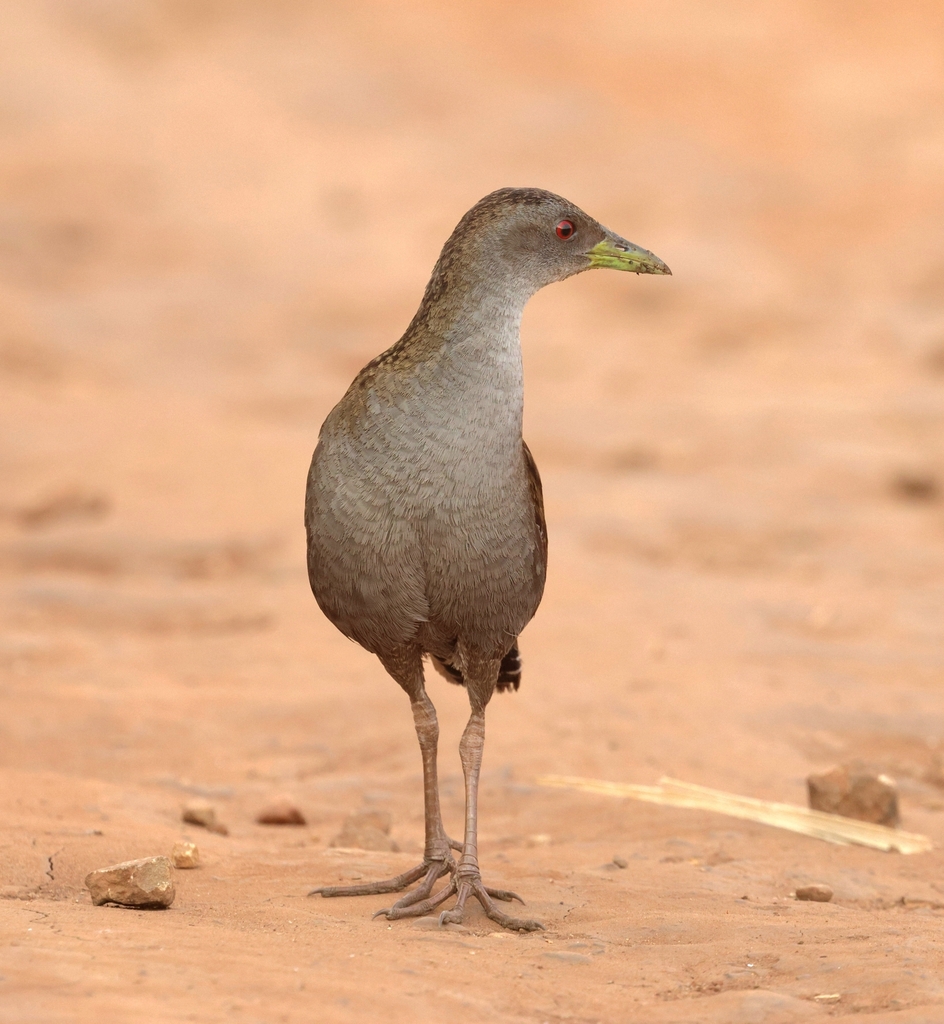
Ash-throated Crake
Photo © Miguel
Photo © Miguel — CC BY-SA 4.0 — Source: iNaturalist photo #440162154Identification
The ash-throated crake is a small rail measuring 21 to 24 cm in length and weighing just 90 to 120 grams, making it a diminutive and elusive member of the rail family. Both sexes share identical plumage, featuring distinctive black upperparts with brown-edged feathers that create a subtle scaled appearance. The throat, breast, and belly are pale gray, providing a striking contrast to the darker back. The flanks and undertail coverts display characteristic black and white barring. Look for the bird's short greenish bill and purplish-brown legs when you catch a glimpse of this cryptic species. The nominate subspecies is larger and darker than the paler M. a. typhoeca found in northern regions.
Range & Habitat
The ash-throated crake is found throughout mainland South America except Chile, with two geographically separated subspecies. The northern subspecies (M. a. typhoeca) ranges from Colombia eastward through Venezuela, extreme northern Brazil, and the Guianas, extending south into far northeastern Ecuador. The southern subspecies (M. a. albicollis) inhabits eastern and southern Brazil, southeastern Peru, northern and eastern Bolivia, eastern Paraguay, and the extreme northern corners of Argentina and Uruguay. The species shows considerable habitat flexibility, occupying freshwater marshes, moriche swamps, rice fields, savannas, and pastures, though it prefers the drier portions of wetland habitats. Elevations range from sea level to 1,200 meters.
Behaviour & Diet
The ash-throated crake is a solitary, shy species that typically forages out of sight within dense vegetation, only occasionally venturing to the edges of cover. Its diet consists primarily of grass seeds supplemented by insects, including lepidopterans, ants, and beetles in both adult and larval stages. The species is generally sedentary, though some seasonal movements have been documented in Colombia. During breeding season—which may occur year-round—pairs construct large, open bowl-shaped nests from dry grass, positioned on the ground or just above it and often concealed between tree roots or thick grass clumps. Clutches typically contain two to three eggs, though up to six have been recorded.
Best Time & Places to See It
Finding this bird requires patience and luck, as the ash-throated crake is notoriously difficult to observe despite its large range. Early morning and evening hours offer the best opportunities, as the species is most vocal during these periods. Listen for its distinctive song—a loud, repeated series of rapid vibrating notes resembling "d'd'd'd'd'd'-ou'"—or the sharp "tuk" call that betrays the bird's presence. Wetland habitats across its South American range, particularly freshwater marshes and rice-field regions, offer the greatest likelihood of encounters, though the species' exact abundance and range limits remain poorly documented due to its shy, secretive nature.
Photography Tips
Photographing the ash-throated crake presents considerable challenges given the species' elusive habits and preference for dense vegetation. Position yourself near marsh edges or open water early in the morning or at dusk when the bird is most likely to emerge briefly. Use a telephoto lens to maintain distance while capturing detail of the pale throat and barred flanks. Patience is essential—sit quietly and listen for vocalizations to pinpoint the bird's location. Photography may be most feasible in open habitats such as rice fields or savanna margins where the crake has less dense cover to retreat into. Given the bird's unpredictability, even experienced naturalists and photographers may spend considerable time in suitable habitat without securing satisfactory views or images.
Emas National Park
Brazil
+333 birds+23 mammals
Across the high plateaux of central Brazil, where the cerrado grasslands roll toward distant horizons under an immense sky, Emas National Park anchors one of South…
VIEW NATIONAL PARKSerra do Cipó National Park
Brazil
+379 birds+5 mammals
Where granite escarpments rise above the Atlantic Forest transition zone in southeastern Brazil, Serra do Cipó National Park unfolds across a landscape of dramatic ridges, cascading…
VIEW NATIONAL PARKNatural Sierra de Chiribiquete National Park
Solano, Colombia
+359 birds+27 mammals
Massive table-top mountains rise abruptly from the lowland rainforest of southeastern Colombia, their sheer sandstone cliffs and isolated summits creating some of the most dramatic topography…
VIEW NATIONAL PARKNatural la Paya National Park
Puerto Leguízamo, Colombia
+262 birds+4 mammals
Where the Amazon's western reaches fold into the Andes foothills, La Paya National Park sprawls across more than 8,500 square kilometers of pristine Amazonian rainforest in…
VIEW NATIONAL PARKNatural Serranía de los Yariguíes National Park
El Carmen de Chucurí, Colombia
+320 birds+3 mammals
Where the northern cordilleras of Colombia rise toward cloud forest, the Serranía de los Yariguíes unfolds across nearly 1,820 square kilometers of some of the most…
VIEW NATIONAL PARKNatural Sierra de la Macarena National Park
Vista Hermosa, Colombia
+566 birds+15 mammals
Across nearly 20,000 square kilometres of Colombia's Meta Department, the terrain rises from lowland savanna into Andean foothills through a mosaic of gallery forests, palm-fringed wetlands,…
VIEW NATIONAL PARKItatiaia National Park
Brazil
+519 birds+12 mammals
Where granite peaks pierce the Atlantic rainforest canopy in southeastern Brazil, Itatiaia National Park rises as one of the country's oldest and most ecologically vital protected…
VIEW NATIONAL PARKPeixe National Park Lagoon
Brazil
+293 birds+4 mammals
Where the coastal plains of Rio Grande do Sul meet the Atlantic, Peixe National Park Lagoon sprawls across nearly 2,200 square kilometres of shallow waters, reed…
VIEW NATIONAL PARKSuperagui National Park
Brazil
+246 birds+2 mammals
Where the Atlantic rainforest meets the subtropical coast of Paraná, Superagui National Park sprawls across more than 1,000 square kilometres of one of Brazil's most biodiverse…
VIEW NATIONAL PARKSerra da Bocaina National Park
Brazil
+441 birds+5 mammals
Where the escarpment of the Serra da Bocaina rises sharply from the Atlantic coastal plain, tropical rainforest cloaks steep mountainsides that climb toward peaks exceeding 2,000…
VIEW NATIONAL PARKViruá National Park
Brazil
+389 birds+6 mammals
Across the northern frontier of Roraima, where the forest canopy rises from ancient Amazonian lowlands, Viruá National Park protects nearly 3,700 square kilometres of terra firme…
VIEW NATIONAL PARKIguaçu National Park
Brazil
+387 birds+17 mammals
Where the Paraná Plateau plunges toward the Atlantic watershed, six thousand square kilometers of subtropical rainforest cling to steep gorges and river valleys in this corner…
VIEW NATIONAL PARKIlha Grande National Park
Brazil
+233 birds
Across the subtropical plateaus and Atlantic forest remnants of southern Brazil, a vast protected landscape spanning nearly 4,600 square kilometers safeguards one of the continent's most…
VIEW NATIONAL PARKSerra dos Órgãos National Park
Brazil
+446 birds+13 mammals
Granite peaks thrust skyward through the Atlantic Forest canopy in the mountains immediately north of Rio de Janeiro, their bare rock faces rising above a landscape…
VIEW NATIONAL PARKChapada dos Guimarães National Park
Brazil
+450 birds+1 mammals
Where weathered sandstone plateaus rise above the cerrado grasslands of central Brazil, Chapada dos Guimarães National Park protects 624 square kilometres of ecological transition zone that…
VIEW NATIONAL PARKChapada dos Veadeiros National Park
Brazil
+324 birds+6 mammals
Where granite plateaus rise above the cerrado savanna in central Brazil, Chapada dos Veadeiros National Park unfolds across 6,665 square kilometres of some of the world's…
VIEW NATIONAL PARKBrasília National Park
Plano Piloto, Brazil
+338 birds+15 mammals
Cerrado grassland and scattered woodland sweep across the central Brazilian plateau where this national park sprawls across more than a thousand square kilometres of the Federal…
VIEW NATIONAL PARKMapinguari National Park
Brazil
+354 birds
Vast tracts of western Amazonian rainforest blanket the remote terrain of this 56,827 square kilometre national park in Amazonas state, where seasonal rivers wind through dense…
VIEW NATIONAL PARKBahuaja Sonene National Park
San Pedro de Putina Punco, Peru
+602 birds+8 mammals
Where the Madre de Dios and Heath rivers converge in southeastern Peru rises one of South America's most biodiverse wilderness regions: a vast protected realm of…
VIEW NATIONAL PARKRío Pilcomayo National Park
Argentina
+271 birds+13 mammals
Where the Río Pilcomayo cuts through northeastern Argentina's subtropical lowlands, a sprawling mosaic of wetlands, grasslands, and seasonally flooded forests creates one of South America's most…
VIEW NATIONAL PARKIguazú National Park
Puerto Iguazú, Argentina
+346 birds+15 mammals
Where the Paraná Plateau plunges toward the Atlantic watershed, nearly 800 square kilometers of subtropical rainforest drape across Misiones Province in a landscape carved by millennia…
VIEW NATIONAL PARKChaco National Park
Municipio de Presidencia de la Plaza, Argentina
+258 birds+7 mammals
Across the humid subtropical lowlands of northeastern Argentina, where the Paraná River basin feeds vast seasonal wetlands and gallery forests, Chaco National Park protects one of…
VIEW NATIONAL PARKNo community photos yet. Log in to add the first one.
No community observations of this species yet.