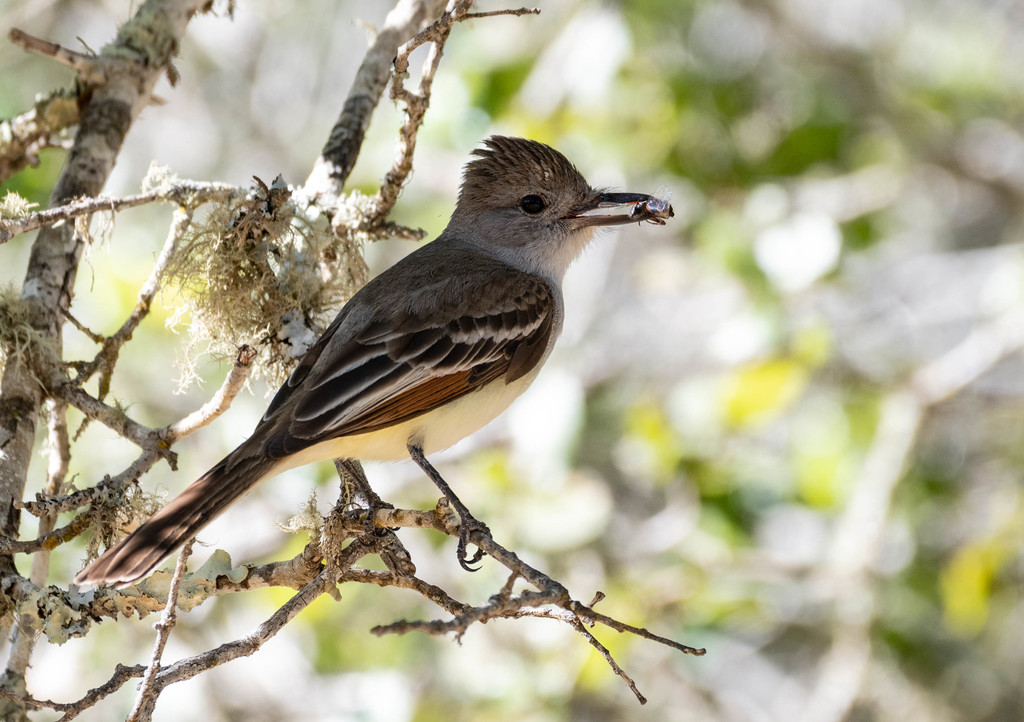
Ash-throated Flycatcher
Photo © Karen (with occasional help from Mike)
Photo © Karen (with occasional help from Mike) — CC BY 4.0 — Source: iNaturalist photo #129825138Identification
The ash-throated flycatcher is a medium-sized tyrant flycatcher measuring 7.5 to 8.6 inches (19 to 22 cm) in length with a wingspan of 11.8 to 12.6 inches (30 to 32 cm). It is slim and long-tailed with a slightly peaked crest on its relatively large head. The upperparts are olive brown with a darker head, the breast is gray, and the belly is very pale yellow. The brown tail feathers and wings display distinctive rufous outer webs with two dull wing bars. The sexes are similar in appearance.
Range & Habitat
This species breeds in desert scrub, riparian forest, brushy pastures, and open woodland from the western United States to central Mexico. It is a short-distance migrant, retreating from most of the U.S. and northern and central Mexico to spend winters from southern Mexico to Honduras. Two subspecies are recognized: the nominate subspecies breeds from the western U.S. south into Mexico and winters primarily on the Pacific slope, while the pertinax subspecies is restricted to Baja California. The ash-throated flycatcher is also prone to wandering, with birds occasionally spotted far outside their normal breeding range, even reaching the east coast of North America.
Behaviour & Diet
This species is primarily an insectivore, foraging by flying from a perch to catch prey from the ground or foliage in the undergrowth, less often from branches and trunks, and hardly ever in midair. Unlike many other tyrant flycatchers, it typically moves to another perch rather than returning to the same one. It also takes some fruit, particularly in winter when insects are scarce, and rarely hunts small mammals and reptiles by striking them against hard objects. During breeding season, the ash-throated flycatcher nests in tree cavities or similar natural and man-made holes, with a typical clutch of three or four eggs. Year-round, it is separated from similar Myiarchus species by its distinctive burry kabrick call and rough prrt or wheer vocalizations.
Best Time & Places to See It
The ash-throated flycatcher is best observed during the breeding season in its preferred habitats of desert scrub, riparian forests, and open woodland in the western United States and Mexico. Winter visitors may be found from southern Mexico south to Honduras. The species' habit of wandering beyond its normal range means that vagrant birds occasionally appear in unexpected locations, making it worth watching for in the eastern United States during migration periods.
Photography Tips
Photograph this flycatcher from a distance using a telephoto lens, as it tends to be wary. The pale yellow belly and rufous-edged tail and wings are key field marks to capture. Look for it perched on exposed branches in open habitats where it hunts insects. Early morning light will best reveal the subtle gray breast and olive-brown upperparts. Patient observers who wait for the bird to sally forth from its perch will have the best opportunities for action shots of this active forager.
Alligator River National Wildlife Refuge
Arches National Park
Bear River Migratory Bird Refuge
Big Bend National Park
Bitter Lake National Wildlife Refuge
Black Canyon of the Gunnison National Park
Blackwater National Wildlife Refuge
Bombay Hook National Wildlife Refuge
Bosque del Apache National Wildlife Refuge
Nothing matches these filters.
No community photos yet. Log in to add the first one.
No community observations of this species yet.