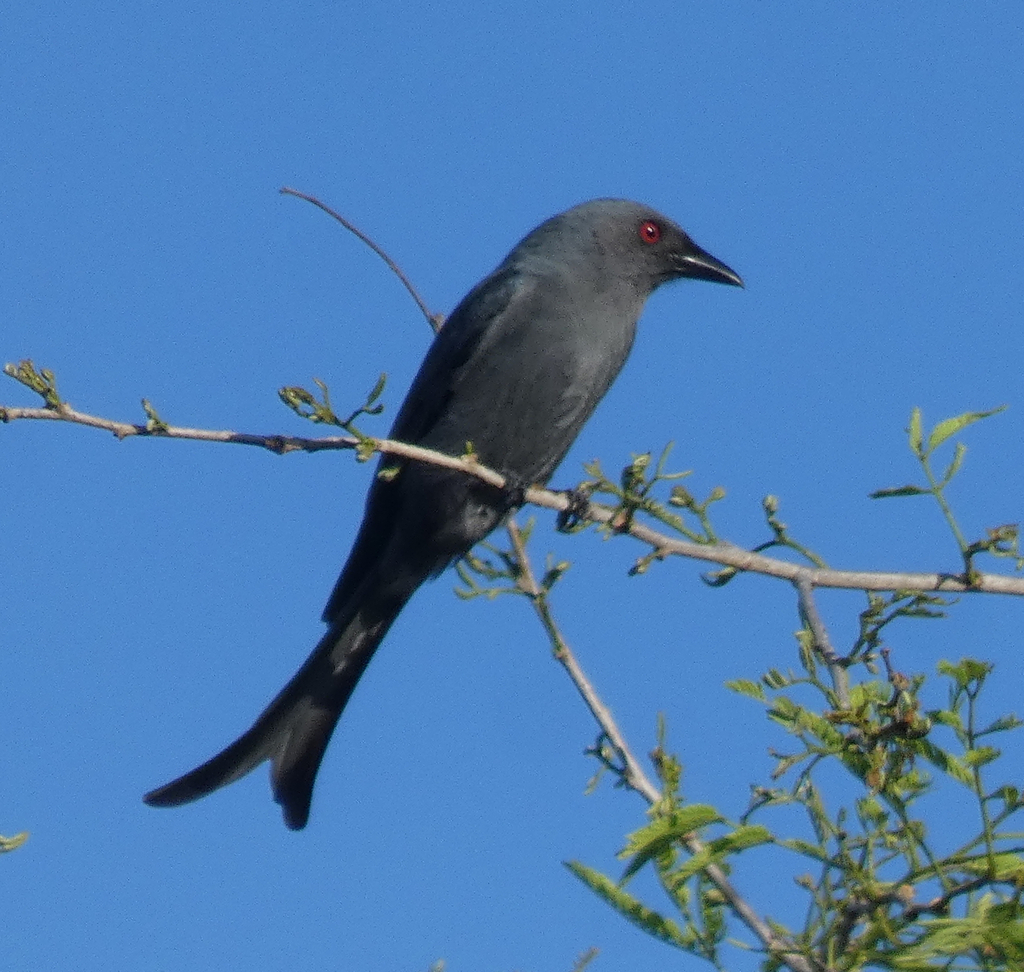
Ashy Drongo
Photo © River Ahlquist
Photo © River Ahlquist — CC BY 4.0 — Source: iNaturalist #176356466Identification
The ashy drongo is a distinctly elegant bird, characterized by dark grey plumage and a long, deeply forked tail that gives it a streamlined silhouette. Adults are predominantly grey, though the exact shade varies among the numerous subspecies found across its range. Young birds are duller, appearing brownish-grey. Several subspecies display striking white eye-patches or head markings, while others lack these features entirely. The bird's most notable structural feature is its slim build and notably long, less-splayed tail compared to the related black drongo. One of the most reliable field marks on some subspecies is the absence of a white rictal spot, and those with it have a distinctive crimson iris.
The ashy drongo sits very upright when perched, often choosing prominent positions high in trees on short legs. This distinctive posture, combined with its forked tail and grey coloration, makes it readily identifiable in the field. The calls are described as slightly more nasal and twangy than those of the black drongo, and remarkably, this species is a capable mimic of other bird calls, including the whistling notes of the common iora.
Range & Habitat
The ashy drongo is widely distributed across eastern and Southeast Asia, with its breeding range extending from eastern Afghanistan eastward to southern China, the Ryukyu Islands (particularly Okinawa) in southern Japan, and throughout the Indonesian archipelago. The species shows considerable variation in migration patterns, with northern populations being largely migratory while southern populations are more sedentary. In winter, the species shows a particular preference for hill forests, a key habitat for survival during the cooler months.
The breeding populations are diverse and complex, with multiple recognized subspecies occupying different regions from the Himalayas through Thailand and Myanmar to the island chains of Southeast Asia. This geographic variation reflects adaptation to different local conditions and seasonal patterns across its extensive range.
Behaviour & Diet
The ashy drongo is an insectivorous bird that employs an active foraging strategy. It hunts primarily by making aerial sallies—quick flights from a perch to snatch insects in mid-air—though it also gleans insects from tree trunks. This opportunistic feeding approach makes it an agile and alert hunter. The species is typically found singly or in pairs, though small groups may gather together. During migration periods, birds congregate in small flocks to travel between their breeding and wintering grounds.
Breeding occurs during May and June, with females laying a clutch of three or four reddish or brown eggs in a loose cup nest constructed in a tree. The ashy drongo is a vocal species, producing distinctive calls described as "drangh gip" or "gip-gip-drangh," and possesses the remarkable ability to imitate the calls of other bird species, adding to its presence in the forest soundscape.
Best Time & Places to See It
For birders and wildlife enthusiasts, the best opportunity to observe ashy drongos depends on location and migration patterns. In the breeding season (May to June), birds are most active and vocal in the hills and forested areas of their range. Winter offers excellent viewing opportunities in hill forests where migratory populations congregate. The species' preference for prominent perching positions high in trees makes it relatively visible compared to many forest birds.
Key regions for observation include the Himalayas and central India, Thailand and Myanmar, and the island chains of Southeast Asia including the Ryukyu Islands, Indonesia, and the Philippines. Its wide range and various subspecies mean that dedicated travellers exploring tropical and subtropical Asian regions have multiple opportunities to encounter this elegant, fork-tailed bird.
Photography Tips
The ashy drongo's habit of perching prominently and sitting very upright makes it relatively approachable for photographers compared to many forest species. Look for birds silhouetted against the sky in the upper branches of tall trees, where their distinctive forked tail and slim profile will be clearly visible. Early morning light during the breeding season will capture the bird's grey plumage and striking eye details effectively.
The deeply forked tail is the defining photographic feature—aim to capture this characteristic in clear profile view. During migration when birds gather in small flocks, there may be increased activity and multiple photo opportunities. In hill forests during winter, patient waiting near suitable perching trees can yield excellent results, particularly if you can position yourself to catch the bird's upright posture and the detail of eye-patches on subspecies that possess them.
Lunugamvehera National Park
Sri Lanka
+204 birds+14 mammals
Dry scrubland and shallow wetlands converge in Sri Lanka's southeastern lowlands, where Lunugamvehera National Park anchors one of the island's most ecologically vital landscapes. The park's…
VIEW NATIONAL PARKLangtang National Park
Helambu, Nepal
+364 birds+14 mammals
Where the southern slopes of the Himalayan highlands descend toward the subtropical valleys of central Nepal, Langtang National Park sprawls across one of the subcontinent's most…
VIEW NATIONAL PARKOrang National Park
Rangagarapathar, India
+298 birds+1 mammals
Where the Brahmaputra's floodplains meet the foothills of Assam, Orang National Park unfolds across a mosaic of riverine grasslands, forests and wetlands that pulse with the…
VIEW NATIONAL PARKValmiki National Park
Ramnagar, India
+66 birds+6 mammals
Along Bihar's western frontier, where the Gandak River winds through subtropical forest and grassland, Valmiki National Park sprawls across terrain shaped by monsoon rains and seasonal…
VIEW NATIONAL PARKRanthambhore National Park
Sawai Madhopur, India
+294 birds+20 mammals
Granite ridges and ravines carved through the Aravalli Range frame this protected landscape in eastern Rajasthan, where deciduous forest mingles with open scrubland and seasonal water…
VIEW NATIONAL PARKSagarmatha National Park
Khumjung, Nepal
+219 birds+7 mammals
Soaring peaks and deep glacial valleys define this alpine wilderness in northeastern Nepal, where the terrain rises from forested foothills into a realm of high-altitude tundra…
VIEW NATIONAL PARKKhangchendzonga National Park
Sakkyong, India
+290 birds+1 mammals
Where the eastern Himalayas surge toward their crowning peaks, Khangchendzonga National Park embraces a landscape of almost overwhelming vertical drama. Rising from subtropical river valleys into…
VIEW NATIONAL PARKEravikulam National Park
Devikulam, India
+192 birds+7 mammals
High in the Western Ghats of Kerala, where monsoon mists cling to slopes that rise above 2,000 metres, Eravikulam National Park preserves one of South India's…
VIEW NATIONAL PARKPhou Khao Khouay National Protected Area
Thaphabath District, Thailand
+113 birds
Where the Annamite Mountains descend into central Thailand's monsoon forests, Phou Khao Khouay National Protected Area sprawls across rugged limestone terrain interlaced with river valleys and…
VIEW NATIONAL PARKHat Noppharat Thara-Mu Ko Phi Phi National Park
Ao Nang, Thailand
+253 birds+9 mammals
Where limestone karsts rise dramatically from turquoise waters, Hat Noppharat Thara-Mu Ko Phi Phi National Park unfolds across a mosaic of beach, mangrove forest, and island…
VIEW NATIONAL PARKKhao Yai National Park
Prachantakham District, Thailand
+377 birds+46 mammals
Evergreen dipterocarp forest blankets the rolling terrain of this national park in eastern Thailand, where limestone hills rise abruptly from the forest floor and seasonal streams…
VIEW NATIONAL PARKKhao Laem Ya-Mu Ko Samet National Park
Mueang Rayong District, Thailand
+159 birds+3 mammals
Where limestone hills meet the Gulf of Thailand, Khao Laem Ya–Mu Ko Samet National Park stitches together a mosaic of terrestrial and marine worlds that few…
VIEW NATIONAL PARKKhao Laem National Park
Sangkhla Buri District, Thailand
+197 birds
Where the Vajiralongkorn Reservoir sprawls across the forested valleys of Kanchanaburi's northern borderlands, Khao Laem National Park protects a landscape where limestone ridges rise dramatically from…
VIEW NATIONAL PARKGiant Panda National Park
Mianyang, China
+447 birds+47 mammals
Where the eastern slopes of China's Sichuan plateau descend into cloud-wrapped valleys, one of Asia's most biodiverse landscapes unfolds across more than 350,000 square kilometres. This…
VIEW NATIONAL PARKMount Nanling Forest Park
Ruyang Forest Farm, China
+179 birds+3 mammals
Granite ridges and weathered peaks rise through a canopy of subtropical montane forest where Ruyang Forest Farm anchors one of southern China's most biodiverse landscapes. Across…
VIEW FOREST & JUNGLEKanha Tiger Reserve
Kanha Kisli F.V., India
+321 birds+23 mammals
Where sal forests give way to emerald meadows and crystalline streams carve through ancient valleys, one of India's finest wilderness reserves unfolds across the Maikal Range.…
VIEW NATIONAL PARKTadoba National Park
Palasgaon Singru, India
+270 birds+20 mammals
Where sal forests meet open grasslands and rocky outcrops rise from red laterite soil, central India's landscape unfolds in raw, untamed beauty. Ancient teak woodlands and…
VIEW NATIONAL PARKBandhavgarh National Park
Garhpuri, India
+285 birds+17 mammals
Where granite ridges rise dramatically above sal and bamboo forests, one of India's most pristine tiger reserves unfolds across the Vindhyan plateau. Ancient rock formations tower…
VIEW NATIONAL PARKPanna National Park
Badgadi Kalan, India
+271 birds+17 mammals
Where granite gorges slice through central India's Vindhyan plateau, a landscape of stark beauty unfolds across nearly six hundred square kilometers. The Ken River carves through…
VIEW NATIONAL PARKKaziranga National Park
Kohora, India
+422 birds+26 mammals
Dawn breaks over the floodplains of the Brahmaputra, where tall grasslands stretch endlessly beneath monsoon-heavy skies. This sprawling wilderness of northeastern Assam is a mosaic of…
VIEW NATIONAL PARKNanda Devi National Park
Garpak, India
+218 birds+5 mammals
Where the Himalayas surge into their most dramatic alpine amphitheater, a wilderness of raw geological power unfolds across 624 square kilometers of pristine terrain. Nanda Devi,…
VIEW NATIONAL PARKValley of Flowers National Park
Ghangaria, India
+117 birds+1 mammals
Where alpine meadows explode with color each monsoon season, the Himalayan slopes of Uttarakhand rise to create one of Earth's most extraordinary floral displays. Perched between…
VIEW NATIONAL PARKKeoladeo National Park
Shreenagar Rural, India
+326 birds+14 mammals
Where shallow wetlands shimmer beneath vast Rajasthani skies, one of Asia's finest bird sanctuaries pulses with extraordinary life. This former maharaja's hunting reserve, now spanning 29…
VIEW NATIONAL PARKPeriyar National Park
Mlappara, India
+232 birds+4 mammals
Dawn breaks over mist-shrouded ridges where the Western Ghats tumble toward Kerala's spice-scented lowlands. Here, ancient tropical forests envelope a glittering artificial lake, creating a mosaic…
VIEW NATIONAL PARKPampadum Shola National Park
Vattavada, India
+258 birds+14 mammals
Where misty shola forests cling to the high plateaus of the Nilgiri Mountains, ancient evergreen remnants create a world apart. This 2,316-hectare reserve protects one of…
VIEW NATIONAL PARKBandipur National Park
Hirehalli, India
+302 birds+19 mammals
Where the Western Ghats descend into the Deccan plateau, ancient deciduous forests blanket a landscape carved by the Nugu River. Bandipur unfolds across 880 square kilometres…
VIEW NATIONAL PARKTaman Negara National Park
Kampong Samas, Malaysia
+393 birds+48 mammals
Where ancient rainforest meets limestone peaks, one of Southeast Asia's oldest protected wilderness preserves sprawls across 4,343 square kilometers of primordial landscape. Dipterocarp giants tower overhead,…
VIEW NATIONAL PARKPenang National Park
Balik Pulau, Malaysia
+107 birds+2 mammals
Granite peaks rise abruptly from the Andaman Sea where tropical rainforest clings to steep slopes in one of Malaysia's oldest protected landscapes. Mangrove forests fringe the…
VIEW NATIONAL PARKGunung Mulu National Park
Long Seridan, Malaysia
+280 birds+39 mammals
Where granite monoliths pierce the rainforest canopy of Sarawak, an ancient limestone karst landscape reveals one of Southeast Asia's most biodiverse strongholds. Soaring peaks cloaked in…
VIEW NATIONAL PARKTaman Nasional Baluran
Situbondo, Indonesia
+189 birds+9 mammals
Across the northeastern tip of East Java, where monsoon winds sweep down from the Bali Strait, a landscape of contrasts unfolds within 374 square kilometres of…
VIEW NATIONAL PARKWest Bali National Park
Gerokgak, Indonesia
+240 birds+8 mammals
Across West Bali's northwestern reaches, where the Indian Ocean meets volcanic slopes and limestone cliffs plunge toward turquoise shallows, sprawls a protected realm of roughly 325…
VIEW NATIONAL PARKGunung Ciremai National Park
Majalengka, Indonesia
+116 birds+1 mammals
Volcanic slopes rise sharply from West Java's interior, where Gunung Ciremai's 3,078-metre summit dominates a landscape carved by geological upheaval and shaped by equatorial monsoon rainfall.…
VIEW NATIONAL PARKGunung Merbabu National Park
Magelang, Indonesia
+61 birds+2 mammals
Where volcanic slopes rise sharply from the plateau of Central Java, Gunung Merbabu National Park encompasses nearly 200 square kilometers of montane forest that transitions through…
VIEW NATIONAL PARKMount Merapi National Park
Hargobinangun, Indonesia
+150 birds+3 mammals
Where the volcanic slopes of central Java rise into mist and montane forest, Mount Merapi National Park guards one of Indonesia's most dynamic landscapes. Spanning roughly…
VIEW NATIONAL PARKBatang Gadis National Park
Mandailing Natal, Indonesia
+16 birds
Steep ridges and river valleys carved through North Sumatra's equatorial interior define Batang Gadis National Park, where monsoon forests cloak almost 3,960 square kilometers of mountainous…
VIEW NATIONAL PARKKerinci Seblat National Park
Kerinci, Indonesia
+228 birds+16 mammals
Across nearly 67,000 square kilometres of Sumatra's spine, a mountainous realm of equatorial rainforest rises from steaming lowlands to volcanic peaks shrouded in cloud. Kerinci Seblat…
VIEW NATIONAL PARKWay Kambas National Park
Lampung Timur, Indonesia
+237 birds+20 mammals
Across the low swamplands of eastern Lampung, where freshwater wetlands merge into tidal mangrove forests along the Sunda Strait, sprawls one of Sumatra's most vital sanctuaries.…
VIEW NATIONAL PARKSanjiangyuan National Park
Nagqu, China
+187 birds+25 mammals
Where the headwaters of three great Asian rivers emerge from a high alpine plateau, the landscape unfolds in tundra and dwarf shrubland—a world of austere beauty…
VIEW NATIONAL PARKWolong National Nature Reserve
Wenchuan County, China
+333 birds+17 mammals
Where the Qingyi River cuts through the eastern flanks of the Minshan Range, a temperate montane forest cloaks steep valleys in dense canopy that thins dramatically…
VIEW NATURE RESERVEPoyang Lake National Nature Reserve
Shangrao, China
+270 birds+7 mammals
Where the Yangtze River's massive floodplain spreads across central China, Poyang Lake National Nature Reserve encompasses one of the continent's most dynamic and water-rich wetland systems.…
VIEW NATURE RESERVEXishuangbanna National Nature Reserve
Xishuangbanna Dai Autonomous Prefecture, China
+173 birds+2 mammals
Where subtropical monsoon forests meet the margins of the Yunnan plateau, Xishuangbanna National Nature Reserve sprawls across a landscape of dramatic relief—deep river valleys carved by…
VIEW NATURE RESERVEGaoligong Mountain National Nature Reserve
Nujiang Lisu Autonomous Prefecture, China
+443 birds+13 mammals
VIEW NATURE RESERVEBaima Snow Mountain National Nature Reserve
Diqing Tibetan Autonomous Prefecture, China
+204 birds+3 mammals
High-altitude ridges and steep-sided valleys define this reserve in northwestern Yunnan, where elevations surge from around 3,000 metres to peaks above 4,100 metres. The terrain supports…
VIEW NATURE RESERVENo community photos yet. Log in to add the first one.
No community observations of this species yet.