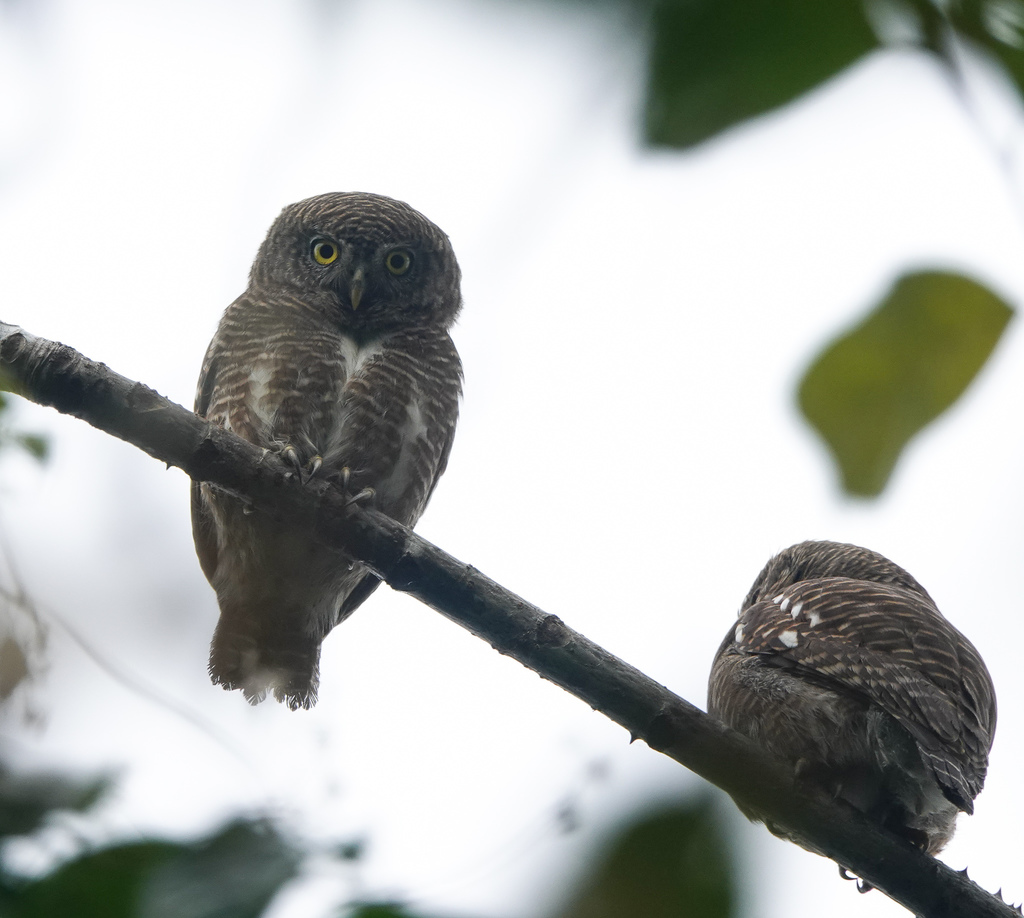
Asian Barred Owlet
Photo © Rejoice Gassah
Photo © Rejoice Gassah — CC BY 4.0 — Source: iNaturalist #69979259Identification
The Asian barred owlet is a compact owl measuring 22–25 cm (8.7–9.8 in), ranking among the larger pygmy owl species. Males weigh 150–176 g while females reach up to 240 g, with females typically larger than males. The plumage is dark brown or olive-brown with dense barring throughout, featuring a distinctive white throat patch. The breast and belly are whitish with dark brown bars, while the wings and tail display dark brown coloring with whitish bars. A notable feature is the absence of false eyes on the back of the head, which distinguishes this species from other pygmy owls. Juveniles are more ruddy brown on the head with streaked rather than barred breasts. The Asian barred owlet shares similarities with the Javan owlet and collared owlet, though experienced birders can distinguish them by these diagnostic features.
Range & Habitat
This species is widespread across mainland Southeast Asia, ranging from southeast China, Bhutan, Myanmar, Laos, Vietnam, Thailand, Nepal, Bangladesh, and northeast India to the foothills of the Himalayas in Pakistan. The highest recorded sighting occurred at 2,700 m (8,900 ft) in the Himalayas of north Pakistan. Asian barred owlets favor woodland habitats including pine and oak forests, subtropical and tropical evergreen jungles at lower elevations, and foothills to submontane regions up to 2,100 m elevation. They have adapted well to developed areas, appearing in gardens and parks, and show a preference for secondary forests over primary forests in parts of their range.
Behaviour & Diet
Remarkably for owls, the Asian barred owlet is primarily diurnal, hunting actively throughout the day from bare perches. They employ an undulating flight pattern of rapid wing flaps followed by gliding with closed wings. Despite their daytime activity, they are frequently mobbed by smaller birds, responding by remaining still and alert during these encounters.
Their diet consists mainly of insects—beetles, grasshoppers, and cicadas—but they opportunistically hunt lizards, small rodents such as mice, and small birds, even capturing common quail in flight. Vocalizations include a distinctive male trill lasting 5–20 seconds that progressively becomes louder and harsher, as well as smooth hooting calls. They are noisiest at dawn and for a couple of hours after sunrise but vocalize throughout the day.
Best Time & Places to See It
Asian barred owlets breed from January to February in Thailand and March to June elsewhere in their range, making these seasons ideal for locating them. They are resident birds with only local movements and elevational shifts, making them potentially observable year-round within their range. Early morning hours offer the best viewing opportunities, as these diurnal owls are most active and vocal at dawn and in the hours following sunrise. Wooded habitats, gardens, and parks throughout Southeast Asia and the Himalayan foothills offer promising locations.
Photography Tips
The Asian barred owlet's daytime activity is exceptional among owls, offering photographers excellent opportunities for natural light photography. Position yourself near suitable woodland perches at dawn and early morning when the birds are most vocal and active. Their habit of perching openly on bare branches makes them relatively accessible subjects compared to nocturnal species. Be prepared for frequent interruptions from mobbing songbirds, which can provide dynamic compositional opportunities. The bird's compact size and detailed plumage patterning rewards telephoto lenses and careful exposure management to capture the intricate barring and tonal variations of the dark brown and whitish markings.
Langtang National Park
Helambu, Nepal
+364 birds+14 mammals
Where the southern slopes of the Himalayan highlands descend toward the subtropical valleys of central Nepal, Langtang National Park sprawls across one of the subcontinent's most…
VIEW NATIONAL PARKOrang National Park
Rangagarapathar, India
+298 birds+1 mammals
Where the Brahmaputra's floodplains meet the foothills of Assam, Orang National Park unfolds across a mosaic of riverine grasslands, forests and wetlands that pulse with the…
VIEW NATIONAL PARKKhangchendzonga National Park
Sakkyong, India
+290 birds+1 mammals
Where the eastern Himalayas surge toward their crowning peaks, Khangchendzonga National Park embraces a landscape of almost overwhelming vertical drama. Rising from subtropical river valleys into…
VIEW NATIONAL PARKPhou Khao Khouay National Protected Area
Thaphabath District, Thailand
+113 birds
Where the Annamite Mountains descend into central Thailand's monsoon forests, Phou Khao Khouay National Protected Area sprawls across rugged limestone terrain interlaced with river valleys and…
VIEW NATIONAL PARKKhao Yai National Park
Prachantakham District, Thailand
+377 birds+46 mammals
Evergreen dipterocarp forest blankets the rolling terrain of this national park in eastern Thailand, where limestone hills rise abruptly from the forest floor and seasonal streams…
VIEW NATIONAL PARKKhao Laem National Park
Sangkhla Buri District, Thailand
+197 birds
Where the Vajiralongkorn Reservoir sprawls across the forested valleys of Kanchanaburi's northern borderlands, Khao Laem National Park protects a landscape where limestone ridges rise dramatically from…
VIEW NATIONAL PARKGiant Panda National Park
Mianyang, China
+447 birds+47 mammals
Where the eastern slopes of China's Sichuan plateau descend into cloud-wrapped valleys, one of Asia's most biodiverse landscapes unfolds across more than 350,000 square kilometres. This…
VIEW NATIONAL PARKMount Nanling Forest Park
Ruyang Forest Farm, China
+179 birds+3 mammals
Granite ridges and weathered peaks rise through a canopy of subtropical montane forest where Ruyang Forest Farm anchors one of southern China's most biodiverse landscapes. Across…
VIEW FOREST & JUNGLEKaziranga National Park
Kohora, India
+422 birds+26 mammals
Dawn breaks over the floodplains of the Brahmaputra, where tall grasslands stretch endlessly beneath monsoon-heavy skies. This sprawling wilderness of northeastern Assam is a mosaic of…
VIEW NATIONAL PARKNanda Devi National Park
Garpak, India
+218 birds+5 mammals
Where the Himalayas surge into their most dramatic alpine amphitheater, a wilderness of raw geological power unfolds across 624 square kilometers of pristine terrain. Nanda Devi,…
VIEW NATIONAL PARKHainan Tropical Rainforest National Park
Haikou, China
+69 birds+1 mammals
Tropical forests blanket the volcanic slopes of central Hainan, where moisture-laden winds from the South China Sea collide with mountainous terrain to create some of China's…
VIEW NATIONAL PARKPoyang Lake National Nature Reserve
Shangrao, China
+270 birds+7 mammals
Where the Yangtze River's massive floodplain spreads across central China, Poyang Lake National Nature Reserve encompasses one of the continent's most dynamic and water-rich wetland systems.…
VIEW NATURE RESERVEXishuangbanna National Nature Reserve
Xishuangbanna Dai Autonomous Prefecture, China
+173 birds+2 mammals
Where subtropical monsoon forests meet the margins of the Yunnan plateau, Xishuangbanna National Nature Reserve sprawls across a landscape of dramatic relief—deep river valleys carved by…
VIEW NATURE RESERVEGaoligong Mountain National Nature Reserve
Nujiang Lisu Autonomous Prefecture, China
+443 birds+13 mammals
VIEW NATURE RESERVENo community photos yet. Log in to add the first one.
No community observations of this species yet.