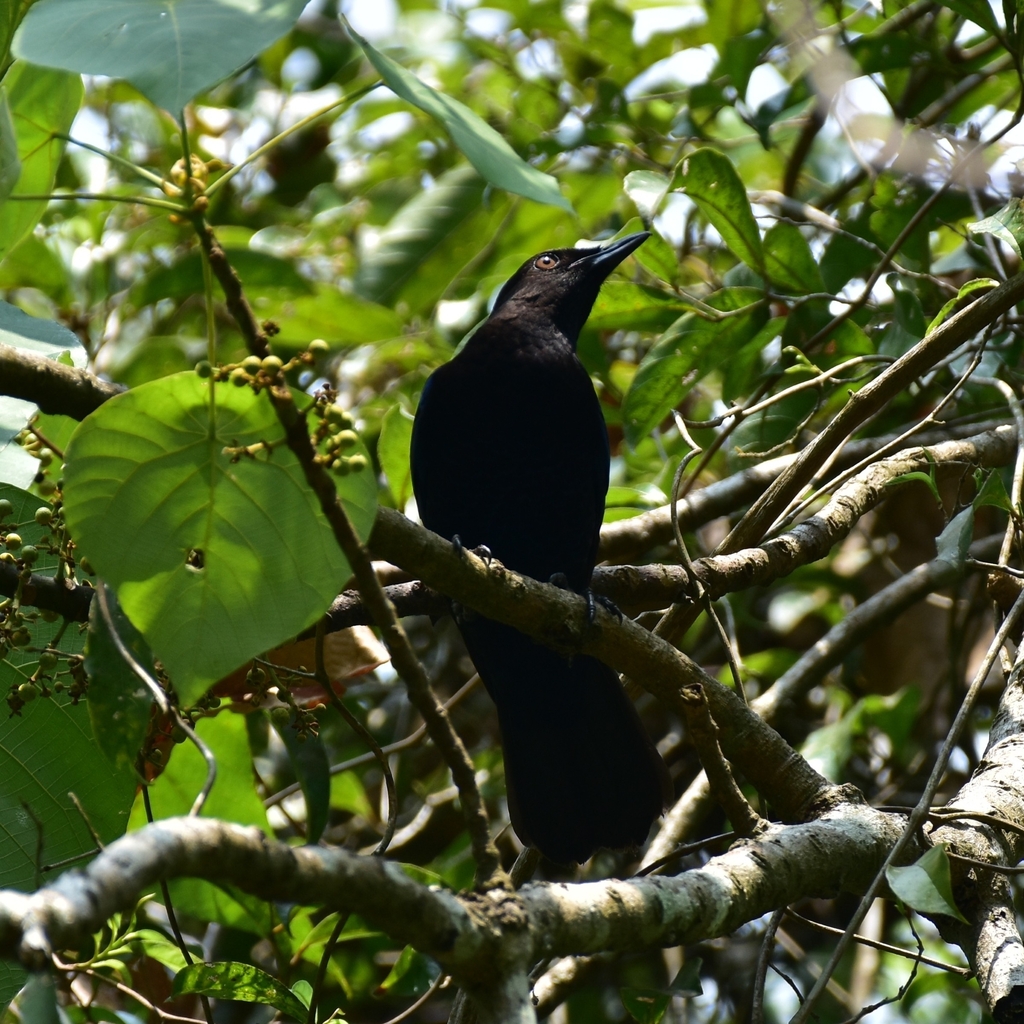
Asian Fairy-bluebird
Photo © Renjith Jacob Mathews
Photo © Renjith Jacob Mathews — CC BY 4.0 — Source: iNaturalist #209976986Identification
The Asian fairy-bluebird is a medium-sized, arboreal passerine measuring 24 to 27 centimetres in length. The species exhibits striking sexual dimorphism. Males are unmistakable: they display glossy, iridescent ultramarine-blue upperparts with lilac reflections, contrasting sharply with deep black underparts, flight feathers, and head sides. Some wing coverts and middle tail-feathers are tipped or glossed with blue. Females and first-year males are considerably duller, appearing entirely in brownish-blue tones with darker brown flight feathers and tail. Both sexes have a distinctive crimson iris, pinkish eyelids, and black bill and legs. Notably, young males acquire adult plumage in March without undergoing a complete moult, with feathers gradually becoming fringed in bright blue.
Range & Habitat
This tropical species is distributed across a vast range spanning southern Asia, Indochina, and the Greater Sundas. Its range extends from Sri Lanka and the western coast of India through the Himalayas and northeastern regions including Assam, across Bangladesh and Burma, and throughout most of Indochina, Peninsular Malaysia, Sumatra, Borneo, and Java, including the Andaman and Nicobar Islands. In India, it is confined to evergreen forests of hills and plains, while elsewhere it inhabits humid and deciduous forests from lowlands up to approximately 1,600 metres elevation. The species shows a preference for mature rainforests and cardamom plantations under native shade trees, being less frequent in coffee plantations.
Behaviour & Diet
The Asian fairy-bluebird is common throughout most of its range, typically moving about in small parties or pairs. It is an arboreal bird, generally found in larger forest trees. The species feeds principally on fruit, supplemented by nectar and some insects. Its distinctive call is a liquid two-note sound rendered as "glue-it." Breeding occurs from February to April, when pairs construct shallow, cup-shaped nests made variously of moss or small twigs in saplings or small trees. Clutches typically consist of two greenish-white eggs marked with brown.
Best Time & Places to See It
The breeding season from February to April offers the best opportunity to observe this species, as birds are actively nesting and more conspicuous. Travellers should visit mature rainforests and humid deciduous forests throughout its range, with particular success likely in cardamom plantations under native shade trees. The species is common in most suitable habitats across its distribution, making it a reliable sighting for those exploring tropical forests from India and Sri Lanka through Southeast Asia to the Greater Sundas.
Photography Tips
The brilliant iridescent blue plumage of males, particularly the ultramarine-blue with lilac reflections on upperparts, requires careful exposure metering to capture accurately without losing detail in the deep black underparts. Position yourself in mature forest canopy areas where these birds naturally forage. The contrast between male and female plumage makes photographing both sexes rewarding for documenting sexual dimorphism. Early morning light will best reveal the glossy, iridescent qualities of the male's blue plumage, while the bird's arboreal habits mean patience and a telephoto lens are essential for successful photography.
Orang National Park
Rangagarapathar, India
+298 birds+1 mammals
Where the Brahmaputra's floodplains meet the foothills of Assam, Orang National Park unfolds across a mosaic of riverine grasslands, forests and wetlands that pulse with the…
VIEW NATIONAL PARKEravikulam National Park
Devikulam, India
+192 birds+7 mammals
High in the Western Ghats of Kerala, where monsoon mists cling to slopes that rise above 2,000 metres, Eravikulam National Park preserves one of South India's…
VIEW NATIONAL PARKHat Noppharat Thara-Mu Ko Phi Phi National Park
Ao Nang, Thailand
+253 birds+9 mammals
Where limestone karsts rise dramatically from turquoise waters, Hat Noppharat Thara-Mu Ko Phi Phi National Park unfolds across a mosaic of beach, mangrove forest, and island…
VIEW NATIONAL PARKKhao Yai National Park
Prachantakham District, Thailand
+377 birds+46 mammals
Evergreen dipterocarp forest blankets the rolling terrain of this national park in eastern Thailand, where limestone hills rise abruptly from the forest floor and seasonal streams…
VIEW NATIONAL PARKKhao Laem Ya-Mu Ko Samet National Park
Mueang Rayong District, Thailand
+159 birds+3 mammals
Where limestone hills meet the Gulf of Thailand, Khao Laem Ya–Mu Ko Samet National Park stitches together a mosaic of terrestrial and marine worlds that few…
VIEW NATIONAL PARKKhao Laem National Park
Sangkhla Buri District, Thailand
+197 birds
Where the Vajiralongkorn Reservoir sprawls across the forested valleys of Kanchanaburi's northern borderlands, Khao Laem National Park protects a landscape where limestone ridges rise dramatically from…
VIEW NATIONAL PARKKaziranga National Park
Kohora, India
+422 birds+26 mammals
Dawn breaks over the floodplains of the Brahmaputra, where tall grasslands stretch endlessly beneath monsoon-heavy skies. This sprawling wilderness of northeastern Assam is a mosaic of…
VIEW NATIONAL PARKPeriyar National Park
Mlappara, India
+232 birds+4 mammals
Dawn breaks over mist-shrouded ridges where the Western Ghats tumble toward Kerala's spice-scented lowlands. Here, ancient tropical forests envelope a glittering artificial lake, creating a mosaic…
VIEW NATIONAL PARKPampadum Shola National Park
Vattavada, India
+258 birds+14 mammals
Where misty shola forests cling to the high plateaus of the Nilgiri Mountains, ancient evergreen remnants create a world apart. This 2,316-hectare reserve protects one of…
VIEW NATIONAL PARKBandipur National Park
Hirehalli, India
+302 birds+19 mammals
Where the Western Ghats descend into the Deccan plateau, ancient deciduous forests blanket a landscape carved by the Nugu River. Bandipur unfolds across 880 square kilometres…
VIEW NATIONAL PARKNagarahole Tiger Reserve
Nalkeri Forest, India
+323 birds+23 mammals
Where granite escarpments rise above dense deciduous forests and the Kabini River carves through pristine wilderness, one of India's most biodiverse landscapes unfolds across the Western…
VIEW NATIONAL PARKBako National Park
Kuching, Malaysia
+210 birds+17 mammals
Weathered sandstone cliffs rise dramatically from the South China Sea, their ochre faces sculpted by millennia of wind and tide into a landscape of extraordinary geological…
VIEW NATIONAL PARKTaman Negara National Park
Kampong Samas, Malaysia
+393 birds+48 mammals
Where ancient rainforest meets limestone peaks, one of Southeast Asia's oldest protected wilderness preserves sprawls across 4,343 square kilometers of primordial landscape. Dipterocarp giants tower overhead,…
VIEW NATIONAL PARKPenang National Park
Balik Pulau, Malaysia
+107 birds+2 mammals
Granite peaks rise abruptly from the Andaman Sea where tropical rainforest clings to steep slopes in one of Malaysia's oldest protected landscapes. Mangrove forests fringe the…
VIEW NATIONAL PARKTaman Negara Bukit Lambir National Park
Miri, Malaysia
+153 birds+7 mammals
Rainforest cascades down sandstone ridges where crystal streams carve through ancient geology, creating a landscape of profound biological richness in Sarawak's interior. This 68-square-kilometre sanctuary protects…
VIEW NATIONAL PARKGunung Mulu National Park
Long Seridan, Malaysia
+280 birds+39 mammals
Where granite monoliths pierce the rainforest canopy of Sarawak, an ancient limestone karst landscape reveals one of Southeast Asia's most biodiverse strongholds. Soaring peaks cloaked in…
VIEW NATIONAL PARKGaoligong Mountain National Nature Reserve
Nujiang Lisu Autonomous Prefecture, China
+443 birds+13 mammals
VIEW NATURE RESERVENo community photos yet. Log in to add the first one.
No community observations of this species yet.