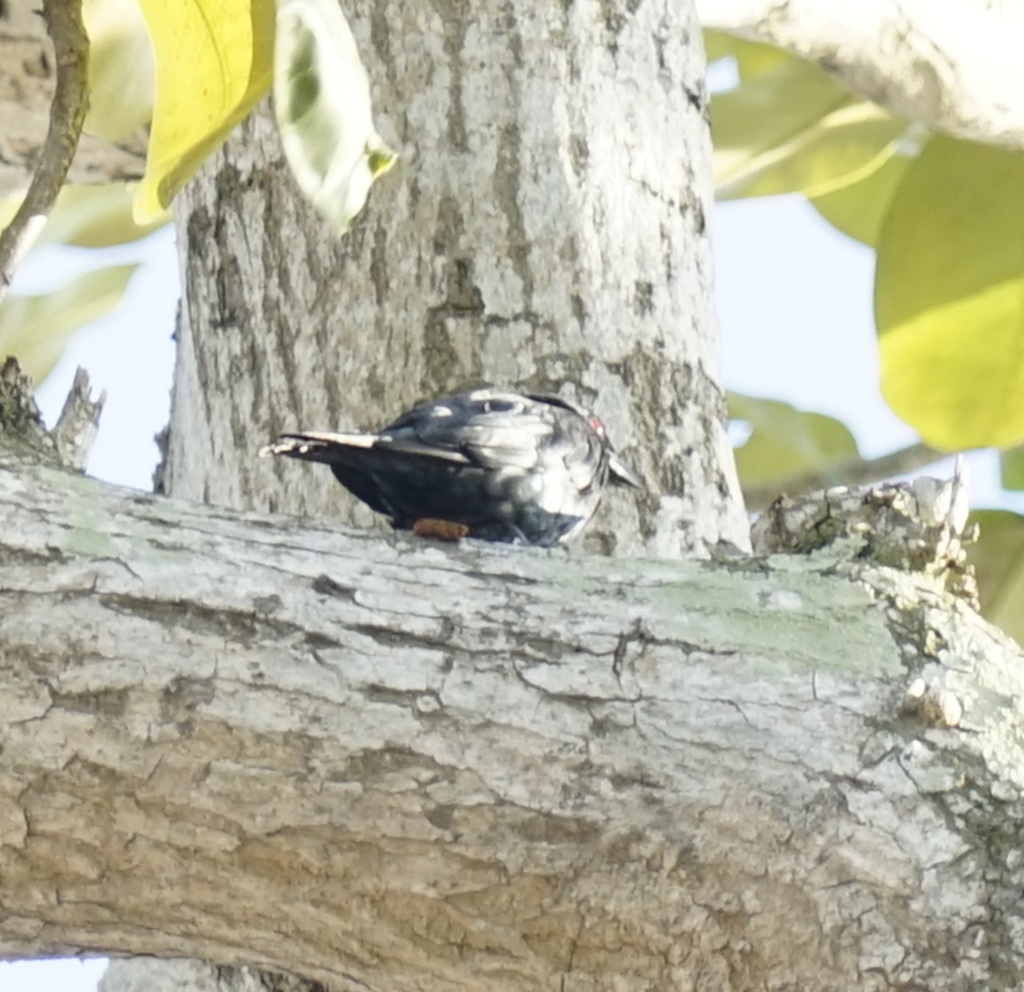
Asian Glossy Starling
Photo © Tim
Photo © Tim — CC BY 4.0 — Source: iNaturalist #36766986Identification
The Asian glossy starling is a sleek, medium-sized starling with distinctive plumage that lives up to its name. The bird displays glossy black or dark plumage across most of its body, giving it an elegant, iridescent appearance. Its most striking feature is a bright red eye-ring that stands out vividly against the dark head, making identification relatively straightforward in the field. This combination of glossy dark coloring and the conspicuous red orbital ring creates a striking visual contrast that is particularly noticeable when the bird is perched in good light.
Range & Habitat
The Asian glossy starling is widely distributed across South and Southeast Asia, with its range encompassing Bangladesh, Brunei, India, Indonesia, Malaysia, Myanmar, the Philippines, Singapore, Cambodia, and Thailand. The species has also been introduced to Taiwan. Its natural habitats include subtropical and tropical moist lowland forests, as well as subtropical and tropical mangrove forests, where it thrives in warm, humid environments.
However, the bird has successfully adapted to human-modified landscapes and is now incredibly abundant in towns and cities throughout its range. In urban and suburban areas, these starlings find refuge in abandoned buildings and trees, making them among the most visible and vocal birds in Asian cities. In the Philippines, where the species is particularly common, it is known by local names including kulansiyang, galansiyang, and kuling-dagat.
Behaviour & Diet
The Asian glossy starling is highly gregarious, often moving in large groups that can be quite conspicuous. These birds are exceptionally vocal and are considered one of the noisiest species of birds, producing loud and varied calls that make their presence known even before they are seen. Their gregarious nature and vocal behavior make them a notable and sometimes challenging presence in areas where they congregate in large numbers.
Best Time & Places to See It
The Asian glossy starling is common and widespread throughout its range, making it relatively easy to observe in suitable habitat. Look for flocks in towns and cities across South and Southeast Asia, where they are particularly abundant. Forest habitats—both lowland moist forests and mangrove forests—also support healthy populations. The bird's highly gregarious nature means that sightings often involve multiple individuals, sometimes in large, noisy flocks.
Photography Tips
The glossy black plumage and bright red eye-ring provide excellent subject contrast for photography. The bird's habit of perching openly in trees and on buildings offers good opportunities for portraiture. Capture images in bright conditions to showcase the iridescence of the plumage and to make the red eye-ring stand out clearly. Flocking behavior offers chances for dynamic group compositions, particularly in urban settings where roosting birds gather in trees at dawn and dusk.
Mu Ko Ang Thong National Park
Thailand
+47 birds+1 mammals
Forty-two limestone islands rise from the Gulf of Thailand, their weathered karst peaks piercing emerald waters in a landscape of stunning geological drama. Mu Ko Ang…
VIEW NATIONAL PARKHat Noppharat Thara-Mu Ko Phi Phi National Park
Ao Nang, Thailand
+253 birds+9 mammals
Where limestone karsts rise dramatically from turquoise waters, Hat Noppharat Thara-Mu Ko Phi Phi National Park unfolds across a mosaic of beach, mangrove forest, and island…
VIEW NATIONAL PARKBako National Park
Kuching, Malaysia
+210 birds+17 mammals
Weathered sandstone cliffs rise dramatically from the South China Sea, their ochre faces sculpted by millennia of wind and tide into a landscape of extraordinary geological…
VIEW NATIONAL PARKKuching Wetlands National Park
Kuching, Malaysia
+103 birds+4 mammals
Where brackish waters meet mangrove stilts and freshwater swamps blend into coastal mudflats, one of Southeast Asia's most dynamic wetland ecosystems unfolds across Sarawak's northwestern coast.…
VIEW NATIONAL PARKTaman Negara National Park
Kampong Samas, Malaysia
+393 birds+48 mammals
Where ancient rainforest meets limestone peaks, one of Southeast Asia's oldest protected wilderness preserves sprawls across 4,343 square kilometers of primordial landscape. Dipterocarp giants tower overhead,…
VIEW NATIONAL PARKPenang National Park
Balik Pulau, Malaysia
+107 birds+2 mammals
Granite peaks rise abruptly from the Andaman Sea where tropical rainforest clings to steep slopes in one of Malaysia's oldest protected landscapes. Mangrove forests fringe the…
VIEW NATIONAL PARKTaman Negara Bukit Lambir National Park
Miri, Malaysia
+153 birds+7 mammals
Rainforest cascades down sandstone ridges where crystal streams carve through ancient geology, creating a landscape of profound biological richness in Sarawak's interior. This 68-square-kilometre sanctuary protects…
VIEW NATIONAL PARKGunung Mulu National Park
Long Seridan, Malaysia
+280 birds+39 mammals
Where granite monoliths pierce the rainforest canopy of Sarawak, an ancient limestone karst landscape reveals one of Southeast Asia's most biodiverse strongholds. Soaring peaks cloaked in…
VIEW NATIONAL PARKTaman Nasional Baluran
Situbondo, Indonesia
+189 birds+9 mammals
Across the northeastern tip of East Java, where monsoon winds sweep down from the Bali Strait, a landscape of contrasts unfolds within 374 square kilometres of…
VIEW NATIONAL PARKWest Bali National Park
Gerokgak, Indonesia
+240 birds+8 mammals
Across West Bali's northwestern reaches, where the Indian Ocean meets volcanic slopes and limestone cliffs plunge toward turquoise shallows, sprawls a protected realm of roughly 325…
VIEW NATIONAL PARKMount Merapi National Park
Hargobinangun, Indonesia
+150 birds+3 mammals
Where the volcanic slopes of central Java rise into mist and montane forest, Mount Merapi National Park guards one of Indonesia's most dynamic landscapes. Spanning roughly…
VIEW NATIONAL PARKLore Lindu National Park
Indonesia
+177 birds+4 mammals
Across the mountainous spine of Central Sulawesi spreads a wilderness of montane forest, rolling ridges, and deep valleys that rises from the island's volcanic bedrock to…
VIEW NATIONAL PARKNo community photos yet. Log in to add the first one.
No community observations of this species yet.