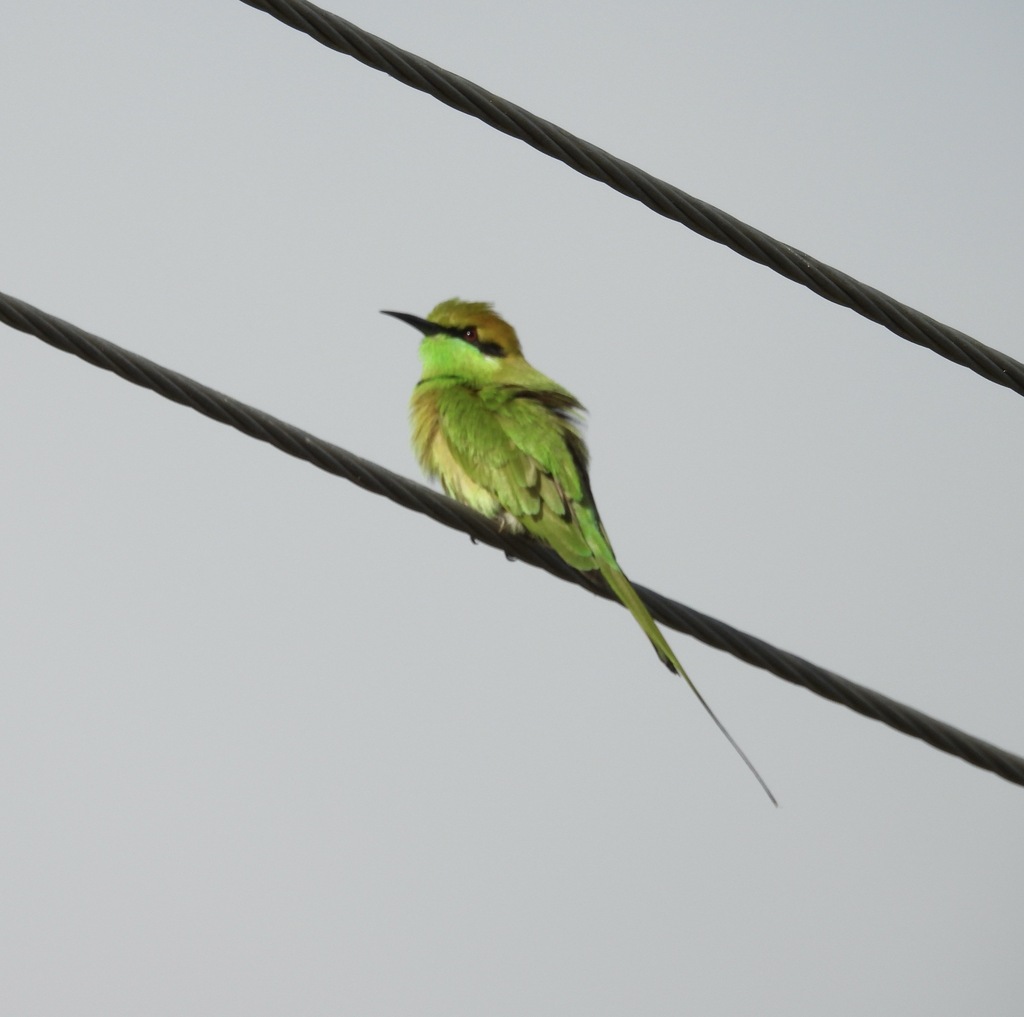
Asian Green Bee-eater
Photo © Ram Dayal Vaishnav
Photo © Ram Dayal Vaishnav — CC BY 4.0 — Source: iNaturalist #247282998Identification
The Asian green bee-eater is a small, elegant bird measuring 16–18 centimetres in length, with elongated central tail-feathers adding an extra 7 centimetres. Like all bee-eaters, it is slender and richly coloured. The entire plumage is bright green, tinged with blue on the chin and throat, while the crown and upper back show golden rufous tones. In flight, the wings display bronzed coppery-green above and coppery-orange below. A distinctive fine black eyestripe runs in front of and behind the eye, and a slender black crescent marks the top of the breast. The iris is striking crimson, the bill is black, and the legs are dark grey. Regional variations exist: southeast Asian birds have a more rufous crown and face with green underparts, while western subspecies show a greener crown, bluer face, and bluish underparts. Juveniles are noticeably paler and duller, lacking the elongated tail feathers, throat crescent, and having yellow-tinged rather than blue-toned throats. The sexes are alike in appearance. In flight, listen for the characteristic nasal trill call: tree-tree-tree-tree, usually given while airborne.
Range & Habitat
The Asian green bee-eater is widely distributed across Asia, ranging from coastal southern Iran eastward through the Indian subcontinent to Vietnam. It is an abundant and fairly tame bird, familiar throughout its range. The species breeds in open country with bushes and grassland, as well as thin scrub and forest, often far from water—a characteristic that distinguishes it from many other bee-eater species. It favours low perches for hunting, sometimes only a metre or less high, and readily makes use of fence wires and electric wires. While mostly seen in the plains, populations can sometimes reach elevations up to 2,000 metres in the Himalayas. Resident in the lowlands of South Asia, some populations make seasonal movements in response to rainfall, moving to drier regions during the rainy season and to warmer regions in winter; in parts of Pakistan, they are summer visitors.
Behaviour & Diet
Like other bee-eaters, this species predominantly feeds on flying insects, especially bees, wasps, and ants, which it catches in the air from open perches. Before swallowing, it removes stings and breaks down the exoskeleton by repeatedly thrashing prey on its perch. The species makes seasonal movements in response to rainfall patterns. These birds are notably sluggish in the mornings and may be found huddled together on wires well after sunrise. They sand-bathe more frequently than other bee-eater species and occasionally bathe in water by dipping in flight. Usually seen in small groups, they often roost communally in large numbers of 200–300 birds, moving excitedly at roost sites and calling loudly before explosively dispersing. Increasingly common in urban and suburban neighbourhoods, they have been observed perching on television antennae, launching into brief zig-zag flights to catch insects between 7:00–8:00 a.m. and after 4:00 p.m. The breeding season runs from March to June. Unlike many bee-eaters, they are often solitary nesters, constructing tunnels up to 1.5 metres long in sandy banks. Clutches of 3–5 glossy white, spherical eggs are laid in cavities at tunnel ends, with both sexes incubating over approximately 14 days. Chicks fledge in 3 to 4 weeks. Studies suggest the species may be capable of interpreting human observer behaviour and predicting whether a human could spot the nest entrance.
Best Time & Places to See It
The Asian green bee-eater can be observed year-round across its Asian range, though timing depends on local population movements. In parts of Pakistan, focus on summer months when they arrive as seasonal visitors. Riverside habitats in southern India support particularly high populations. The species is abundant and fairly tame, making it relatively easy to locate. Early mornings between 7:00–8:00 a.m. and late afternoons after 4:00 p.m. are optimal viewing times, especially in urban and suburban areas where birds hunt from perches like wires and antennae. Look for birds in open grassland, scrub, and agricultural areas, as well as near human habitations. The plains offer the best viewing opportunities, though montane regions up to 2,000 metres in the Himalayas occasionally host populations.
Photography Tips
Photograph the Asian green bee-eater from low angles to capture the iridescent green plumage and the distinctive black eyestripe and throat crescent. The bird's habit of hunting from low, exposed perches—fences, wires, and low branches—provides excellent opportunities for clean, unobstructed shots. Early morning and late afternoon light will best showcase the bright greens and blue tones of the plumage and the striking crimson iris. Action shots of the characteristic zig-zag flight pattern used to snatch insects are rewarding but require a fast shutter speed. Communal roosting behaviour offers chances to photograph multiple birds, and their sluggish morning behaviour provides a window for closer approach before they become more active. The elongated tail feathers and coppery-orange underwing colours are particularly photogenic in flight, so be ready for quick captures as birds launch from their perches.
Lunugamvehera National Park
Sri Lanka
+204 birds+14 mammals
Dry scrubland and shallow wetlands converge in Sri Lanka's southeastern lowlands, where Lunugamvehera National Park anchors one of the island's most ecologically vital landscapes. The park's…
VIEW NATIONAL PARKWasgamuwa National Park
Sri Lanka
+156 birds+8 mammals
Dry deciduous forest and open grassland sweep across the North Central lowlands where Wasgamuwa National Park protects one of Sri Lanka's largest remaining tracts of this…
VIEW NATIONAL PARKAngamedilla National Park
Polonnaruwa, Sri Lanka
+40 birds+2 mammals
Ancient tanks and sal forests define this water-rich sanctuary in Sri Lanka's North Central heartland, where seasonal wetlands and dry deciduous woodland create a mosaic of…
VIEW NATIONAL PARKOrang National Park
Rangagarapathar, India
+298 birds+1 mammals
Where the Brahmaputra's floodplains meet the foothills of Assam, Orang National Park unfolds across a mosaic of riverine grasslands, forests and wetlands that pulse with the…
VIEW NATIONAL PARKIndravati National Park
Bijapur, India
+41 birds
Where the Indravati River cuts through the elevated plateaus of central India, a landscape of deciduous forest and open woodland unfolds across Bijapur district in Chhattisgarh.…
VIEW NATIONAL PARKEravikulam National Park
Devikulam, India
+192 birds+7 mammals
High in the Western Ghats of Kerala, where monsoon mists cling to slopes that rise above 2,000 metres, Eravikulam National Park preserves one of South India's…
VIEW NATIONAL PARKKhao Yai National Park
Prachantakham District, Thailand
+377 birds+46 mammals
Evergreen dipterocarp forest blankets the rolling terrain of this national park in eastern Thailand, where limestone hills rise abruptly from the forest floor and seasonal streams…
VIEW NATIONAL PARKKhao Laem Ya-Mu Ko Samet National Park
Mueang Rayong District, Thailand
+159 birds+3 mammals
Where limestone hills meet the Gulf of Thailand, Khao Laem Ya–Mu Ko Samet National Park stitches together a mosaic of terrestrial and marine worlds that few…
VIEW NATIONAL PARKKhao Laem National Park
Sangkhla Buri District, Thailand
+197 birds
Where the Vajiralongkorn Reservoir sprawls across the forested valleys of Kanchanaburi's northern borderlands, Khao Laem National Park protects a landscape where limestone ridges rise dramatically from…
VIEW NATIONAL PARKKanha Tiger Reserve
Kanha Kisli F.V., India
+321 birds+23 mammals
Where sal forests give way to emerald meadows and crystalline streams carve through ancient valleys, one of India's finest wilderness reserves unfolds across the Maikal Range.…
VIEW NATIONAL PARKTadoba National Park
Palasgaon Singru, India
+270 birds+20 mammals
Where sal forests meet open grasslands and rocky outcrops rise from red laterite soil, central India's landscape unfolds in raw, untamed beauty. Ancient teak woodlands and…
VIEW NATIONAL PARKBandhavgarh National Park
Garhpuri, India
+285 birds+17 mammals
Where granite ridges rise dramatically above sal and bamboo forests, one of India's most pristine tiger reserves unfolds across the Vindhyan plateau. Ancient rock formations tower…
VIEW NATIONAL PARKPanna National Park
Badgadi Kalan, India
+271 birds+17 mammals
Where granite gorges slice through central India's Vindhyan plateau, a landscape of stark beauty unfolds across nearly six hundred square kilometers. The Ken River carves through…
VIEW NATIONAL PARKKaziranga National Park
Kohora, India
+422 birds+26 mammals
Dawn breaks over the floodplains of the Brahmaputra, where tall grasslands stretch endlessly beneath monsoon-heavy skies. This sprawling wilderness of northeastern Assam is a mosaic of…
VIEW NATIONAL PARKPeriyar National Park
Mlappara, India
+232 birds+4 mammals
Dawn breaks over mist-shrouded ridges where the Western Ghats tumble toward Kerala's spice-scented lowlands. Here, ancient tropical forests envelope a glittering artificial lake, creating a mosaic…
VIEW NATIONAL PARKPampadum Shola National Park
Vattavada, India
+258 birds+14 mammals
Where misty shola forests cling to the high plateaus of the Nilgiri Mountains, ancient evergreen remnants create a world apart. This 2,316-hectare reserve protects one of…
VIEW NATIONAL PARKBandipur National Park
Hirehalli, India
+302 birds+19 mammals
Where the Western Ghats descend into the Deccan plateau, ancient deciduous forests blanket a landscape carved by the Nugu River. Bandipur unfolds across 880 square kilometres…
VIEW NATIONAL PARKGir National Park
Asundrali, India
+258 birds+13 mammals
Dry deciduous forests cloak the rolling hills of western Gujarat where the Gir landscape rises as a final sanctuary for one of the world's rarest felids:…
VIEW NATIONAL PARKGaoligong Mountain National Nature Reserve
Nujiang Lisu Autonomous Prefecture, China
+443 birds+13 mammals
VIEW NATURE RESERVENo community photos yet. Log in to add the first one.
No community observations of this species yet.