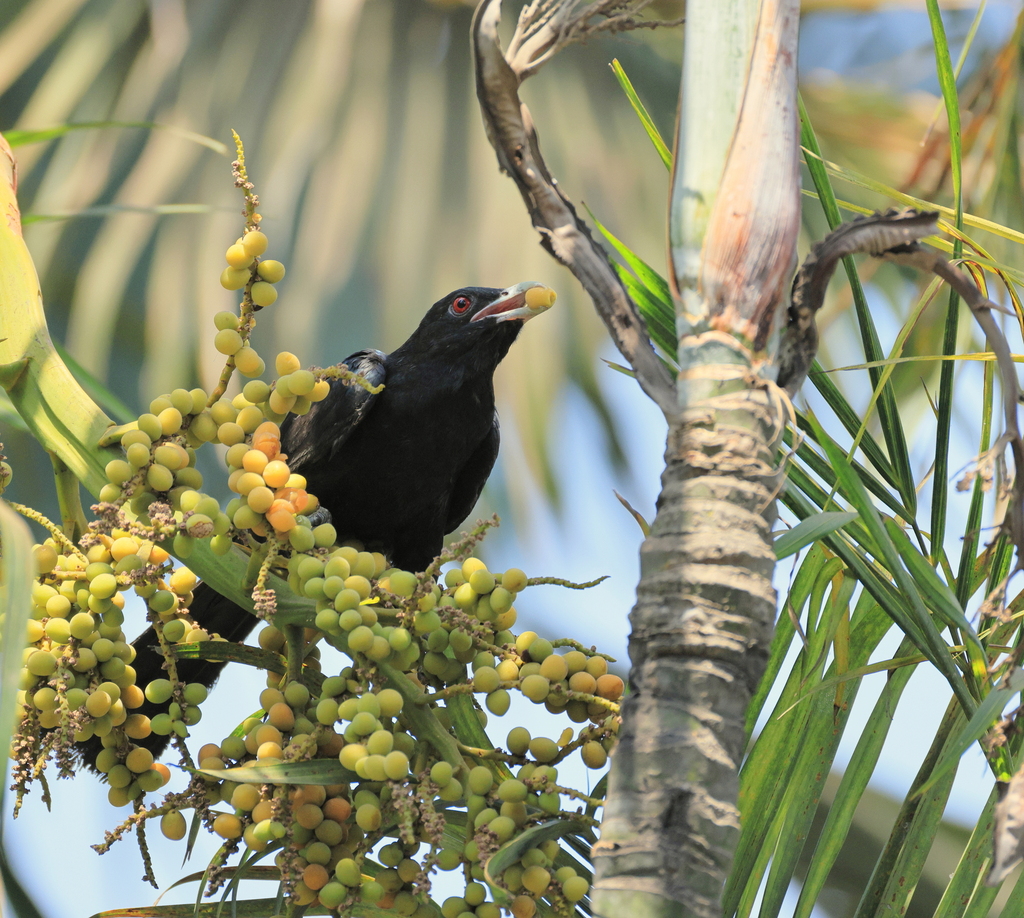
Asian Koel
Photo © Darren Obbard
Photo © Darren Obbard — CC BY 4.0 — Source: iNaturalist photo #630446627Identification
The Asian koel is a large, long-tailed cuckoo measuring 39–46 cm in length and weighing 190–327 grams. Males of the nominate race are strikingly glossy bluish-black with a pale greenish-grey bill, crimson iris, and grey legs. Females present quite differently, displaying brownish crowns with rufous streaks on the head, dark brown backs with white and buff spotting, and heavily striped whitish underparts. Young birds resemble males in their upper plumage but sport black beaks. The species shows considerable plumage variation across its wide geographic range, with several distinct subspecies displaying marked differences in colouration and size.
Range & Habitat
The Asian koel inhabits light woodland and cultivation across tropical southern Asia, from Iran, Pakistan, and India through Bangladesh and Sri Lanka to southern China and the Greater Sundas. It is primarily a resident breeder throughout this vast range, though some populations undertake long-distance movements and have been recorded as far as Australia. The species demonstrates remarkable colonizing ability; koels were among the pioneer birds to settle the volcanic island of Krakatau following its eruption, and they first arrived in Singapore during the 1980s, where they subsequently became very common.
Behaviour & Diet
Like many of its cuckoo relatives, the Asian koel is a brood parasite, laying single eggs in the nests of various host species. Jungle crows and house crows are primary hosts across much of its range, though the species has shown remarkable flexibility in shifting to alternative hosts—notably long-tailed shrikes, common mynas, and other crow species depending on availability and local conditions. In some regions, koels have entirely switched from crow hosts to mynas as the latter became more prevalent.
Unusually among cuckoos, Asian koels are largely frugivorous as adults, supplementing their diet with fruit rather than relying solely on insects. They are highly vocal during the breeding season from March to August in the Indian Subcontinent, with males producing a distinctive repeated "koo-Ooo" song and females uttering sharp "kik-kik-kik" calls. Vocalizations vary across different populations.
Best Time & Places to See It
The breeding season from March to August offers the best opportunity to locate Asian koels, when their vocal activity peaks dramatically. Light woodland and cultivated areas throughout the Indian subcontinent, southern China, Southeast Asia, and the Greater Sundas are prime habitats. Singapore and other urban areas where the species has recently established itself provide accessible viewing opportunities, particularly where fruiting trees attract these largely fruit-eating cuckoos.
Photography Tips
Photograph males in good light to capture the glossy bluish-black plumage and striking crimson iris that characterize this species. Females present a different photographic challenge—focus on recording the contrasting rufous head streaks and white spotting on dark brown upperparts. The bird's long tail is a distinctive feature worth including in composition. During the breeding season, when birds are most vocal and active, early morning sessions in light woodland habitat will yield the best opportunities for approaching these birds. Patience is rewarded; wait near fruiting trees where koels gather to feed, offering excellent chances for natural behaviour photography.
Kanha Tiger Reserve
Minneriya National Park
Aketajawe Lolobata National Park
Bandhavgarh National Park
Bandipur National Park
Banke National Park
Bardiya National Park
Chitwan National Park
Doi Inthanon National Park
Nothing matches these filters.
No community photos yet. Log in to add the first one.
No community observations of this species yet.