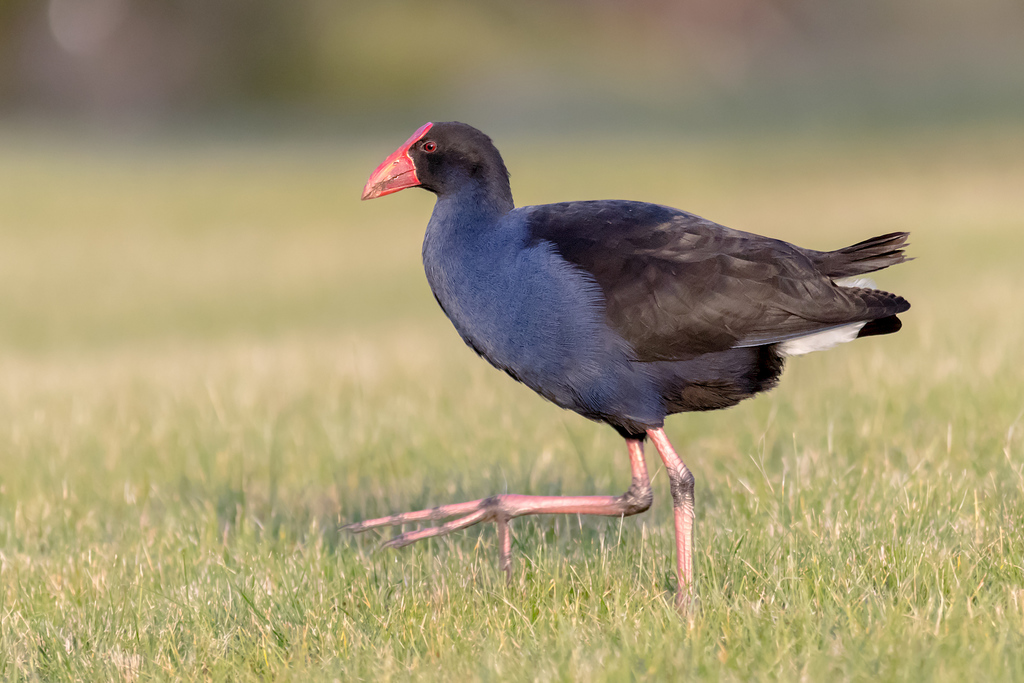
Australasian Swamphen
Photo © Andrew Allen
Photo © Andrew Allen — CC BY 4.0 — Source: iNaturalist photo #147232760Identification
The Australasian Swamphen is a striking, long-legged rail standing about 51 cm tall. Its most distinctive features are its brilliant blue-purple plumage on the throat and breast, contrasting sharply with black upper-parts and a white undertail. The bird displays a large, bright red bill and an expanded frontal shield that extends prominently from the head, along with equally striking red legs. Within the five recognised subspecies, plumage variations occur—some populations show greener or bluer upper-parts and slightly smaller body sizes—though New Zealand birds are considered among the largest.
Range & Habitat
This species is distributed across Oceania, occurring in mainland Australia, eastern Indonesia (including the Moluccas, Aru, and Kai Islands), Papua New Guinea, and throughout New Zealand including the Chatham and Kermadec Islands. Remarkably, the species only colonised New Zealand approximately 500 years ago following Polynesian settlement. Australasian Swamphens favour swamps, marshes, and wet lowland areas, but have proven highly adaptable to landscape changes, now thriving in pastures, roadside verges, and farmland across human-modified environments.
Behaviour & Diet
This communal gallinule exhibits complex social behaviour, typically breeding in groups of three to nine individuals rather than pairs. Both males and females contribute to territory defence, nesting, and chick-rearing duties. A linear dominance hierarchy operates within these groups, reinforced by physical traits such as frontal shield size, which signals social rank. Their diet reflects their opportunistic nature: primarily plant material including grass stems, shoots, and leaves, supplemented by invertebrates and occasionally young of other bird species.
Best Time & Places to See It
Australasian Swamphens are year-round residents throughout their range. Seek them in wetland habitats—swamps and marshes—but also check farmland, pastures, and roadside verges where habitat conversion has created new opportunities. Their adaptability means sightings are possible in both pristine natural wetlands and heavily modified agricultural landscapes. New Zealand populations, being among the most accessible and largest subspecies, offer excellent viewing opportunities on the North and South Islands.
Photography Tips
The bird's vibrant plumage and bold colour contrasts—red bill and legs against blue-purple and black—demand fast shutter speeds to freeze movement in wetland settings where light can be challenging. Position yourself with the sun behind or to the side to emphasise the iridescent quality of the throat and breast. The distinctive frontal shield and elongated bill are key identification features worth capturing in profile. Early morning in marshland habitats typically offers the best light and activity levels for photography.
Abel Tasman National Park
Aoraki / Mount Cook National Park
Arthur’s Pass National Park
Barrington Tops National Park
Belair National Park
Ben Boyd National Park
Blue Mountains National Park
Bogani Nani Wartabone National Park
Boodjamulla National Park
Nothing matches these filters.
No community photos yet. Log in to add the first one.
No community observations of this species yet.