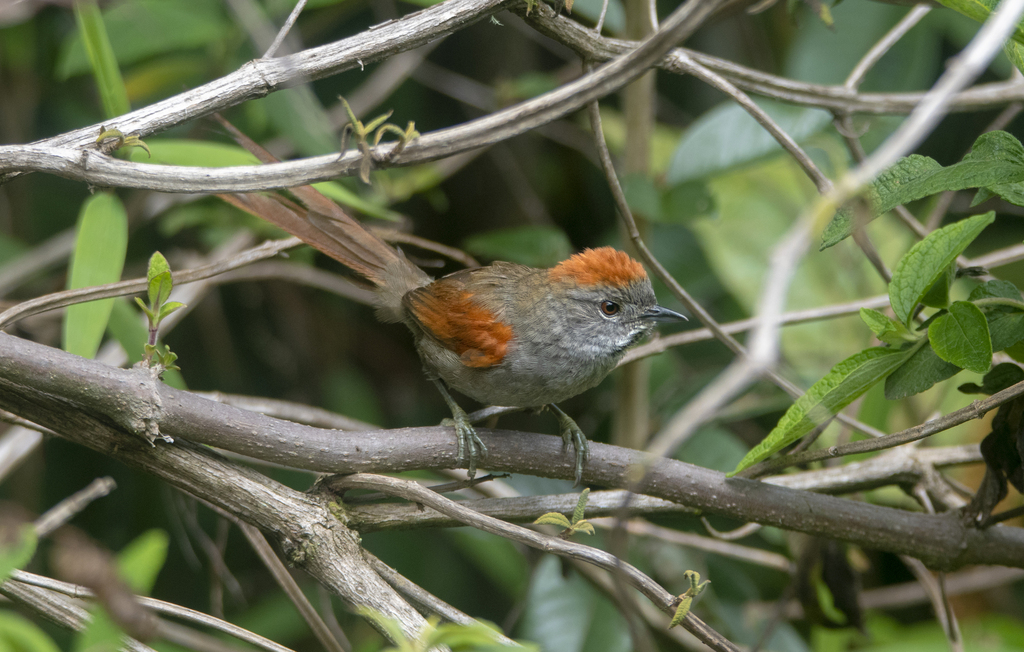
Azara’s Spinetail
Photo © David F. Belmonte
Photo © David F. Belmonte — CC BY 4.0 — Source: iNaturalist photo #258399174Identification
Azara's Spinetail is a small ovenbird measuring 15–18 cm in length, with subtle plumage variations across its nine subspecies. The nominate subspecies features a brownish-gray face with a slightly paler supercilium, dark grayish-brown forehead, and distinctive dark rufous hindcrown and nape. The back, rump, and uppertail coverts are rich olive-brown, while the wings display mostly rufous-chestnut plumage with darker tips on the flight feathers. The tail is dull chestnut-brown with characteristic pointed feather tips. The throat exhibits striking contrast: pale grayish edges with a sooty-black center, while the breast is dark brownish-gray and the belly paler and grayer. The bird's reddish-brown iris and graduated tail are useful field marks. Other subspecies range from considerably paler (such as S. a. ochracea and S. a. superciliosa) to darker versions, with variations in supercilium prominence, facial markings, and underpart coloration.
Range & Habitat
This species is a year-round resident found across the Andes from Venezuela and Colombia south through Ecuador, Peru, and Bolivia to northwestern Argentina. Nine subspecies occupy different elevational zones and geographic regions, allowing birders to encounter different populations depending on their location. Azara's Spinetail shows a strong preference for semi-open montane habitats, frequenting forest edges, secondary growth, cloudforest borders, bushy pastures, riparian thickets, and semi-deciduous woodlands. It typically occurs between 1,500–3,500 m elevation across most of its range, though in Bolivia and Argentina it descends to 600–1,600 m, and locally in Ecuador and Colombia to 900–1,200 m. The species remains close to dense vegetation near ground level, making it a resident of scrubby and brushy areas rather than open terrain.
Behaviour & Diet
Azara's Spinetail is an active forager specializing in arthropods, supplementing its diet with small seeds. It typically hunts in pairs and frequently joins mixed-species feeding flocks, gleaning prey deliberately from foliage, small branches, and dead leaves. Unusually for a species that generally stays below 2 meters, it has been recorded feeding as high as 6 meters above ground. The species is monogamous and has a prolonged breeding season spanning wet and dry months, with some populations potentially breeding year-round. Its distinctive nest is a longish mass of sticks with a horizontal or upward-facing entrance tube, lined with soft plant material and sometimes incorporating shed snake skin—a characteristic trait of the ovenbird family. Nests are placed low in dense vegetation, and clutches typically contain two to four eggs.
Best Time & Places to See It
As a year-round resident throughout its range, Azara's Spinetail can be encountered in any season, though breeding activity is most evident between February and September depending on location. Fledglings have been documented from May to September across its range. The species is most readily observed in montane regions with suitable habitat: birders should focus on forest edges, secondary growth, riparian corridors, and bushy pastures at appropriate elevations. In the Andes of Colombia and Ecuador, look between 1,200–3,500 m; in Peru and Bolivia, search between 600–3,500 m depending on subspecies; and in Argentina, focus on elevations between 600–1,600 m in Jujuy and Catamarca provinces. Patient observation near dense vegetation where pairs forage together will improve your chances of sightings.
Photography Tips
Photographing Azara's Spinetail requires patience and attention to its low-elevation foraging behavior. Position yourself near dense brush and riparian vegetation where the species typically hunts, using a slow shutter speed and steady tracking as birds move deliberately through foliage. Early morning light often provides the best conditions for capturing the subtle plumage details—particularly the rufous-chestnut wings and distinctive throat pattern. Since the species usually remains below 2 meters, shooting from a lower angle can help isolate birds against the sky. The graduated tail with pointed feather tips makes an excellent identifying feature worth capturing. Mixed-species feeding flocks offer opportunities for multiple exposures; position yourself downwind of active flocks and wait for birds to approach. Given the bird's preference for dense vegetation, a 300–400mm lens with fast autofocus will help you track movement through foliage while maintaining sufficient reach and shutter speed for sharp images.
Antisana National Park
Baritú National Park
Cajas National Park
Calilegua National Park
Cerros de Amotape National Park
Cotopaxi National Park
El Rey National Park
El Tamá National Park
Guácharos Cave National Natural Park
Nothing matches these filters.
No community photos yet. Log in to add the first one.
No community observations of this species yet.