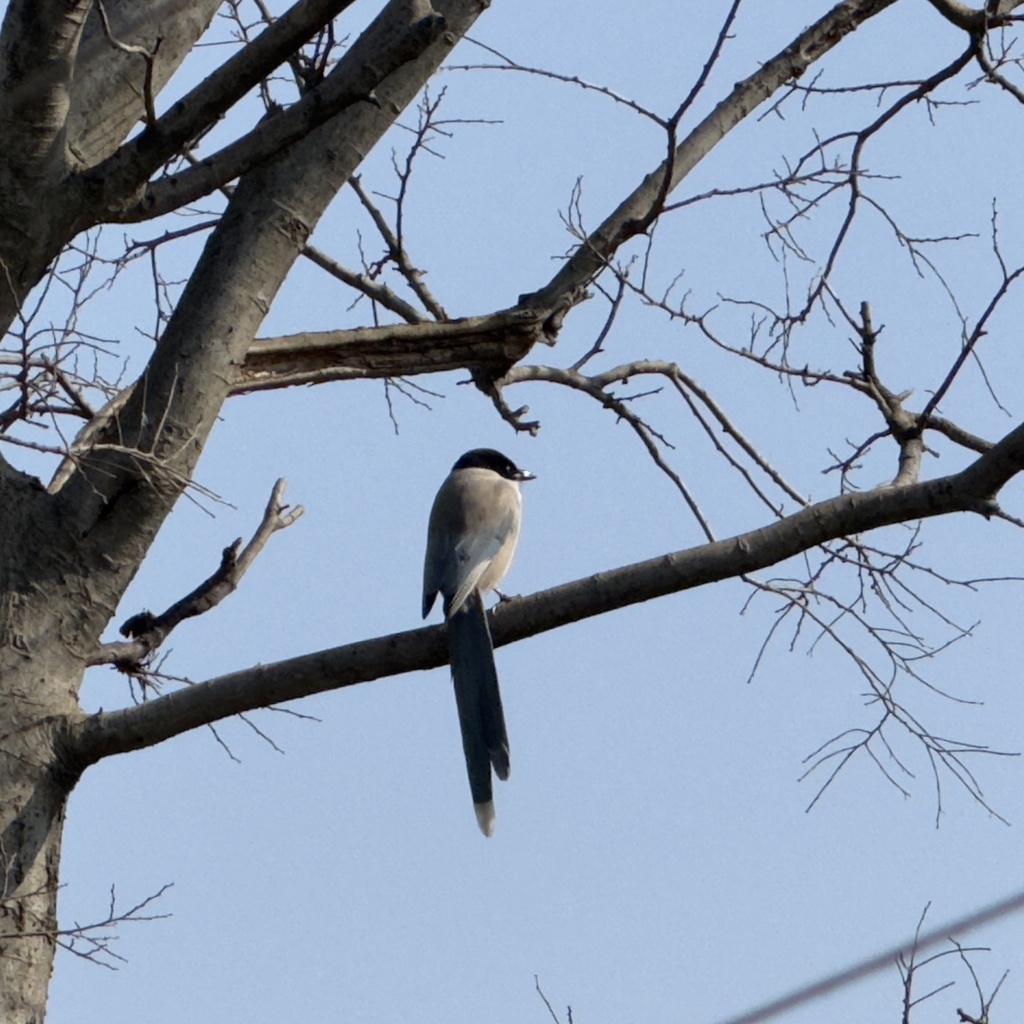
Azure-winged Magpie
Photo © RX ZHANG
Photo © RX ZHANG — CC BY 4.0 — Source: iNaturalist #194339836Identification
The azure-winged magpie is a striking member of the crow family, measuring 31–35 cm in length. While similar in overall shape to the Eurasian magpie, it is noticeably more slender with proportionately smaller legs and bill. The most distinctive features are its glossy black crown, white throat, and light grey-fawn underparts and back. The wings and long tail (16–20 cm) are a brilliant azure blue, making this species unmistakable when in flight or perched in good light.
Range & Habitat
The azure-winged magpie is distributed across a large region of eastern Asia, occurring in China, Korea, Japan, Mongolia, and southern Siberia. The species inhabits various types of coniferous forests—particularly pine woods—as well as broadleaf forests. In eastern populations, it has readily adapted to parks and gardens, making it accessible to observers in both wild and human-modified landscapes.
It is worth noting that a superficially similar magpie from southwestern and central Iberia in Spain and Portugal was once thought to be the same species but has been shown through genetic analysis to be distinct. The Iberian bird's white-tipped tail is a prominent visual difference.
Behaviour & Diet
Azure-winged magpies are highly social birds, typically foraging as family groups or joining flocks of up to 70 individuals. The largest congregations occur after breeding season and throughout winter. Their diet is varied and opportunistic: they feed mainly on acorns and pine nuts, but extensively supplement this with invertebrates and their larvae, soft fruits, berries, and—in parks and towns—human-provided scraps.
The species nests in loose, open colonies with typically one nest per tree. Clutches usually contain 6–8 eggs, which are incubated for 15 days. Interestingly, nests with asynchronous broods—where eggs hatch at different times—produce more eggs and successfully fledge more nestlings than those with synchronous broods. The azure-winged magpie's voice is distinctive: a quick, metallic kwink-kwink-kwink call, usually preceded by a single krarrah.
Best Time & Places to See It
The largest and most conspicuous flocks occur after the breeding season and throughout the winter months, making these periods ideal for observing the species. Look for them in coniferous and broadleaf forests across eastern Asia, particularly in China, Japan, Korea, Mongolia, and southern Siberia. In areas with parks and gardens, azure-winged magpies are often remarkably approachable, especially where they have become accustomed to human presence.
Photography Tips
The azure-winged magpie's brilliant blue wings and tail are best captured in bright, direct light. The contrast between the glossy black crown, white throat, and azure plumage provides excellent opportunities for striking portraits. When photographing flocking birds, patient positioning near feeding sites—particularly oak and pine areas in autumn and winter—increases your chances of capturing dynamic group behaviour. The bird's smaller size relative to the Eurasian magpie and its more slender proportions should be kept in mind when composing shots.
Monfragüe National Park
Torrejón el Rubio, Spain
+219 birds+10 mammals
Where the Tagus River cuts through limestone plateaus in central Extremadura, Monfragüe National Park rises as a fortress of Mediterranean and Atlantic woodland, its dramatic rocky…
VIEW NATIONAL PARKSierra de Guadarrama National Park
Rascafría, Spain
+179 birds+13 mammals
Where granite peaks rise abruptly from the central Spanish plateau, the Sierra de Guadarrama National Park unfolds across more than eleven hundred square kilometres of montane…
VIEW NATIONAL PARKSierra de Andújar Natural Park
Our Lady of Cabeza, Spain
+198 birds+19 mammals
Where granite gorges slice through Mediterranean scrubland and cork forests cascade down Andalusian hillsides, one of Spain's most pristine wilderness areas unfolds across 74,000 hectares of…
VIEW NATURAL PARKSierra de Gredos Regional Park
Candeleda, Spain
+180 birds+18 mammals
Where granite peaks claw at 2,592 metres and alpine meadows give way to cork oak scrubland, Spain's central highlands reveal a landscape of remarkable vertical drama.…
VIEW NATURE RESERVEBaikal National Park
Ольхонский район, Russia
+184 birds+11 mammals
Where the world's deepest freshwater lake meets ancient Siberian taiga, Baikal National Park sprawls across 66,203 square kilometers of one of Earth's most singular ecosystems. The…
VIEW NATIONAL PARKWulingyuan
Jundiping, China
+97 birds+3 mammals
Sandstone peaks erupting from forested valleys define this sprawling 993-square-kilometre national park in Hunan Province, where vertical cliffs rise dramatically above lush subtropical woodland. The landscape—a…
VIEW NATURAL MONUMENTGiant Panda National Park
Mianyang, China
+447 birds+47 mammals
Where the eastern slopes of China's Sichuan plateau descend into cloud-wrapped valleys, one of Asia's most biodiverse landscapes unfolds across more than 350,000 square kilometres. This…
VIEW NATIONAL PARKJiuzhai Valley
Jiuzhaigou County, China
+226 birds+7 mammals
Where crystalline alpine streams cascade through limestone gorges and karst terrain rises in dramatic vertical walls, Jiuzhai Valley unfolds across nearly 1,300 square kilometers of southwestern…
VIEW NATURAL MONUMENTLand of the Leopard National Park
Khasansky District, Russia
+83 birds+11 mammals
Where coniferous and mixed forests sweep across the rolling terrain of Russia's Far East, Land of the Leopard National Park embraces a landscape shaped by the…
VIEW NATIONAL PARKNortheast China Tiger and Leopard National Park
Mu Dan Jiang Shi, China
+202 birds+19 mammals
Across the temperate forests of northeastern China, where winters grip the landscape in subzero silence and summers remain cool and brief, the Mudanjiang region supports a…
VIEW NATIONAL PARKYancheng National Nature Reserve
Yancheng, China
+208 birds+4 mammals
Where the East China Sea's tidal rhythms sculpt the Jiangsu coast, Yancheng National Nature Reserve sprawls across one of Asia's most dynamic wetland complexes. This vast…
VIEW NATURE RESERVEZhalong National Nature Reserve
Qiqihar, China
+78 birds
Across the wetlands of northeastern China, where the Heilongjiang climate swings between brutal winters and warm summers, lies one of East Asia's most vital refuges for…
VIEW NATURE RESERVEPoyang Lake National Nature Reserve
Shangrao, China
+270 birds+7 mammals
Where the Yangtze River's massive floodplain spreads across central China, Poyang Lake National Nature Reserve encompasses one of the continent's most dynamic and water-rich wetland systems.…
VIEW NATURE RESERVEQinghai Lake National Nature Reserve
Hainan Tibetan Autonomous Prefecture, China
+243 birds+11 mammals
At 3,200 metres above sea level on the Tibetan plateau, where winter temperatures plunge far below freezing and snow blankets the landscape for half the year,…
VIEW NATURE RESERVENo community photos yet. Log in to add the first one.
No community observations of this species yet.