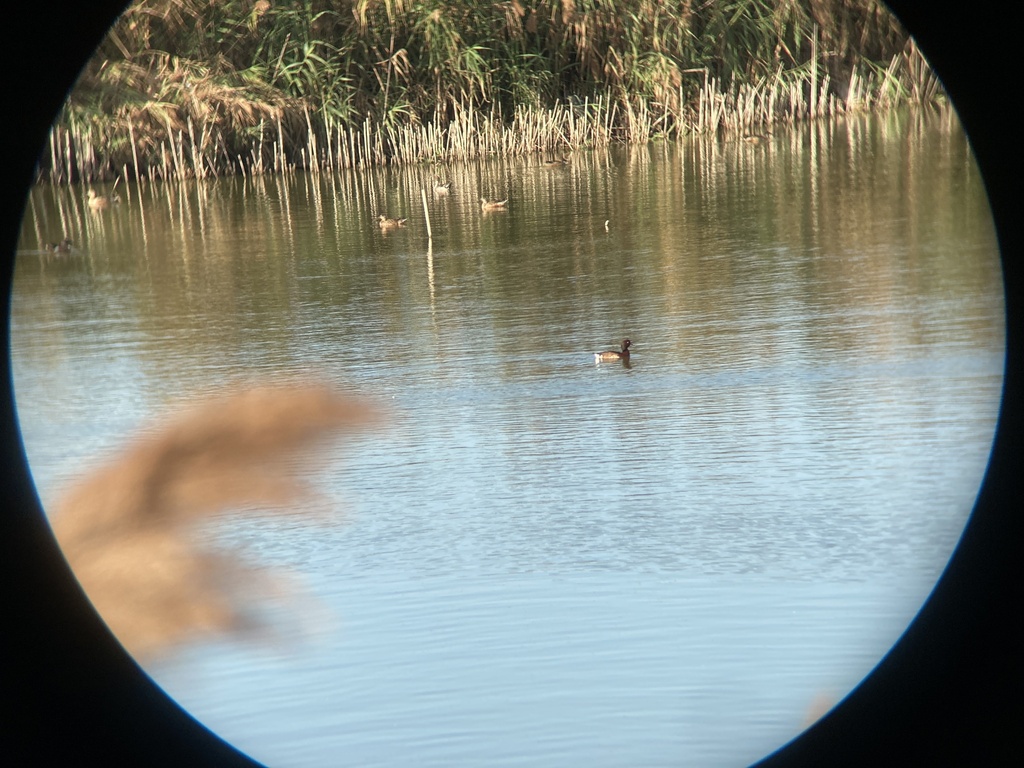
Baer’s Pochard
Photo © Tatsutomo Chin
Photo © Tatsutomo Chin — CC BY 4.0 — Source: iNaturalist #147042080Identification
Baer's pochard is a medium-sized diving duck measuring 41–47 cm in length with a wingspan of 70–79 cm. The breeding male is unmistakable, featuring a distinctive black head and neck with an emerald-green gloss, contrasting sharply with white or pale yellow eyes. The back is blackish-brown, the breast dark chestnut, and the flanks white or light chestnut. In poor light, males may appear entirely black. Females are considerably duller, with dark brown plumage on the head and neck that blends into chestnut-brown on the breast and flanks, though they retain dark eyes. Both sexes display wide white speculum feathers on the wings and a white vent area.
Baer's pochard is closely related to the ferruginous duck but can be distinguished by its larger size, longer and more rounded head with a flatter forehead, and notably by its white flanks visible when floating on water—a feature absent in the ferruginous duck. Females possess a distinctive bright chestnut spot at the lore (corner of the eye), another distinguishing feature. Eclipse males resemble females but retain the characteristic white eyes of breeding males.
Range & Habitat
Baer's pochard is an eastern Asian species with a complex migratory pattern. It traditionally bred in the Amur and Ussuri basins in Northeast China and southeastern Russia's Far East, though breeding has expanded in recent years to North and Central China. The species is highly migratory, wintering across a broad range from southern China southward through Taiwan, Japan, Bangladesh, India, and Vietnam, with occasional sightings as far as Bhutan, South Korea, the Philippines, and Pakistan. Birds depart wintering grounds by mid-March and return by mid-October or early November.
As a diving duck, Baer's pochard favors shallow wetland environments during breeding season, nesting among emergent vegetation in shallow water or on small islands and ridges. The nest is constructed from sedges, reeds, and other aquatic plants.
Behaviour & Diet
Baer's pochard is typically a quiet species, but during courtship both sexes produce harsh graaaak calls. Females may give kura kura kura calls, while males produce kuro kuro vocalizations at other times. The species exhibits clear breeding behavior, with males assuming sentry duty while females take responsibility for incubating eggs. Clutch sizes range from 5 to 14 eggs, depending on conditions and latitude.
Best Time & Places to See It
Baer's pochard is now critically endangered, with fewer than 1,000 mature individuals remaining and populations still declining. This species is most reliably encountered during winter months across its southern wintering range, particularly in southern China, Vietnam, Japan, and India. However, sightings are increasingly rare, and the species' severely depleted numbers make it a challenging subject for wildlife observers. The species is protected as a first-class protected animal in China due to its critically endangered status.
Photography Tips
Photographing Baer's pochard requires patience and access to its wintering grounds, particularly in southern China and Southeast Asia where they congregate seasonally. The male's striking green-glossed black head and contrasting white flanks and eyes provide excellent photographic contrast, particularly in clear morning light when colors are most vibrant. The species' rarity demands respect for protected sites and adherence to local regulations, especially in China where it is a first-class protected species. Early morning is ideal, as the distinctive white eye-ring and flank markings are most visible in good light conditions.
Kaziranga National Park
Kohora, India
+422 birds+26 mammals
Dawn breaks over the floodplains of the Brahmaputra, where tall grasslands stretch endlessly beneath monsoon-heavy skies. This sprawling wilderness of northeastern Assam is a mosaic of…
VIEW NATIONAL PARKYancheng National Nature Reserve
Yancheng, China
+208 birds+4 mammals
Where the East China Sea's tidal rhythms sculpt the Jiangsu coast, Yancheng National Nature Reserve sprawls across one of Asia's most dynamic wetland complexes. This vast…
VIEW NATURE RESERVEPoyang Lake National Nature Reserve
Shangrao, China
+270 birds+7 mammals
Where the Yangtze River's massive floodplain spreads across central China, Poyang Lake National Nature Reserve encompasses one of the continent's most dynamic and water-rich wetland systems.…
VIEW NATURE RESERVENo community photos yet. Log in to add the first one.
No community observations of this species yet.