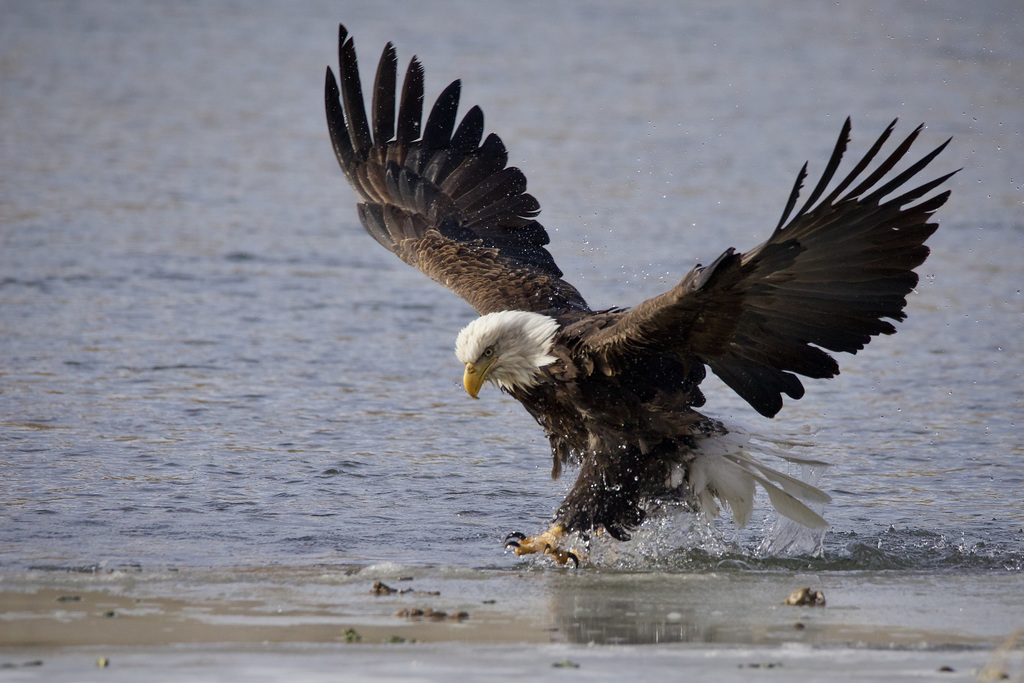
Bald Eagle
Photo © John Krampl
Photo © John Krampl — CC BY 4.0 — Source: iNaturalist photo #111879315Identification
The bald eagle is unmistakable in North America. Adults are evenly dark brown with a distinctive white head and tail, bright yellow beak, feet, and irises. The beak is large and hooked. Despite their name, bald eagles are not hairless; the term derives from an older English meaning of "white-headed," referring to the contrasting white head feathers against the darker body. Males and females are identical in plumage, though females are approximately 25% larger than males.
Immature bald eagles present a different challenge for identification, as they display dark brown plumage overlaid with messy white streaking until reaching sexual maturity at four to five years old. Immature birds can be confused with golden eagles, but bald eagles have a larger, more protruding head with a larger beak, straighter-edged wings held flat, and feathers that do not completely cover the legs. The golden eagle by contrast has a more solid warm brown color and distinctive reddish-golden nape patch.
Range & Habitat
Bald eagles are found throughout North America, with range including most of Canada and Alaska, all of the contiguous United States, and northern Mexico. The species forms a species pair with the white-tailed eagle of Eurasia, occupying the same ecological niche in their respective ranges. Two subspecies are recognized: the northern subspecies, found in the Northern United States, Canada, and Alaska, is larger than the southern nominate subspecies found in the southern United States and the Baja California peninsula.
Bald eagles are strongly associated with large bodies of open water offering abundant food supplies and old-growth trees suitable for nesting. These specific habitat requirements make them indicators of healthy aquatic ecosystems.
Behaviour & Diet
The bald eagle is an opportunistic feeder subsisting mainly on fish, which it snatches from the water by swooping down and grasping prey with its talons. The highly developed talon of the hind toe is specially adapted to pierce vital areas of prey while the front toes hold it immobile.
Bald eagles are famous for constructing the largest nests of any North American bird—indeed, the largest tree nests ever recorded for any animal species. These massive structures can measure up to 4 meters (13 feet) deep and 2.5 meters (8.2 feet) wide, weighing up to 1 metric ton. Sexual maturity is attained between four and five years of age.
Best Time & Places to See It
Bald eagles are best observed near large bodies of open water throughout their range in Canada, Alaska, and the contiguous United States, as well as northern Mexico. Look for them in areas with abundant fish populations and mature trees suitable for perching and nesting. The species' recovery from near-extirpation in the late 20th century means populations are now healthy and more readily observable across their historic range.
Photography Tips
Adult bald eagles with their striking white heads and dark brown bodies are iconic photographic subjects and unmistakable in their native range. For photographing immature birds, note their brown plumage with white streaking and larger head profile compared to golden eagles. Position yourself near suitable water bodies where eagles hunt for fish, watching for their characteristic swooping dives. The bright yellow beak, feet, and irises of adults provide excellent detail for close-up shots. Exercise patience, as these large raptors can be distant subjects; a telephoto lens is essential for capturing meaningful images.
Manitoba Owls
Nothing matches these filters.
Tombstone Territorial Park
Acadia National Park
Alaska Maritime National Wildlife Refuge
Algonquin Provincial Park
Alligator River National Wildlife Refuge
Arches National Park
Arctic National Wildlife Refuge
Badlands National Park
Banff National Park
Nothing matches these filters.
No community photos yet. Log in to add the first one.
No community observations of this species yet.