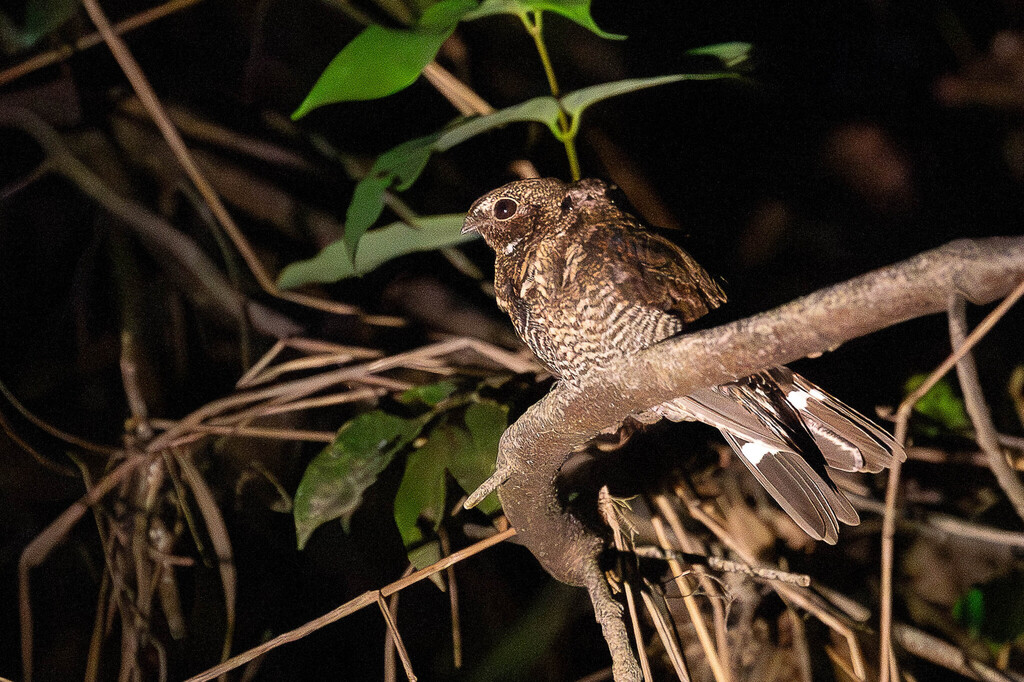
Band-tailed Nighthawk
Photo © Claudio Martins de Souza
Photo © Claudio Martins de Souza — CC BY-SA 4.0 — Source: iNaturalist photo #579056488The band-tailed nighthawk (Nyctiprogne leucopyga) is a species of nightjar in the family Caprimulgidae. It is widely spread throughout northern and central South America. Five subspecies are recognised. They are nocturnal birds that feed on flying insects. As with almost all nightjars, they lay their eggs directly on the ground and rely their camouflaged plumage to avoid predation. == Taxonomy == The band-tailed nighthawk was formally described and illustrated in 1825 by the German naturalist Johann Baptist von Spix under the binomial name Caprimulgus leucopygus. Spix specified the habitat as the wooded shores of the Amazon. The specific epithet is derived from Ancient Greek λευκοπυγος/leukopugos meaning "with white rear", from λευκος/leukos meaning "white" and -πυγος/-pugos meaning "-rumped". The band-tailed nighthawk is now placed together with the plain-tailed nighthawk in the genus Nyctiprogne that was introduced in 1847 by the French naturalist Charles Lucien Bonaparte. === Subspecies === There are 5 recognized subspecies which differ in size, colour and vocalizations. The subspecies N. l. latifascia has been suggested to be a separate species. It is visually distinct from the other subspecies, as its plumage is darker in colour, and there are differences in its vocalizations. N. l. exigua Friedmann, 1945 –…
Amacayacu National Park
Leticia, Colombia
+567 birds+25 mammals
Where the Rio Amazonas curves through the tri-border region where Colombia, Peru, and Brazil converge, Amacayacu National Park sprawls across more than 5,250 square kilometres of…
VIEW NATIONAL PARKViruá National Park
Brazil
+389 birds+6 mammals
Across the northern frontier of Roraima, where the forest canopy rises from ancient Amazonian lowlands, Viruá National Park protects nearly 3,700 square kilometres of terra firme…
VIEW NATIONAL PARKChapada dos Guimarães National Park
Brazil
+450 birds+1 mammals
Where weathered sandstone plateaus rise above the cerrado grasslands of central Brazil, Chapada dos Guimarães National Park protects 624 square kilometres of ecological transition zone that…
VIEW NATIONAL PARKChapada dos Veadeiros National Park
Brazil
+324 birds+6 mammals
Where granite plateaus rise above the cerrado savanna in central Brazil, Chapada dos Veadeiros National Park unfolds across 6,665 square kilometres of some of the world's…
VIEW NATIONAL PARKPantanal Matogrossense National Park
Brazil
+322 birds+17 mammals
Where the flooded forests of central Brazil meet vast seasonally inundated grasslands, Pantanal Matogrossense National Park sprawls across nearly 2,900 square kilometers of one of the…
VIEW NATIONAL PARKAmazônia National Park
Brazil
+439 birds+6 mammals
Where the Rio Amazonas and its tributaries weave through the heart of Pará state, a vast tapestry of rainforest stretches across 23,611 square kilometers of unbroken…
VIEW NATIONAL PARKJaú National Park
Brazil
+354 birds+3 mammals
Vast floodplain forests and blackwater rivers define this remote corner of western Amazonas, where the Rio Negro and its tributaries have carved an intricate mosaic of…
VIEW NATIONAL PARKAnavilhanas National Park
Brazil
+468 birds+8 mammals
Across the Rio Negro in central Amazonas, an archipelago of over a thousand islands rises from the world's largest rainforest river system, creating a labyrinth of…
VIEW NATIONAL PARKCampos Amazónicos National Park
Amazonas, Brazil
+434 birds+7 mammals
Sprawling across the southwestern Amazon basin in Amazonas state, this 27,263-square-kilometre national park encompasses some of the region's most pristine lowland rainforest, where terra firme forest…
VIEW NATIONAL PARKPico da Neblina National Park
Brazil
+103 birds
Where the Amazon's western rampart rises into perpetual mist, Pico da Neblina National Park sprawls across more than 33,000 square kilometres of some of Earth's least…
VIEW NATIONAL PARKNo community photos yet. Log in to add the first one.
No community observations of this species yet.