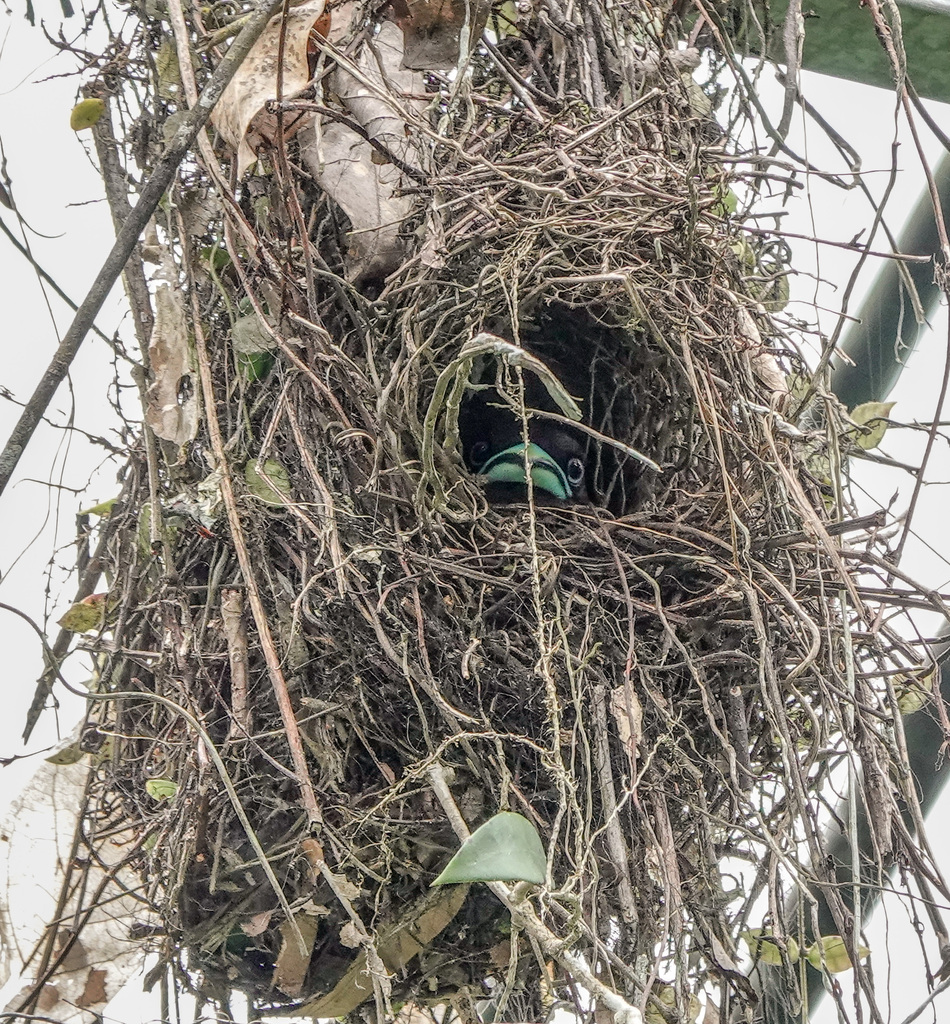
Banded Broadbill
Photo © Sevin Dee
Photo © Sevin Dee — CC BY 4.0 — Source: iNaturalist #180738663Identification
The Banded Broadbill is a striking, large-bodied bird measuring 21.5–23.0 cm (8.5–9.1 in), unlikely to be mistaken for another species if seen clearly. Its most distinctive features include mostly purplish-red plumage, yellow-streaked black wings, a bright blue beak, a blackish face, and greyish chin and upper breast. Females can be distinguished from males by their lack of a black neckband, though this marking is indistinct in males from Borneo and Java. Despite its conspicuous appearance, the bird is usually difficult to observe due to its sluggish nature and is typically noticed only when it vocalises.
Range & Habitat
This species is found across Mainland Southeast Asia and the Greater Sunda Islands, inhabiting a variety of forest types including forest edges, rubber plantations, and Falcataria falcata groves, with a strong preference for lowland areas. Four subspecies are currently recognised, distributed across different regions: populations occur from southeastern Myanmar through Vietnam and the Malay Peninsula, with additional populations on Sumatra, Borneo, Java, and various island groups. On Java, the species is thought to breed year-round, while populations in the Greater Sundas have an extended breeding season.
Behaviour & Diet
The Banded Broadbill is primarily an arthropod-eater, with a diet consisting mainly of orthopterans such as grasshoppers, katydids and crickets, along with true bugs and beetles. It has also been recorded feeding on snails, lizards, frogs and figs. Breeding patterns vary geographically: mainland populations typically breed during the dry season, while Greater Sunda populations breed from March to November. This species constructs large, raggedy nests hung from trees at heights of 6–21 m (20–69 ft) over clearings or water bodies, typically containing clutches of two or three eggs with distinctive markings that vary by region.
Best Time & Places to See It
For travellers and photographers seeking the Banded Broadbill, visiting lowland forests across its range offers the best opportunities. The dry season is optimal for mainland populations in Southeast Asia, while Greater Sunda island populations can be encountered during their extended breeding season from March to November. Though visually conspicuous, the species' sluggish behaviour makes it challenging to spot; patience and listening for vocalisations will significantly improve chances of encounter.
Photography Tips
The bird's striking plumage—with vivid purplish-red tones, bright blue beak, and contrasting yellow-streaked black wings—makes for compelling photography when sighted. However, the species' preference for forest habitats and sluggish nature means photographers should be prepared for challenging lighting conditions typical of forested environments. Positioning near forest clearings or water bodies where nests are hung may increase opportunities for photography, particularly during breeding season when birds are more active.
Phou Khao Khouay National Protected Area
Thaphabath District, Thailand
+113 birds
Where the Annamite Mountains descend into central Thailand's monsoon forests, Phou Khao Khouay National Protected Area sprawls across rugged limestone terrain interlaced with river valleys and…
VIEW NATIONAL PARKKhao Yai National Park
Prachantakham District, Thailand
+377 birds+46 mammals
Evergreen dipterocarp forest blankets the rolling terrain of this national park in eastern Thailand, where limestone hills rise abruptly from the forest floor and seasonal streams…
VIEW NATIONAL PARKKhao Laem National Park
Sangkhla Buri District, Thailand
+197 birds
Where the Vajiralongkorn Reservoir sprawls across the forested valleys of Kanchanaburi's northern borderlands, Khao Laem National Park protects a landscape where limestone ridges rise dramatically from…
VIEW NATIONAL PARKTaman Negara National Park
Kampong Samas, Malaysia
+393 birds+48 mammals
Where ancient rainforest meets limestone peaks, one of Southeast Asia's oldest protected wilderness preserves sprawls across 4,343 square kilometers of primordial landscape. Dipterocarp giants tower overhead,…
VIEW NATIONAL PARKTaman Negara Bukit Lambir National Park
Miri, Malaysia
+153 birds+7 mammals
Rainforest cascades down sandstone ridges where crystal streams carve through ancient geology, creating a landscape of profound biological richness in Sarawak's interior. This 68-square-kilometre sanctuary protects…
VIEW NATIONAL PARKGunung Mulu National Park
Long Seridan, Malaysia
+280 birds+39 mammals
Where granite monoliths pierce the rainforest canopy of Sarawak, an ancient limestone karst landscape reveals one of Southeast Asia's most biodiverse strongholds. Soaring peaks cloaked in…
VIEW NATIONAL PARKTaman Nasional Baluran
Situbondo, Indonesia
+189 birds+9 mammals
Across the northeastern tip of East Java, where monsoon winds sweep down from the Bali Strait, a landscape of contrasts unfolds within 374 square kilometres of…
VIEW NATIONAL PARKTaman Nasional Meru Betiri
Jember, Indonesia
+93 birds+1 mammals
Across East Java's southeastern coast, where the Indian Ocean meets a landscape of volcanic soils and monsoon-fed forests, sprawls a national park that epitomizes the ecological…
VIEW NATIONAL PARKGunung Ciremai National Park
Majalengka, Indonesia
+116 birds+1 mammals
Volcanic slopes rise sharply from West Java's interior, where Gunung Ciremai's 3,078-metre summit dominates a landscape carved by geological upheaval and shaped by equatorial monsoon rainfall.…
VIEW NATIONAL PARKMount Merapi National Park
Hargobinangun, Indonesia
+150 birds+3 mammals
Where the volcanic slopes of central Java rise into mist and montane forest, Mount Merapi National Park guards one of Indonesia's most dynamic landscapes. Spanning roughly…
VIEW NATIONAL PARKKerinci Seblat National Park
Kerinci, Indonesia
+228 birds+16 mammals
Across nearly 67,000 square kilometres of Sumatra's spine, a mountainous realm of equatorial rainforest rises from steaming lowlands to volcanic peaks shrouded in cloud. Kerinci Seblat…
VIEW NATIONAL PARKNo community photos yet. Log in to add the first one.
No community observations of this species yet.