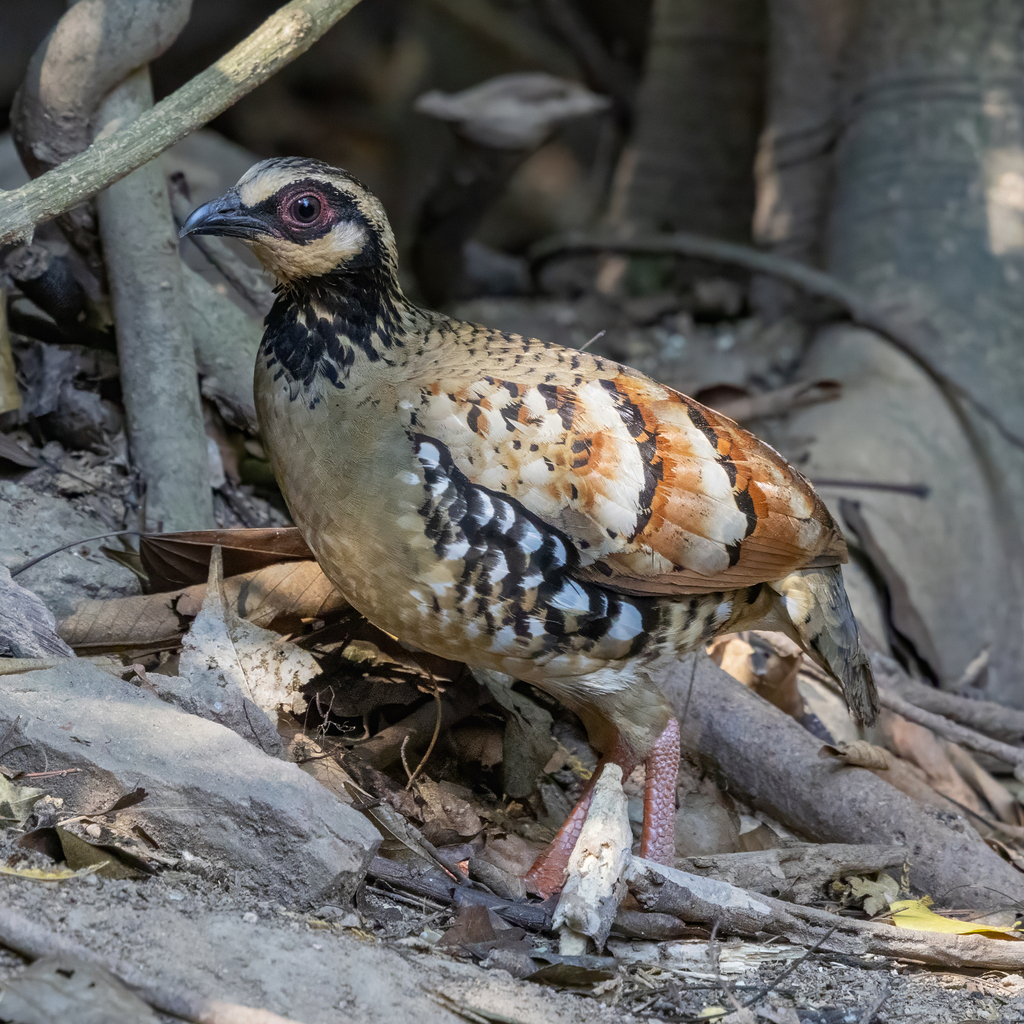
Bar-backed Partridge
Photo © Dan Vickers
Photo © Dan Vickers — CC BY 4.0 — Source: iNaturalist #344771415Identification
The bar-backed partridge is a compact gamebird, typically 280 mm (11 in) in length, with males and females displaying similar plumage. This small partridge is predominantly buff in colour, marked by distinctive black running from the beak, around the eyes, and down to the throat, along with a black crown. The feather tips along its back are black, and red eyelids provide a striking facial accent. The wing feathers are white with black tips and brown near the back, creating a subtle patterned appearance. Males average a wingspan of 144 mm (5.7 in) and females 134 mm (5.3 in), making this one of the smaller partridge species in its range.
Three recognized subspecies exist, differing primarily in colouration and patterns of their underparts and head markings. The bar-backed partridge is sometimes classified alongside related species such as the chestnut-bellied, grey-breasted, Sichuan, and red-breasted partridges, though taxonomic relationships remain subject to ongoing research.
Range & Habitat
The bar-backed partridge is found across southwestern China and Southeast Asia, occurring in Cambodia, China, Laos, Myanmar, Thailand, and Vietnam across an estimated range of 486,000 square kilometres. Despite this extensive distribution, the species remains relatively localized and elusive within its range.
This partridge inhabits subtropical and tropical moist forests, occurring in both lowland and montane environments. It is typically found at relatively low elevations below 3,000 feet (910 m), though populations have been recorded at 5,000 feet (1,500 m) and above. The species favours dense forest floor vegetation, where it forages and nests among leaf litter and bamboo thickets.
Behaviour & Diet
Bar-backed partridges are social birds, living in small flocks of 4–9 individuals, typically comprising two parents and their latest offspring, or occasionally two family groups together. They are ground-feeders, foraging in the leaf litter on the forest floor for seeds, small shells, and insects. When disturbed by humans, they respond characteristically by scattering rapidly into the underbrush.
Breeding occurs around May to June, with males attracting mates by exposing their distinctive red throat feathers while calling. Females lay eggs measuring 37 by 28 mm (1.5 by 1.1 in) in nests constructed as holes covered with bamboo and grass, often built directly on the forest floor among dense vegetation.
Best Time & Places to See It
The bar-backed partridge is best sought during the breeding season from May to June when males are more vocal and active in mate attraction. The species is distributed across multiple countries, with populations in the montane and lowland forests of Cambodia, Laos, Myanmar, Thailand, and Vietnam offering opportunities for observation. Early morning hours are typically most productive for hearing and observing these partridges.
Birders should focus on areas of intact subtropical and tropical moist forest, particularly where bamboo and dense understory vegetation provide adequate cover and foraging habitat. The species' tendency to scatter quickly into cover makes patient, careful approach essential for successful encounters.
Photography Tips
Photographing bar-backed partridges presents considerable challenges due to their small size, preference for dense forest understory, and habit of rapidly disappearing into cover when disturbed. Early morning visits to suitable forest habitat offer the best opportunities, when birds are more active and light is optimal. A telephoto lens is essential, as the species typically keeps its distance from observers.
The bird's subtle buff and black plumage blends effectively with the forest floor environment, so patience and careful positioning are critical. Focus on areas where leaf litter and bamboo are abundant, and listen for calling males during the breeding season. Given the species' wariness, a slow approach and extended waiting periods will yield better photographic opportunities than active searching.
No community photos yet. Log in to add the first one.
No community observations of this species yet.