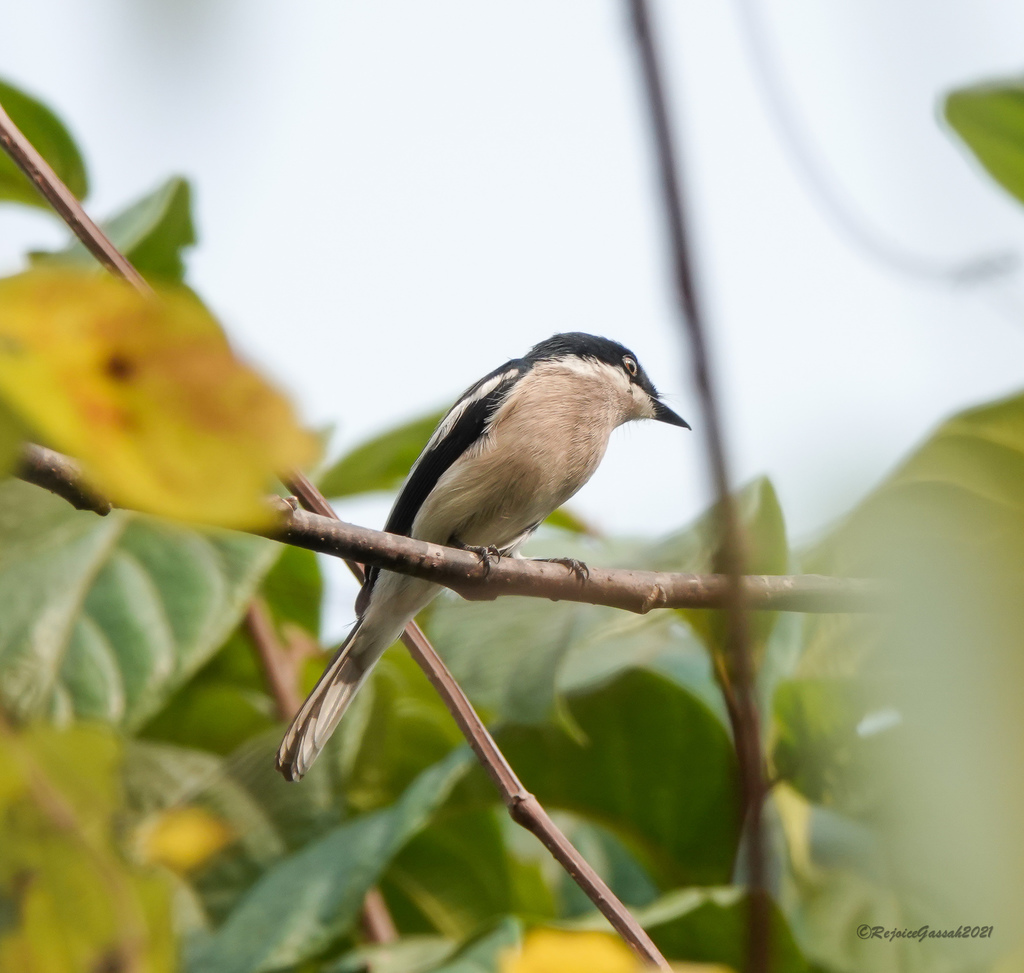
Bar-winged Flycatcher-shrike
Photo © Rejoice Gassah
Photo © Rejoice Gassah — CC BY 4.0 — Source: iNaturalist #72009254Identification
The bar-winged flycatcher-shrike is a small passerine with a distinctive black-and-white pattern. It is black-capped with black wings that contrast sharply against the white of the body. A striking white slash runs across each wing, and the white rump stands out prominently. The tail is black, with white outer tail feathers and white tips on the non-central tail feathers. These birds sit upright on branches in a characteristic posture.
Sexual and geographic variation is notable in this species. Males are typically velvety black, while females tend toward greyish brown, though this pattern varies across populations. The Himalayan subspecies features a brown back with males having a black head, while the Sri Lankan population shows no sexual dimorphism in plumage. Young birds display a broken pattern of white and grey that resembles lichens. The bird's beak has a curved upper mandible with nostrils hidden by hairs—adaptations for its insectivorous lifestyle.
Range & Habitat
The bar-winged flycatcher-shrike is found throughout the forests of tropical southern Asia, ranging from the Himalayas and hills of southern India to Indonesia. Its distribution spans multiple subspecies across this vast region. The nominate race inhabits the Western Ghats of India, while the Himalayan subspecies ranges from Simla eastward to Manipur and Chittagong, extending into northern Thailand, Myanmar, and Laos. The Sri Lankan subspecies occupies hill forests on the island, and the Southeast Asian subspecies is found in Sumatra, Borneo, and parts of the Malay Peninsula.
These birds prefer the mid-canopy of forests, where they hunt for insects among the foliage. They are known to move through the forest regularly and rarely remain in one location, often joining mixed-species foraging flocks with babblers, velvet-fronted nuthatches, and white-eyes. While they have been noted as sensitive to forest degradation, some populations demonstrate the capacity to persist even in considerably disturbed forests.
Behaviour & Diet
The bar-winged flycatcher-shrike is mainly insectivorous, catching prey through two primary methods: gleaning insects from foliage and making aerial sallies to capture flushed insects. These birds are highly social foragers, regularly associating with other small bird species in mixed feeding flocks as they move through the forest canopy. They maintain their upright perching posture while scanning for food opportunities.
The nesting season varies by location, occurring mainly from February to August in Sri Lanka and March to May in India. These birds construct neat cup-shaped nests held together with spider silk and lined with fine grass and fiber. Remarkably, the nest surface is covered with lichens, and it is positioned on the horizontal surface of a dry branch—often near the tip or on a leafless tree—where it resembles a knot in the wood. Clutches typically consist of 2 or 3 pale greenish-white eggs blothed with black and grey. Both males and females participate in incubation. Young birds remain motionless with eyes closed and raised bills pointing toward the nest center, creating the appearance of broken branches.
Best Time & Places to See It
To observe bar-winged flycatcher-shrikes, visit forested regions throughout their range during the warmer months when activity is highest. In Sri Lanka, February through August offers good viewing opportunities, while in India, March through May is optimal. The Himalayan subspecies can be found in hill forests from Simla eastward, making the forested hills of northern regions promising destinations. The Western Ghats of India support the nominate race, though populations there are becoming rare in some areas.
Look for these birds in the mid-canopy of forests, watching for their characteristic upright posture and distinctive black-and-white plumage. They are most easily located by watching for mixed-species feeding flocks, which often attract multiple small bird species to the same area. Patience and careful observation of forest canopy movement will reward birdwatchers seeking this striking species.
Photography Tips
The bar-winged flycatcher-shrike's high-contrast plumage—bold black and white markings—makes it an appealing photographic subject, though the mid-canopy habitat presents challenges. Position yourself to capture the bird's characteristic upright perching posture and the distinctive white slash across the wings. The white rump and outer tail feathers provide bright accents that stand out against forest shadows.
Since these birds are often found in mixed feeding flocks, patience and positioning are essential. Watch for activity in the mid-canopy and be prepared for rapid movement as the bird gleans insects or makes aerial sallies. Early morning light will best reveal the glossy black plumage of males and enhance the contrast between the dark upperparts and white underparts, creating striking images of this handsome species.
Lunugamvehera National Park
Sri Lanka
+204 birds+14 mammals
Dry scrubland and shallow wetlands converge in Sri Lanka's southeastern lowlands, where Lunugamvehera National Park anchors one of the island's most ecologically vital landscapes. The park's…
VIEW NATIONAL PARKMinneriya National Park
Sri Lanka
+158 birds+9 mammals
Across the dry zone of Sri Lanka's North Central Province spreads a landscape of shallow tanks, grassland margins, and scattered dry forest—a mosaic of water and…
VIEW NATIONAL PARKWasgamuwa National Park
Sri Lanka
+156 birds+8 mammals
Dry deciduous forest and open grassland sweep across the North Central lowlands where Wasgamuwa National Park protects one of Sri Lanka's largest remaining tracts of this…
VIEW NATIONAL PARKLangtang National Park
Helambu, Nepal
+364 birds+14 mammals
Where the southern slopes of the Himalayan highlands descend toward the subtropical valleys of central Nepal, Langtang National Park sprawls across one of the subcontinent's most…
VIEW NATIONAL PARKOrang National Park
Rangagarapathar, India
+298 birds+1 mammals
Where the Brahmaputra's floodplains meet the foothills of Assam, Orang National Park unfolds across a mosaic of riverine grasslands, forests and wetlands that pulse with the…
VIEW NATIONAL PARKGangotri National Park
Bhatwari, India
+119 birds+1 mammals
Where the Bhagirathi River carves through the western Himalayas in northern Uttarakhand, Gangotri National Park rises across steep alpine terrain that defines the boundary between temperate…
VIEW NATIONAL PARKEravikulam National Park
Devikulam, India
+192 birds+7 mammals
High in the Western Ghats of Kerala, where monsoon mists cling to slopes that rise above 2,000 metres, Eravikulam National Park preserves one of South India's…
VIEW NATIONAL PARKPhou Khao Khouay National Protected Area
Thaphabath District, Thailand
+113 birds
Where the Annamite Mountains descend into central Thailand's monsoon forests, Phou Khao Khouay National Protected Area sprawls across rugged limestone terrain interlaced with river valleys and…
VIEW NATIONAL PARKHat Noppharat Thara-Mu Ko Phi Phi National Park
Ao Nang, Thailand
+253 birds+9 mammals
Where limestone karsts rise dramatically from turquoise waters, Hat Noppharat Thara-Mu Ko Phi Phi National Park unfolds across a mosaic of beach, mangrove forest, and island…
VIEW NATIONAL PARKKhao Yai National Park
Prachantakham District, Thailand
+377 birds+46 mammals
Evergreen dipterocarp forest blankets the rolling terrain of this national park in eastern Thailand, where limestone hills rise abruptly from the forest floor and seasonal streams…
VIEW NATIONAL PARKKhao Laem National Park
Sangkhla Buri District, Thailand
+197 birds
Where the Vajiralongkorn Reservoir sprawls across the forested valleys of Kanchanaburi's northern borderlands, Khao Laem National Park protects a landscape where limestone ridges rise dramatically from…
VIEW NATIONAL PARKKanha Tiger Reserve
Kanha Kisli F.V., India
+321 birds+23 mammals
Where sal forests give way to emerald meadows and crystalline streams carve through ancient valleys, one of India's finest wilderness reserves unfolds across the Maikal Range.…
VIEW NATIONAL PARKBandhavgarh National Park
Garhpuri, India
+285 birds+17 mammals
Where granite ridges rise dramatically above sal and bamboo forests, one of India's most pristine tiger reserves unfolds across the Vindhyan plateau. Ancient rock formations tower…
VIEW NATIONAL PARKKaziranga National Park
Kohora, India
+422 birds+26 mammals
Dawn breaks over the floodplains of the Brahmaputra, where tall grasslands stretch endlessly beneath monsoon-heavy skies. This sprawling wilderness of northeastern Assam is a mosaic of…
VIEW NATIONAL PARKPeriyar National Park
Mlappara, India
+232 birds+4 mammals
Dawn breaks over mist-shrouded ridges where the Western Ghats tumble toward Kerala's spice-scented lowlands. Here, ancient tropical forests envelope a glittering artificial lake, creating a mosaic…
VIEW NATIONAL PARKPampadum Shola National Park
Vattavada, India
+258 birds+14 mammals
Where misty shola forests cling to the high plateaus of the Nilgiri Mountains, ancient evergreen remnants create a world apart. This 2,316-hectare reserve protects one of…
VIEW NATIONAL PARKBandipur National Park
Hirehalli, India
+302 birds+19 mammals
Where the Western Ghats descend into the Deccan plateau, ancient deciduous forests blanket a landscape carved by the Nugu River. Bandipur unfolds across 880 square kilometres…
VIEW NATIONAL PARKNagarahole Tiger Reserve
Nalkeri Forest, India
+323 birds+23 mammals
Where granite escarpments rise above dense deciduous forests and the Kabini River carves through pristine wilderness, one of India's most biodiverse landscapes unfolds across the Western…
VIEW NATIONAL PARKTaman Negara National Park
Kampong Samas, Malaysia
+393 birds+48 mammals
Where ancient rainforest meets limestone peaks, one of Southeast Asia's oldest protected wilderness preserves sprawls across 4,343 square kilometers of primordial landscape. Dipterocarp giants tower overhead,…
VIEW NATIONAL PARKGunung Mulu National Park
Long Seridan, Malaysia
+280 birds+39 mammals
Where granite monoliths pierce the rainforest canopy of Sarawak, an ancient limestone karst landscape reveals one of Southeast Asia's most biodiverse strongholds. Soaring peaks cloaked in…
VIEW NATIONAL PARKKerinci Seblat National Park
Kerinci, Indonesia
+228 birds+16 mammals
Across nearly 67,000 square kilometres of Sumatra's spine, a mountainous realm of equatorial rainforest rises from steaming lowlands to volcanic peaks shrouded in cloud. Kerinci Seblat…
VIEW NATIONAL PARKWay Kambas National Park
Lampung Timur, Indonesia
+237 birds+20 mammals
Across the low swamplands of eastern Lampung, where freshwater wetlands merge into tidal mangrove forests along the Sunda Strait, sprawls one of Sumatra's most vital sanctuaries.…
VIEW NATIONAL PARKXishuangbanna National Nature Reserve
Xishuangbanna Dai Autonomous Prefecture, China
+173 birds+2 mammals
Where subtropical monsoon forests meet the margins of the Yunnan plateau, Xishuangbanna National Nature Reserve sprawls across a landscape of dramatic relief—deep river valleys carved by…
VIEW NATURE RESERVEGaoligong Mountain National Nature Reserve
Nujiang Lisu Autonomous Prefecture, China
+443 birds+13 mammals
VIEW NATURE RESERVENo community photos yet. Log in to add the first one.
No community observations of this species yet.