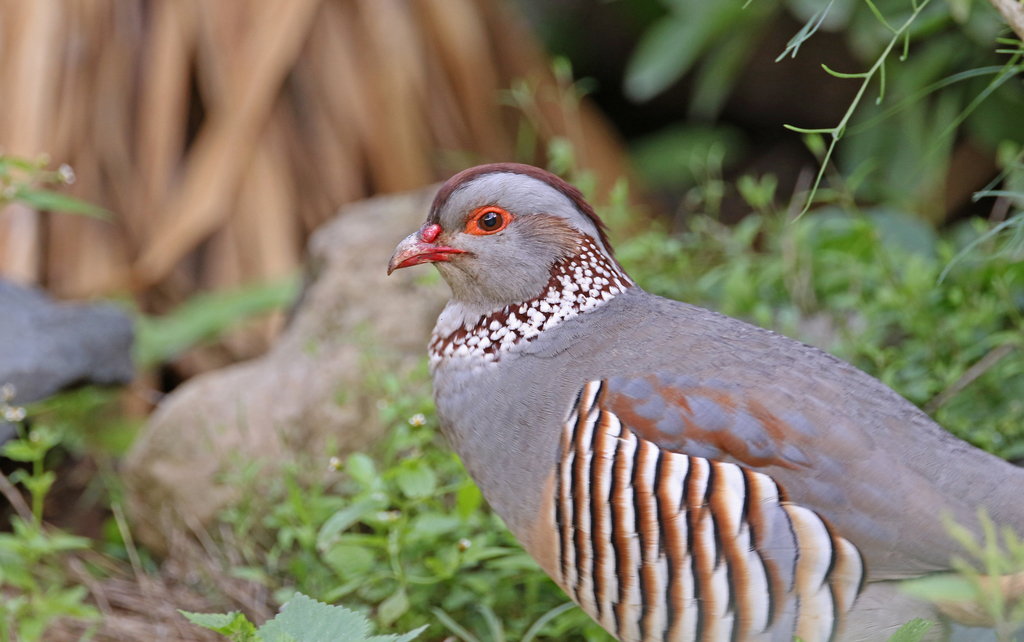
Barbary Partridge
Photo © Christoph Moning
Photo © Christoph Moning — CC BY 4.0 — Source: iNaturalist photo #184060643Identification
The Barbary partridge is a compact, rotund gamebird measuring 33–36 cm in length. Its plumage combines grey-brown upperparts with a grey breast and buff belly, creating effective camouflage in its arid habitat. The most distinctive feature is its head pattern: a light grey face marked by a broad reddish-brown gorget (throat patch) that immediately separates it from its closest European relative, the red-legged partridge. Additional identifying marks include rufous-streaked white flanks and striking red legs. When alarmed, this partridge characteristically prefers to run rather than fly, but if forced into the air, it flies only short distances on rounded wings. Its song is distinctive and loud—a rapid, repetitive "tre-tre-tre-tre-tre-cheeche-tre-tre-tre" that carries across open terrain.
Range & Habitat
This species is native to North Africa, where it inhabits dry, open and often hilly country. Beyond its natural range, the Barbary partridge has been introduced to Gibraltar and the Canary Islands, where established populations persist. Introductions to continental Portugal and Madeira have occurred, though recent records from Madeira are lacking. Populations also exist in Sardinia. The bird favours arid, semi-open landscapes typical of its Mediterranean and North African strongholds.
Behaviour & Diet
The Barbary partridge is a resident breeder that nests in a scantily lined ground scrape, typically laying 10–16 eggs. Unusually for ground-nesting gamebirds, a few documented cases in Tunisia show individuals breeding in trees within abandoned nests of the African Magpie—a strategy thought to reduce predation pressure on vulnerable eggs and chicks. This partridge is primarily granivorous, taking a wide variety of seeds supplemented by some insect food. It is crepuscular, typically beginning to feed and drink at dawn, allowing it to forage during cooler parts of the day and avoid peak heat.
Best Time & Places to See It
Gibraltar offers the most accessible opportunity to encounter this species, where it holds cultural significance as the national bird and appears on local currency. The Canary Islands population is also well-established. In its North African strongholds, the species is a year-round resident, making any season potentially productive for observation. Early morning excursions through dry, hilly terrain offer the best chance of encounters, as birds are most active at dawn. Listen for the distinctive loud call, which often betrays the bird's presence before visual contact is made.
Photography Tips
Photographing Barbary partridges requires patience and an understanding of their behaviour. Since they prefer running to flying, positioning yourself along likely escape routes through open terrain may yield closer opportunities than pursuing flushed birds. Early morning light is ideal for capturing the subtle colours of the plumage and the striking red gorget. Use a telephoto lens to maintain distance without disturbing the birds, as they are wary gamebirds. The contrasting head pattern—light grey face and reddish-brown gorget—should be your focus for identifying shots. Patient stalking of calling birds at dawn offers your best chance for intimate portraits in their natural habitat.
Teide Natural Monument
La Orotava, Spain
+41 birds+4 mammals
High on the volcanic slopes of Tenerife, where the landscape transforms from lush laurel forests into lunar terrain, the Teide Natural Monument preserves one of Spain's…
VIEW NATURE RESERVETimanfaya National Park
Tinajo, Spain
+37 birds
Across Lanzarote's northwestern plains, where the Atlantic wind sculpts black lava fields into a landscape of geological drama, lies one of Europe's most visually arresting volcanic…
VIEW NATIONAL PARKTeide National Park
La Orotava, Spain
+83 birds+7 mammals
At nearly 3,900 metres, Spain's highest peak rises from the Canary Islands as a singular volcanic monument, its slopes sweeping through five distinct climate zones in…
VIEW NATIONAL PARKGarajonay National Park
Hermigua, Spain
+68 birds+1 mammals
Laurel forests cloak the volcanic ridges of this Canarian national park, their evergreen canopy so dense that mist clings to the moss-draped branches even on cloudless…
VIEW NATIONAL PARKAsinara National Park
Porto Torres, Italy
+103 birds+5 mammals
Rocky limestone cliffs plunge toward the Tyrrhenian Sea where Dell'Asinara National Park guards a slender island sanctuary off Sardinia's northwestern coast. The park's terrain is a…
VIEW NATIONAL PARKNo community photos yet. Log in to add the first one.
No community observations of this species yet.