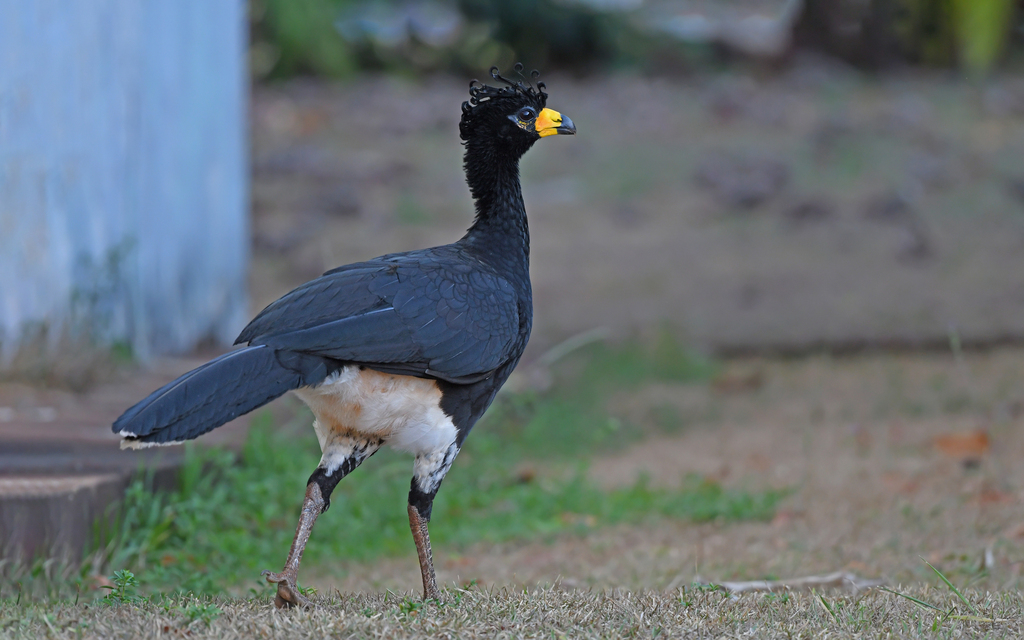
Bare-faced Curassow
Photo © Christoph Moning
Photo © Christoph Moning — CC BY 4.0 — Source: iNaturalist photo #444201521Identification
The bare-faced curassow is a large galliform bird measuring 82 to 92 centimetres in length. The most striking feature is the distinctive bare facial skin, which gives the species its common name. Sexual dimorphism is pronounced in this species, making identification straightforward once you determine the bird's sex.
Males are predominantly black on the upper parts, with a subtle greenish-olive gloss. They display yellowish bare facial skin, a small black crest, and contrasting white underparts. Females present a more complex plumage pattern: the head, throat, neck, and upper mantle are black, topped with a black and white barred crest. Their upper parts are greenish-black heavily barred with white or ochre, the tail is black with white or ochre tips, and the underparts are black with ochre barring on the breast fading to a yellowish or ochre belly. Females have blackish facial skin rather than the males' yellow.
Range & Habitat
The bare-faced curassow occurs in Brazil, Paraguay, eastern Bolivia, and extreme northeast Argentina. Three recognized subspecies are distributed across this range: C. f. fasciolata occupies the lowlands of Brazil to Paraguay and northeast Argentina; C. f. grayi is found in eastern Bolivia; and C. f. pinima inhabits northeastern Brazil.
This species favours subtropical and tropical forests, including dry forests and moist lowland forests. It is particularly associated with the cerrado, pantanal, and the southeastern region of the Amazon basin. Within these habitats, the birds prefer moist, semi-deciduous, and gallery forests, often foraging along woodland fringes.
Behaviour & Diet
The bare-faced curassow is primarily frugivorous, with fruit comprising the bulk of its diet. However, it opportunistically supplements its diet with seeds, flowers, and small invertebrates. The species is typically found in small numbers within its preferred forest habitats.
Breeding occurs during summer in the southern portion of the species' range. Nests are constructed as platforms of sticks built in trees, a characteristic breeding strategy among curassows. The bird's preference for forest fringes and semi-deciduous woodlands means observers may encounter them while scanning woodland edges at dawn or dusk.
Best Time & Places to See It
The bare-faced curassow is fairly numerous in parts of its range, offering reasonable opportunities for observation. Travellers should focus on the cerrado, pantanal, and southeastern Amazon basin regions, particularly within protected areas that preserve gallery forests and semi-deciduous woodlands.
Early morning visits to woodland fringes offer the best chances of encounters. Summer is the breeding season in the southern parts of the range, potentially making birds more active and visible during this period.
Photography Tips
The bare-faced curassow's contrasting plumage and distinctive bare facial features make it an attractive photographic subject. The sexual dimorphism provides opportunities to capture distinctly different plumage patterns. Position yourself at forest edges during early morning light when the birds are most active and when woodland lighting is most favourable.
The white underparts of males and the barred patterns of females provide good contrast against the forest backdrop. Patient observation near fruiting trees within suitable habitat may reward photographers with extended viewing opportunities and the chance to capture natural behaviour.
Emas National Park
Brazil
+333 birds+23 mammals
Across the high plateaux of central Brazil, where the cerrado grasslands roll toward distant horizons under an immense sky, Emas National Park anchors one of South…
VIEW NATIONAL PARKChapada dos Guimarães National Park
Brazil
+450 birds+1 mammals
Where weathered sandstone plateaus rise above the cerrado grasslands of central Brazil, Chapada dos Guimarães National Park protects 624 square kilometres of ecological transition zone that…
VIEW NATIONAL PARKChapada dos Veadeiros National Park
Brazil
+324 birds+6 mammals
Where granite plateaus rise above the cerrado savanna in central Brazil, Chapada dos Veadeiros National Park unfolds across 6,665 square kilometres of some of the world's…
VIEW NATIONAL PARKPantanal Matogrossense National Park
Brazil
+322 birds+17 mammals
Where the flooded forests of central Brazil meet vast seasonally inundated grasslands, Pantanal Matogrossense National Park sprawls across nearly 2,900 square kilometers of one of the…
VIEW NATIONAL PARKBrasília National Park
Plano Piloto, Brazil
+338 birds+15 mammals
Cerrado grassland and scattered woodland sweep across the central Brazilian plateau where this national park sprawls across more than a thousand square kilometres of the Federal…
VIEW NATIONAL PARKRío Pilcomayo National Park
Argentina
+271 birds+13 mammals
Where the Río Pilcomayo cuts through northeastern Argentina's subtropical lowlands, a sprawling mosaic of wetlands, grasslands, and seasonally flooded forests creates one of South America's most…
VIEW NATIONAL PARKNo community photos yet. Log in to add the first one.
No community observations of this species yet.