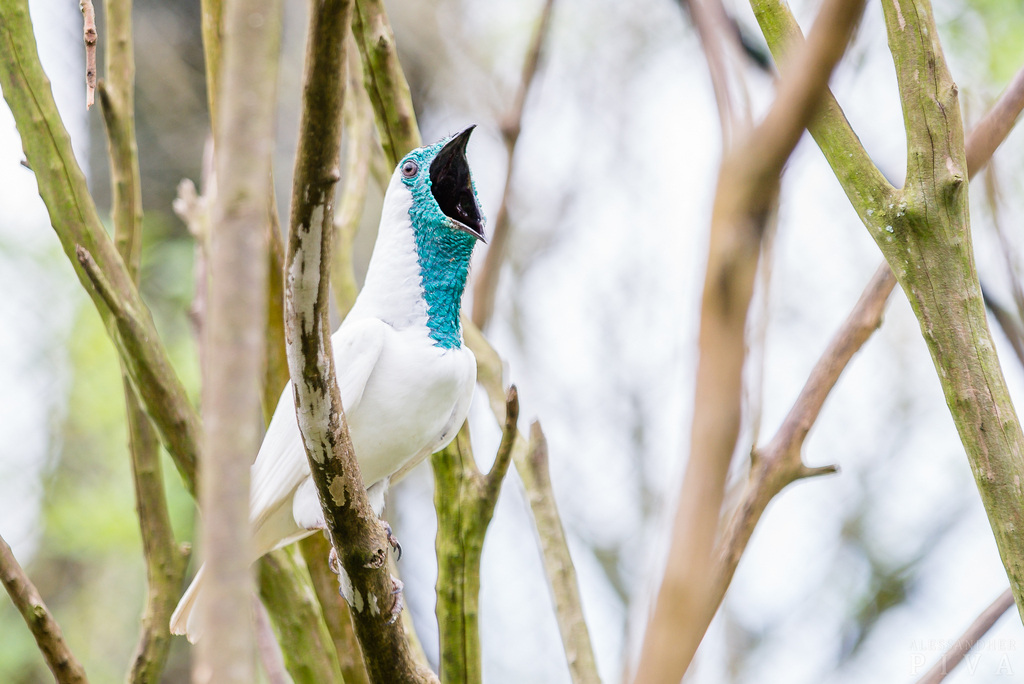
Bare-throated Bellbird
Photo © Alessandher Piva
Photo © Alessandher Piva — CC BY 4.0 — Source: iNaturalist photo #248196419The bare-throated bellbird (Procnias nudicollis) is a species of bird in the family Cotingidae. It is found in moist subtropical and tropical forests in Argentina, Brazil, and Paraguay. The male has white plumage and bristly bluish-black bare skin around its eye, beak and throat. The female is more drab, being olive-brown above with streaked yellow underparts. The male has one of the loudest known bird calls, producing a metallic sound similar to a hammer striking an anvil. This bird feeds strictly on fruit and plays a part in dispersing the seeds of forest trees. It is considered Near Threatened because of loss of its forest habitat and collection for the pet bird trade. The male bird has striking white plumage and a bare bluish-black patch of skin around its eyes and beak and on its throat. The female is duller in colour with a black crown, olive-brown upper parts and yellowish underparts streaked with olive green. This bird is about 27 cm (11 in) long. Like other bellbirds (Procnias), P. nudicollis has a short bill with a very wide gape. == Voice == The male has one of the loudest calls of any bird—a sharp sound like that of a…
Tijuca National Park
Brazil
+317 birds+13 mammals
Where the Atlantic forest rises steeply from Rio de Janeiro's urban edge, Tijuca National Park encompasses a landscape of dramatic granite peaks, cascading waterfalls, and closed-canopy…
VIEW NATIONAL PARKItatiaia National Park
Brazil
+519 birds+12 mammals
Where granite peaks pierce the Atlantic rainforest canopy in southeastern Brazil, Itatiaia National Park rises as one of the country's oldest and most ecologically vital protected…
VIEW NATIONAL PARKSuperagui National Park
Brazil
+246 birds+2 mammals
Where the Atlantic rainforest meets the subtropical coast of Paraná, Superagui National Park sprawls across more than 1,000 square kilometres of one of Brazil's most biodiverse…
VIEW NATIONAL PARKSaint-Hilaire/Lange National Park
Brazil
+225 birds
Subtropical Atlantic forests rise and fall across the plateaus of inland Paraná, where Saint-Hilaire/Lange National Park protects nearly 578 square kilometres of Brazil's most biodiverse woodland…
VIEW NATIONAL PARKSerra do Itajaí National Park
Brazil
+227 birds+2 mammals
Where the Atlantic rainforest rises steeply from the coastal plains of Santa Catarina, Serra do Itajaí National Park spreads across 1,136 square kilometres of montane wilderness…
VIEW NATIONAL PARKSerra da Bocaina National Park
Brazil
+441 birds+5 mammals
Where the escarpment of the Serra da Bocaina rises sharply from the Atlantic coastal plain, tropical rainforest cloaks steep mountainsides that climb toward peaks exceeding 2,000…
VIEW NATIONAL PARKGuaricana National Park
Brazil
+4 birds+1 mammals
Where the Atlantic Forest transitions toward the interior plateaus of Paraná state, this 829-square-kilometre national park encompasses a mosaic of subtropical forest, riverine corridors, and transitional…
VIEW NATIONAL PARKIguaçu National Park
Brazil
+387 birds+17 mammals
Where the Paraná Plateau plunges toward the Atlantic watershed, six thousand square kilometers of subtropical rainforest cling to steep gorges and river valleys in this corner…
VIEW NATIONAL PARKSão Joaquim National Park
Brazil
+222 birds+9 mammals
Where the southern Brazilian highlands rise above the Atlantic Forest, São Joaquim National Park protects nearly 1,000 square kilometers of montane terrain that shifts between temperate…
VIEW NATIONAL PARKPau Brasil National Park
Brazil
+211 birds
Tropical Atlantic forest cloaks the rolling terrain of northeastern Bahia, where Pau Brasil National Park protects nearly 390 square kilometers of one of Brazil's most biodiverse…
VIEW NATIONAL PARKSerra dos Órgãos National Park
Brazil
+446 birds+13 mammals
Granite peaks thrust skyward through the Atlantic Forest canopy in the mountains immediately north of Rio de Janeiro, their bare rock faces rising above a landscape…
VIEW NATIONAL PARKChapada Diamantina National Park
Brazil
+346 birds+5 mammals
Where granite peaks and sandstone cliffs rise abruptly from the Brazilian interior, Chapada Diamantina National Park sprawls across 4,215 square kilometers of some of Brazil's most…
VIEW NATIONAL PARKSerra Geral National Park
Brazil
+211 birds+2 mammals
Where basalt cliffs and sandstone escarpments rise above the subtropical forests of southern Brazil, Serra Geral National Park preserves one of the Atlantic region's most dramatic…
VIEW NATIONAL PARKCampos Gerais National Park
Brazil
+143 birds
Where rolling plateaus rise above the Atlantic forest escarpment in Paraná's interior, Campos Gerais National Park unfolds across 539 square kilometers of highland grassland and forest…
VIEW NATIONAL PARKIguazú National Park
Puerto Iguazú, Argentina
+346 birds+15 mammals
Where the Paraná Plateau plunges toward the Atlantic watershed, nearly 800 square kilometers of subtropical rainforest drape across Misiones Province in a landscape carved by millennia…
VIEW NATIONAL PARKNo community photos yet. Log in to add the first one.
No community observations of this species yet.