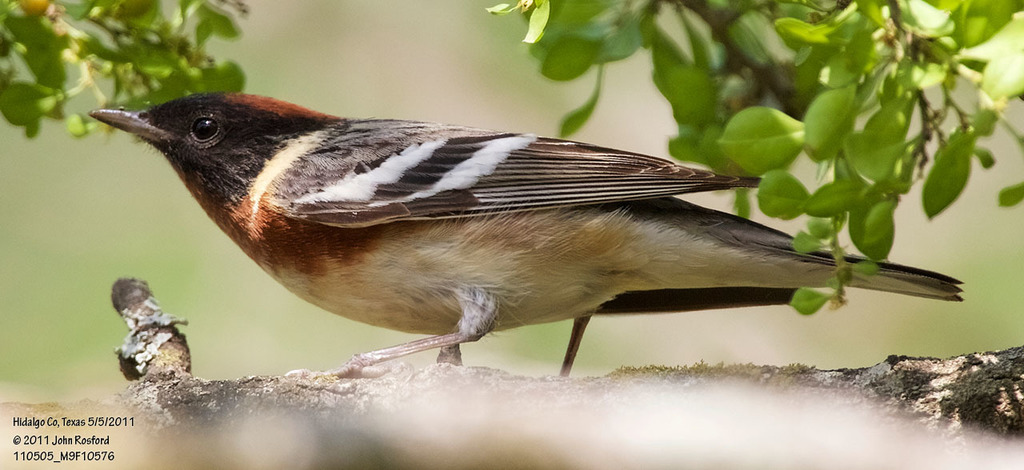
Bay-breasted Warbler
Photo © John Rosford
Photo © John Rosford — CC BY 4.0 — Source: iNaturalist photo #197874540Identification
The bay-breasted warbler is a small songbird with distinctive plumage that varies seasonally. Adult males in breeding plumage are greyish above with dark streaks on the back, two white wing bars, and a creamy neck patch. The face is black, while the crown, throat, and sides display a dark chestnut colour. Breeding females follow a similar pattern but appear paler and duller. In nonbreeding season, both sexes acquire olive-green feathers on the back, nape, and head, with rufous on the flanks becoming limited or fading entirely in females. The two white wing bars remain visible in all plumages.
In breeding plumage, bay-breasted warblers may be confused with chestnut-sided warblers, which have similar chestnut colouring on the sides—though the chestnut does not reach the throat or crown. In fall, nonbreeding birds closely resemble blackpoll warblers, but bay-breasted warblers retain a hint of chestnut on the flanks and possess black feet, whereas blackpolls have yellowish feet and no chestnut colouring.
Range & Habitat
Bay-breasted warblers breed in the boreal spruce-fir forests of eastern and central Canada, from Newfoundland west to northeastern British Columbia, and in the far northeast of the United States. They winter in wet lowland forests of northeastern South America, the Caribbean, and southern Central America. During spring and fall migration, they traverse the eastern half of the United States across various vegetative communities, with many individuals crossing the Gulf of Mexico on their long-distance journeys, though some follow the Mexican shore northward and southward. The species is a rare vagrant to the west coast of North America and has been recorded in Greenland.
Behaviour & Diet
During breeding season, bay-breasted warblers feed primarily on insects and spiders, particularly the spruce budworm, gleaning these prey items from vegetation rather than catching them in flight. To minimize competition, they concentrate foraging in the interior middle portions of coniferous trees. On their tropical wintering grounds, fruit becomes the majority of their diet. Wintering birds often join mixed-species flocks with other neotropical migrants and resident species, foraging in the forest canopy where they are notably aggressive members, sometimes bullying smaller species away from food sources.
Bay-breasted warblers nest in the lower portions of spruce or fir trees, constructing cup-shaped nests primarily from plant material, often incorporating spider silk. A typical clutch contains 4–7 whitish eggs with dark spots. Chicks are altricial at birth and have limited down.
Best Time & Places to See It
Breeders visiting Canada's boreal forests during summer months will find bay-breasted warblers in spruce-fir forests from Newfoundland through central and eastern regions. Migration periods in spring and fall offer opportunities to observe these birds throughout the eastern United States as they move between breeding and wintering grounds. For winter observations, travellers should visit wet lowland forests in northeastern South America, the Caribbean, or southern Central America, where the species is regular and often joins mixed-species feeding flocks in the canopy.
Photography Tips
The contrasting chestnut and black facial markings of breeding males make them excellent photographic subjects, particularly during breeding season. Frame shots to highlight the distinctive dark chestnut crown, throat, and sides against the greyish back and white wing bars. In nonbreeding plumage or migration, the duller olive-green tones and reduced rufous require patience but offer more subtle compositional opportunities. Forest canopy foraging behaviour provides dynamic shooting chances, though the birds' preference for the interior portions of conifers can present challenging lighting. Early morning light in boreal forests or tropical wintering grounds will best reveal the species' plumage details and colours.
Acadia National Park
Algonquin Provincial Park
Alligator River National Wildlife Refuge
Arenal Volcano National Park
Banff National Park
Barbilla National Park
Barra del Colorado National Wildlife Refuge
Baru Volcano National Park
Bic National Park
Nothing matches these filters.
No community photos yet. Log in to add the first one.
No community observations of this species yet.