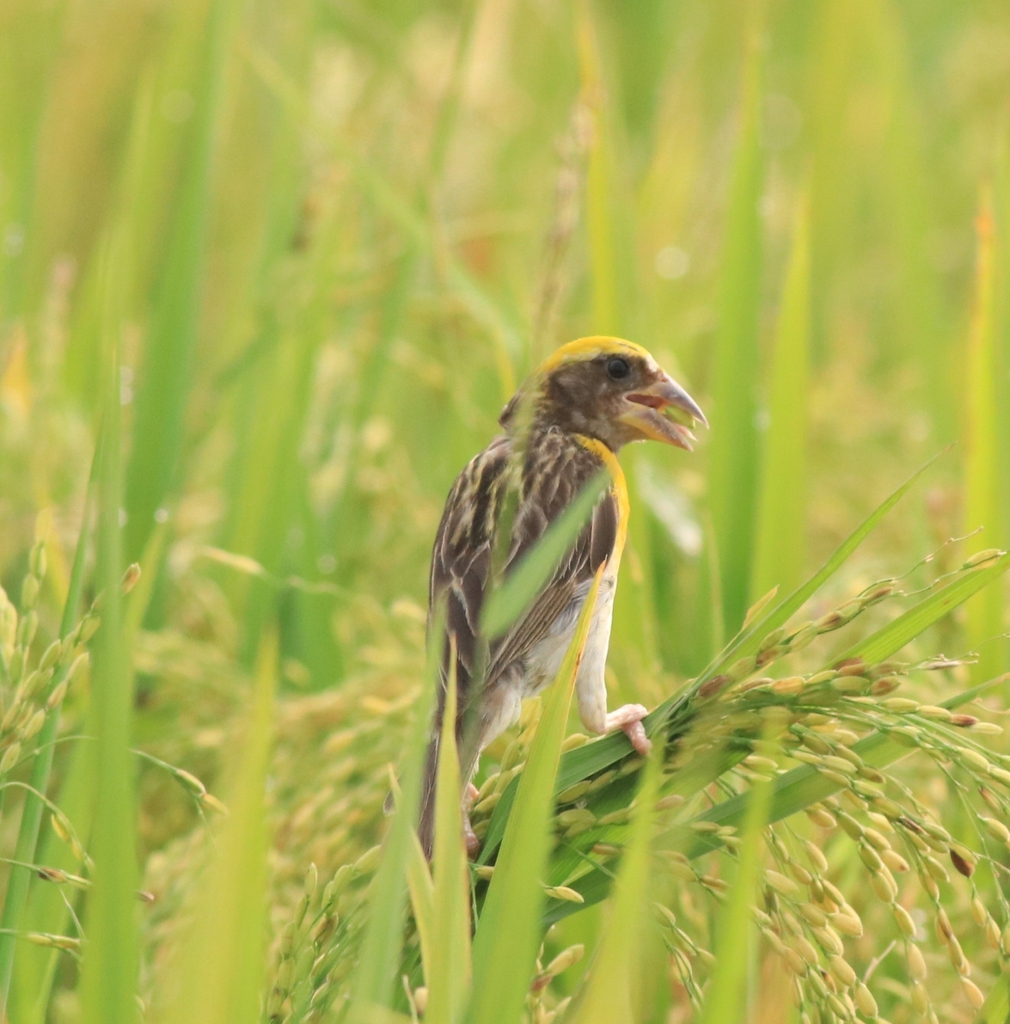
Baya Weaver
Photo © Afsar Nayakkan
Photo © Afsar Nayakkan — CC BY 4.0 — Source: iNaturalist #200507554Identification
The Baya Weaver is a sparrow-sized bird, measuring around 15 cm in length, with a stout conical bill and short square tail. In non-breeding plumage, both males and females are remarkably similar to female house sparrows, with dark brown upperparts streaked with fulvous buff, plain whitish underparts, a long buff eyebrow stripe, and a horn-coloured bill. Breeding males are far more striking, sporting a bright yellow crown, dark brown mask, blackish-brown bill, dark brown upperparts streaked with yellow, and a bright yellow breast with cream-buff underparts.
Range & Habitat
This widespread and common weaverbird is found across the Indian subcontinent and Southeast Asia. Five subspecies are recognised across the range: the nominate race inhabits much of mainland India, while darker southwestern Indian populations are separately classified. Other subspecies extend eastward into Southeast Asia, reaching Bhutan, Bangladesh, Myanmar, Thailand, Laos, Vietnam, and the Malay Peninsula, as well as islands including Borneo, Sumatra, Java and Bali.
Baya Weavers favour grasslands, cultivated areas, scrub and secondary growth habitats. They are prone to local, seasonal movements in response to rainfall and food availability, roosting in reed-beds bordering waterbodies and depending on wild grasses and cultivated crops for sustenance and nesting material.
Behaviour & Diet
Highly social and gregarious, Baya Weavers forage in flocks for seeds both on plants and on the ground, gleaning paddy and other grains from harvested fields. They fly in tight formations, often performing complicated aerial manoeuvres. Beyond seeds, they feed on insects including butterflies, and occasionally take small frogs, geckos and molluscs, particularly when feeding young. Their males produce continuous chit-chit calls, sometimes ending in a wheezy cheee-eee-ee when chorusing, while lower-intensity calls characterise the non-breeding season.
Best Time & Places to See It
Breeding occurs during the monsoon season, making this the best time to observe the spectacular nest-building behaviour and colonial activity. Look for them in agricultural areas, reed-beds, and grasslands near water sources throughout their range. They are widespread and common, so patient observation in suitable habitat should yield sightings, particularly during the breeding season when males are actively displaying at their nests.
Photography Tips
The most compelling photographic opportunities come during the breeding season when males display at their extraordinary hanging nests. Position yourself near thorny acacias, palm trees or reed-beds where colonies typically gather, ideally near water where the suspended nests are most visible. Capture the contrast between the drab non-breeding plumage and the brilliant breeding male's yellow and black markings. The retort-shaped nests themselves, with their distinctive entrance tubes, make striking subjects. Early morning light on the eastern side of trees—where nests are often located for monsoon protection—provides excellent photographic conditions.
Lunugamvehera National Park
Sri Lanka
+204 birds+14 mammals
Dry scrubland and shallow wetlands converge in Sri Lanka's southeastern lowlands, where Lunugamvehera National Park anchors one of the island's most ecologically vital landscapes. The park's…
VIEW NATIONAL PARKWasgamuwa National Park
Sri Lanka
+156 birds+8 mammals
Dry deciduous forest and open grassland sweep across the North Central lowlands where Wasgamuwa National Park protects one of Sri Lanka's largest remaining tracts of this…
VIEW NATIONAL PARKOrang National Park
Rangagarapathar, India
+298 birds+1 mammals
Where the Brahmaputra's floodplains meet the foothills of Assam, Orang National Park unfolds across a mosaic of riverine grasslands, forests and wetlands that pulse with the…
VIEW NATIONAL PARKRanthambhore National Park
Sawai Madhopur, India
+294 birds+20 mammals
Granite ridges and ravines carved through the Aravalli Range frame this protected landscape in eastern Rajasthan, where deciduous forest mingles with open scrubland and seasonal water…
VIEW NATIONAL PARKHat Noppharat Thara-Mu Ko Phi Phi National Park
Ao Nang, Thailand
+253 birds+9 mammals
Where limestone karsts rise dramatically from turquoise waters, Hat Noppharat Thara-Mu Ko Phi Phi National Park unfolds across a mosaic of beach, mangrove forest, and island…
VIEW NATIONAL PARKKhao Yai National Park
Prachantakham District, Thailand
+377 birds+46 mammals
Evergreen dipterocarp forest blankets the rolling terrain of this national park in eastern Thailand, where limestone hills rise abruptly from the forest floor and seasonal streams…
VIEW NATIONAL PARKKhao Laem National Park
Sangkhla Buri District, Thailand
+197 birds
Where the Vajiralongkorn Reservoir sprawls across the forested valleys of Kanchanaburi's northern borderlands, Khao Laem National Park protects a landscape where limestone ridges rise dramatically from…
VIEW NATIONAL PARKKanha Tiger Reserve
Kanha Kisli F.V., India
+321 birds+23 mammals
Where sal forests give way to emerald meadows and crystalline streams carve through ancient valleys, one of India's finest wilderness reserves unfolds across the Maikal Range.…
VIEW NATIONAL PARKTadoba National Park
Palasgaon Singru, India
+270 birds+20 mammals
Where sal forests meet open grasslands and rocky outcrops rise from red laterite soil, central India's landscape unfolds in raw, untamed beauty. Ancient teak woodlands and…
VIEW NATIONAL PARKBandhavgarh National Park
Garhpuri, India
+285 birds+17 mammals
Where granite ridges rise dramatically above sal and bamboo forests, one of India's most pristine tiger reserves unfolds across the Vindhyan plateau. Ancient rock formations tower…
VIEW NATIONAL PARKPanna National Park
Badgadi Kalan, India
+271 birds+17 mammals
Where granite gorges slice through central India's Vindhyan plateau, a landscape of stark beauty unfolds across nearly six hundred square kilometers. The Ken River carves through…
VIEW NATIONAL PARKKaziranga National Park
Kohora, India
+422 birds+26 mammals
Dawn breaks over the floodplains of the Brahmaputra, where tall grasslands stretch endlessly beneath monsoon-heavy skies. This sprawling wilderness of northeastern Assam is a mosaic of…
VIEW NATIONAL PARKKeoladeo National Park
Shreenagar Rural, India
+326 birds+14 mammals
Where shallow wetlands shimmer beneath vast Rajasthani skies, one of Asia's finest bird sanctuaries pulses with extraordinary life. This former maharaja's hunting reserve, now spanning 29…
VIEW NATIONAL PARKBandipur National Park
Hirehalli, India
+302 birds+19 mammals
Where the Western Ghats descend into the Deccan plateau, ancient deciduous forests blanket a landscape carved by the Nugu River. Bandipur unfolds across 880 square kilometres…
VIEW NATIONAL PARKNagarahole Tiger Reserve
Nalkeri Forest, India
+323 birds+23 mammals
Where granite escarpments rise above dense deciduous forests and the Kabini River carves through pristine wilderness, one of India's most biodiverse landscapes unfolds across the Western…
VIEW NATIONAL PARKTaman Negara National Park
Kampong Samas, Malaysia
+393 birds+48 mammals
Where ancient rainforest meets limestone peaks, one of Southeast Asia's oldest protected wilderness preserves sprawls across 4,343 square kilometers of primordial landscape. Dipterocarp giants tower overhead,…
VIEW NATIONAL PARKWest Bali National Park
Gerokgak, Indonesia
+240 birds+8 mammals
Across West Bali's northwestern reaches, where the Indian Ocean meets volcanic slopes and limestone cliffs plunge toward turquoise shallows, sprawls a protected realm of roughly 325…
VIEW NATIONAL PARKKerinci Seblat National Park
Kerinci, Indonesia
+228 birds+16 mammals
Across nearly 67,000 square kilometres of Sumatra's spine, a mountainous realm of equatorial rainforest rises from steaming lowlands to volcanic peaks shrouded in cloud. Kerinci Seblat…
VIEW NATIONAL PARKKomodo National Park
Komodo, Indonesia
+155 birds+14 mammals
Where volcanic peaks rise dramatically from turquoise waters, a primordial landscape unfolds across three main islands and countless smaller ones scattered throughout the Lesser Sunda archipelago.…
VIEW NATIONAL PARKGir National Park
Asundrali, India
+258 birds+13 mammals
Dry deciduous forests cloak the rolling hills of western Gujarat where the Gir landscape rises as a final sanctuary for one of the world's rarest felids:…
VIEW NATIONAL PARKNo community photos yet. Log in to add the first one.
No community observations of this species yet.