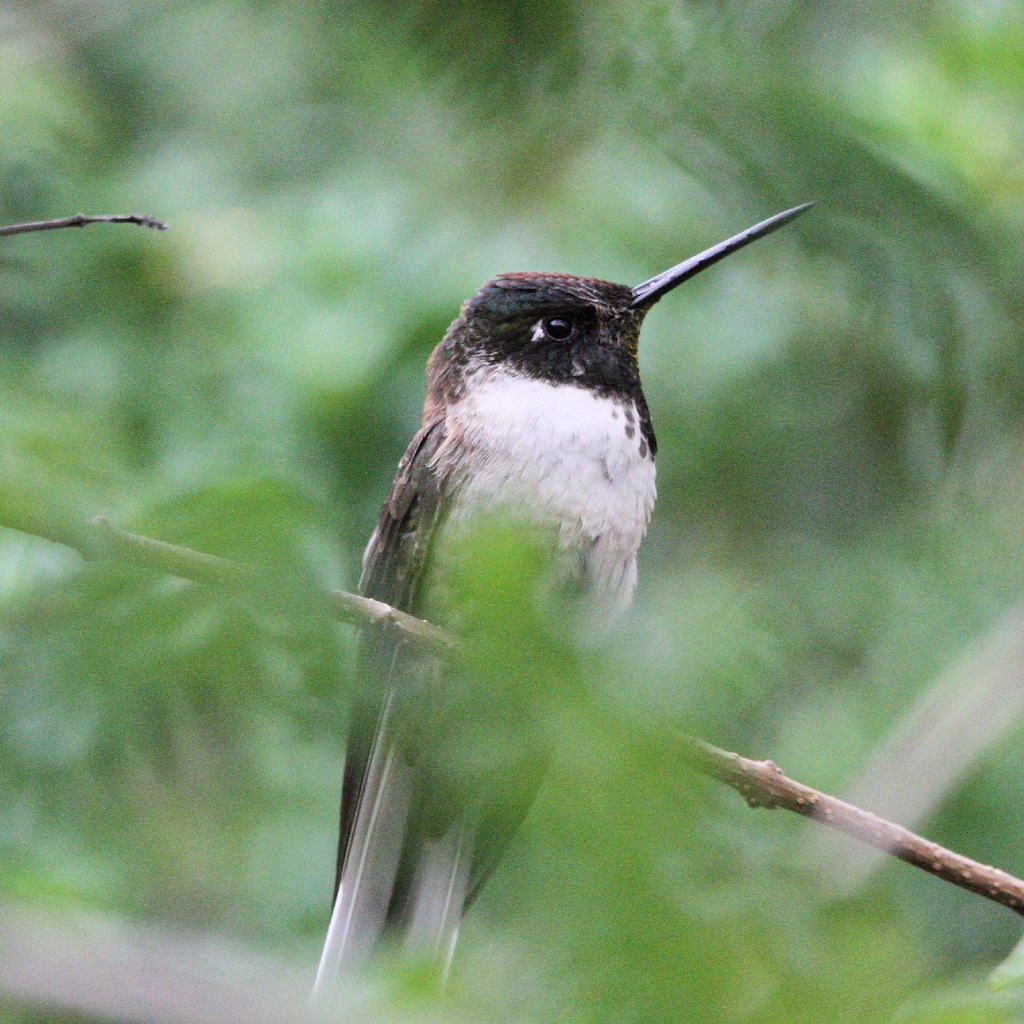
Bearded Mountaineer
Photo © capacoscar
Photo © capacoscar — CC BY 4.0 — Source: iNaturalist #262273139Identification
The bearded mountaineer is a small hummingbird, measuring 14 to 16.5 cm in length with a notably long, narrow bill of approximately 2.3 cm. Males of the nominate subspecies are strikingly patterned with a deep purplish-blue forecrown and crown bisected by a narrow black stripe, complemented by a bronzy-black face and distinctive white band at the rear. The species derives its name from its characteristic long, narrow emerald-green gorget that transitions to purplish hues with a bluish tip. The tail is notably long and deeply forked, displaying bronze tones with increasing white toward the outer feathers. The back and rump are bronzy to bronzy-brown, while the breast center is white with brownish flanks. Females are duller overall with a smaller, mostly white gorget and less deeply forked tail. The western subspecies O. n. albolimbata displays white bands flanking the crown and a much more coppery tail, with females showing white extending from the crown through the lores to the gorget.
Range & Habitat
The bearded mountaineer is endemic to Peru, with two subspecies occupying distinct regions. The eastern nominate subspecies inhabits south-central Peru in the departments of Apurímac and Cuzco, particularly in the Urubamba and upper Apurímac river drainages. The western subspecies occurs in the departments of Huancavelica, Ayacucho, and Apurímac, in the Mantaro, Pampas, and Chalhuanca river drainages. The species is a year-round resident throughout its range.
Bearded mountaineers occupy dry Andean valleys characterized by rocky, scrubby hillsides and open woodland, typically at elevations between 2,500 and 3,900 meters. While they frequent native plant communities, they have adapted readily to human-modified landscapes, regularly appearing in tree tobacco and Eucalyptus plantations, including disturbed areas along roadsides and in towns.
Behaviour & Diet
The bearded mountaineer feeds primarily on nectar from agave, cacti, tree tobacco, and Eucalyptus flowers. It displays an unusual feeding technique, hovering with an almost vertical stance and flicking its tail, but also clinging to flowers with wings held open. The species supplements its diet with small arthropods. In mixed-species settings, the bearded mountaineer is notably submissive to most other hummingbird species.
While specific breeding phenology remains undocumented, historical accounts suggest the species may breed in caves above rivers. Its vocalizations are distinctive and varied, consisting of "a descending, squeaky series followed by a rich chatter" (rendered as "swee swee chew-chew-chew") and a dry "dzzrt" call.
Best Time & Places to See It
The bearded mountaineer is described as uncommon to locally common throughout its range. Observers should focus on the two distinct subspecies regions: the Urubamba and upper Apurímac valleys for the nominate eastern form, and the Mantaro, Pampas, and Chalhuanca river valleys for the western albolimbata subspecies. Since the species is resident year-round, it can be encountered during any season, though specific seasonal patterns within the breeding cycle remain unknown.
Photography Tips
Photographing the bearded mountaineer presents both challenges and rewards. The species' iridescent gorget and deeply forked tail are particularly striking subjects, especially in males. Look for them feeding at Eucalyptus and tree tobacco flowers, which are accessible even in disturbed roadsides and settled areas. Their submissive behavior toward other hummingbirds means they may be less aggressive at feeders, offering patient photographers opportunities for close-range images. The contrasting white breast and bronzy flanks provide good compositional elements, while the distinctive facial markings and crown pattern aid in field identification. Early morning light will best illuminate the male's purplish-blue plumage and the emerald-green gorget.
Birdwatching in Peru
Nothing matches these filters.
No community photos yet. Log in to add the first one.
No community observations of this species yet.