Bearded Vulture
Gypaetus barbatus
Photo © wildatlasguide
Photo © wildatlasguide — Used with permissionABOUT
Subspecies of Bearded Vulture
Eurasian Bearded VultureAfrican Bearded Vulture
Identification
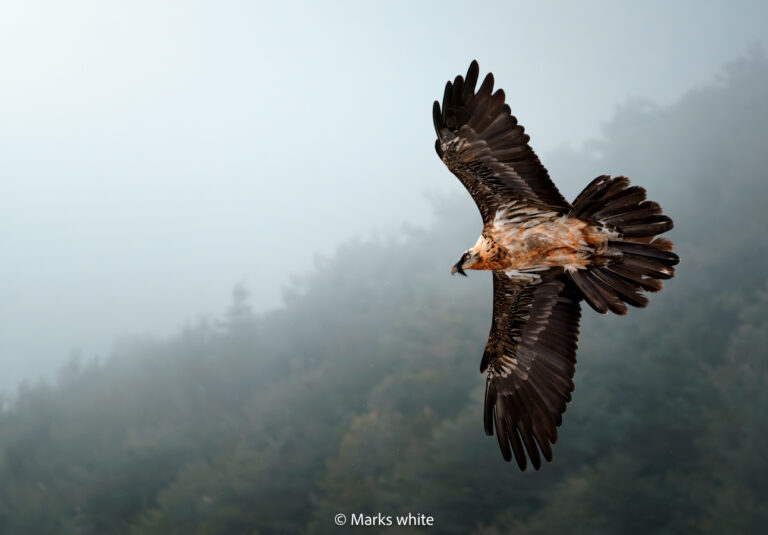
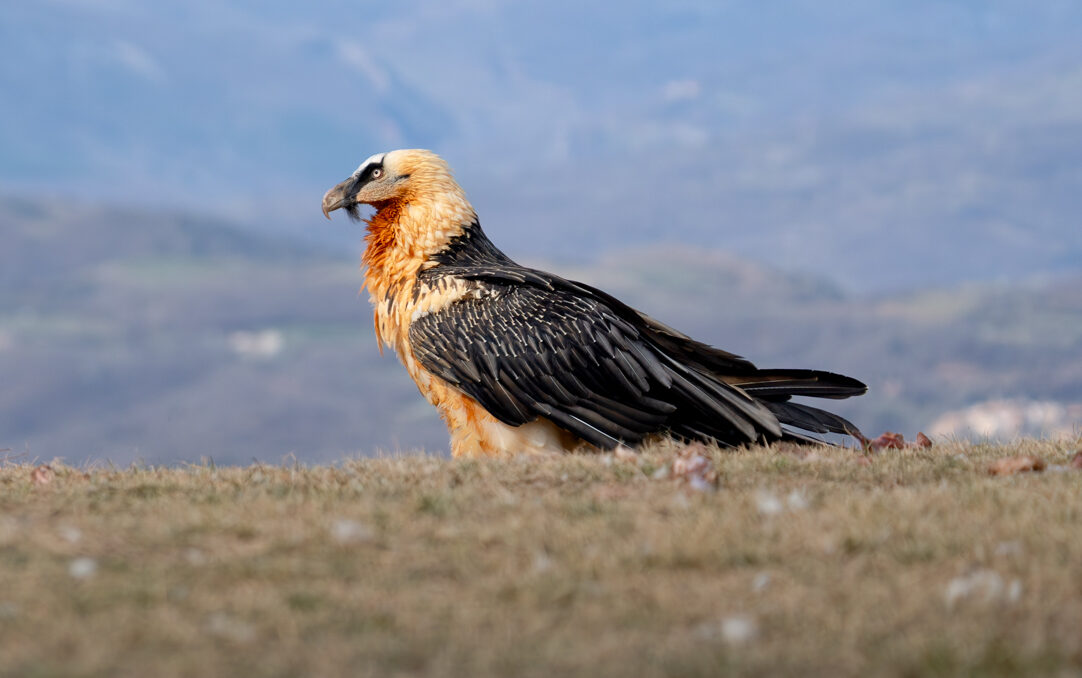
The bearded vulture is unmistakable in flight, distinguished by its exceptionally long, narrow wings and long, wedge-shaped tail that is actually longer than the width of its wings—proportions sometimes compared to a giant falcon. At 94–125 cm long with a wingspan of 2.31–2.83 m and weighing 4.5–7.8 kg, it is a very large bird of prey. Unlike most vultures, it has a fully feathered neck and relatively small head, though powerful and thick-necked overall. Adults are mostly dark grey above with creamy foreheads contrasted by a distinctive black band across the eyes and characteristic black bristles under the chin forming a beard. The breast, head, and leg feathers display variable rusty or orange colouration acquired through dust-bathing in iron-rich mud. Juveniles are dark blackish-brown, gradually acquiring adult plumage over five to seven years before reaching full maturity at eight years or older.
Range & habitat
The bearded vulture is sparsely distributed across a vast range, living and breeding on crags in high mountains in Iran, southern Europe, East Africa, the Indian subcontinent, Tibet, and the Caucasus. Birds found around the Himalayas tend to be slightly larger than those from other mountain ranges, reflecting the species' adaptability to diverse high-altitude environments across its wide geographic distribution.
Behaviour & diet
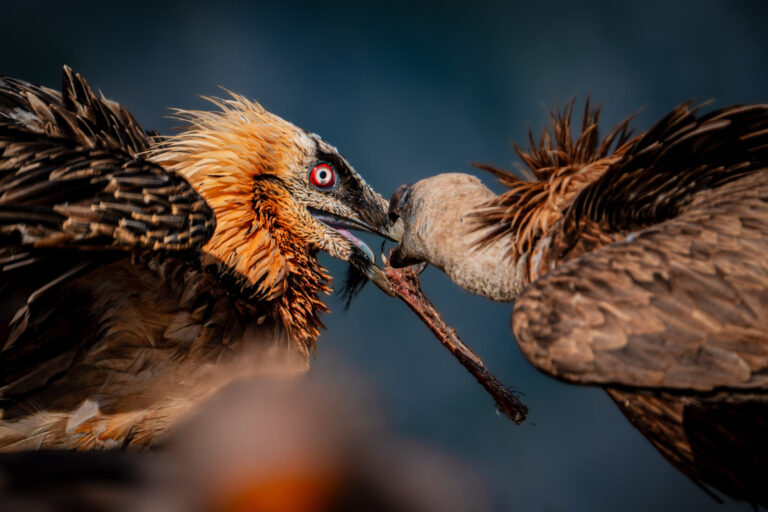
The bearded vulture is remarkable for its unique diet: 70–90% of its food consists of bone, making it the only known vertebrate with such bone-dependent feeding habits. Its stomach acid, with a pH around 1, dissolves large bones within approximately 24 hours through slow churning of stomach contents. Bones are energy-rich food sources—the protein in bone matrix and the high lipid content of bone marrow mean that fresh bones provide about 108% of the energy content of fresh meat by weight. The bird can exploit carcasses months after other scavengers have consumed soft tissues, as skeletons left on mountains dehydrate and become protected from bacterial degradation. The bearded vulture is generally silent except for shrill whistles during breeding displays and a falcon-like cheek-acheek call around the nest.
Best time & places to see it
Females lay one or two eggs in mid-winter that hatch at the beginning of spring, suggesting that spring observation may coincide with breeding activity and increased visibility. The species occurs in high mountain regions across Iran, southern Europe, East Africa, the Indian subcontinent, Tibet, and the Caucasus, where it can be spotted soaring over crags and rocky terrain in these mountain strongholds.
Photography tips
The bearded vulture's distinctive silhouette in flight—with long, narrow wings and an elongated wedge-shaped tail—makes it highly photogenic during soaring. Capture the striking facial markings: the creamy forehead, black eye-band, and characteristic beard. The rusty or orange plumage on the head, breast, and legs, acquired from iron-rich mud, adds striking colour variation that may be emphasized in photographs. Mountain habitat photography should emphasize the bird against crags and rocky landscapes where it breeds and hunts for bone-laden carcasses.
HIDES
Sort by
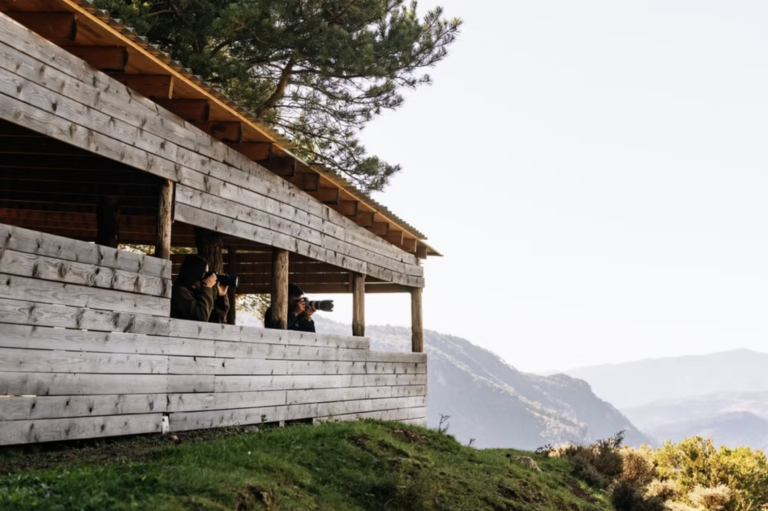
Vultures in flight (without glass)
Buseu Wild Pyrenees·Buseu·Spain
Bearded Vulture · Cinereous Vulture+2
20 max.
50 €/ person
Book nowNothing matches these filters.
EXPERIENCES
Sort by
Photography WorkshopEasy
Pedro Marín – Instante Natural
Bearded Vulture photography workshop at Buseu
13–16 Nov 2026 and 1 more date
3 full days
6
ES
Golden Eagle · Bearded Vulture +10
735 €/ person
Book nowNothing matches these filters.
STAYS
Sort by
Nothing matches these filters.
HOTSPOTS
Country
Type
Sort by
Natural Park
Alpilles Regional Nature Park
Saint-Rémy-de-Provence·France
+219 birds+37 mammals
National Park
Altai Tavan Bogd National Park
Tsengel·Mongolia
+146 birds+3 mammals
Natural Park
Awash National Park
Didiga·Ethiopia
+473 birds+23 mammals
Nature Reserve
Baima Snow Mountain National Nature Reserve
Diqing Tibetan Autonomous Prefecture·China
+204 birds+3 mammals
National Park
Bale Mountains National Park
Ethiopia
+397 birds+20 mammals
Desert & Arid Lands
Bardenas Reales
Arguedas·Spain
+234 birds+10 mammals
Forest & Jungle
Bosc de Virós
Ainet de Besan·Spain
+126 birds+10 mammals
Forest & Jungle
Bosques de Plan
San Juan de Plan·Spain
+125 birds+4 mammals
Natural Park
Cadí Moixeró Natural Park
Bor·Spain
+172 birds+21 mammals
Nothing matches these filters.
COMMUNITY
Share your photo of this species
Sort by
1
Observed by
1
Hotspot reported
1
Country
Countries reported:
Spain