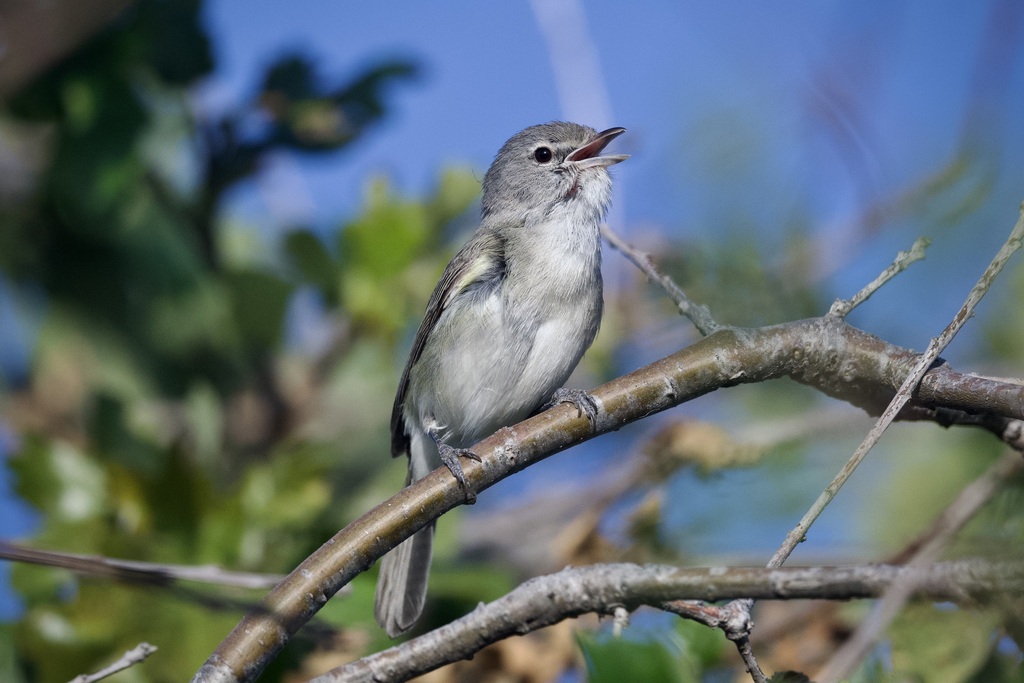
Bell’s Vireo
Photo © Dario Taraborelli
Photo © Dario Taraborelli — CC0 1.0 — Source: iNaturalist photo #384653585Identification
Bell's vireo is a small songbird measuring 4.5–4.9 inches in length, with a wingspan of 6.7–7.5 inches and weighing just 0.3–0.3 ounces. It is dull olive-gray above and whitish below, with a faint white eye ring and faint wing bars. These subtle markings and modest size make it a challenging bird to identify in the field, requiring patience and careful observation of its distinctive features.
Range & Habitat
Bell's vireo is a migratory species that breeds across Western North America and winters in Central America. Four subspecies are recognized: the endangered least Bell's vireo (V.b. pusillus) in Southern California; the Arizona Bell's vireo (V.b. arizonae) in the southwestern United States and northern Mexico; V.b. medius in southwestern Texas and Mexico; and V.b. belli across central and midwestern United States to central Mexico. During breeding season, Bell's vireos favor dense shrubbery in riparian areas near water, with willow trees being the preferred nesting species across all subspecies. In western regions, mesquite and seep-willow are also frequently used. The least Bell's vireo, once common throughout lowland riparian habitats of coastal and interior Southern California, now occupies a greatly reduced range due to habitat loss.
Behaviour & Diet
Bell's vireos construct distinctive hanging nests suspended between the ends of low tree branches. However, these nests face significant predation pressure from brown-headed cowbirds, which parasitize them and reduce breeding success overall. Interestingly, vireos nesting in upland habitats experience less parasitism than those in river-adjacent riparian areas. In winter, the least Bell's vireo shows greater habitat flexibility, utilizing mesquite scrub within arroyos, palm groves, and hedgerows in agricultural and residential areas of Baja California Peninsula, rather than remaining confined to willow-dominated riparian zones.
Best Time & Places to See It
For observers in California, the least Bell's vireo population has made a remarkable recovery since being listed as endangered in 1986, when only 300 pairs remained. By 1998, numbers had increased six-fold to approximately 2,000 pairs. Today, the best locations to find nesting least Bell's vireos include San Diego County—which supports roughly half the current population, particularly along Marine Corps Base Camp Pendleton and the lower Santa Margarita River—and recently recolonized areas including the Santa Clara River in Ventura County and the Mojave River in San Bernardino County. Spring and early summer offer the best viewing opportunities during the breeding season.
Photography Tips
The subtle plumage of Bell's vireo demands patient, careful photography. Focus on capturing the faint white eye ring and wing bars, which are key identification features. Early morning light works well for highlighting the bird's olive-gray upperparts against its whitish underside. Because vireos favor dense shrubbery and low branches, a telephoto lens and flexible positioning will help you photograph these small birds without disturbing nesting attempts. Visits to protected riparian habitats like those at Camp Pendleton and along restored river corridors in Southern California offer the most reliable opportunities to photograph the endangered least Bell's vireo.
Gulf Islands National Park Reserve
Southern Gulf Islands Electoral Area, Canada
+268 birds+26 mammals
Scattered across the Salish Sea in British Columbia's southwestern corner, this national park reserve stitches together a fragmented archipelago of forested islands and rocky outcrops where…
VIEW NATIONAL PARKBig Bend National Park
Brewster County, United States
+345 birds+34 mammals
Where the Chisos Mountains rise abruptly from the Sonoran Desert floor, Big Bend National Park spans over 7,300 square kilometers of one of North America's most…
VIEW NATIONAL PARKSaguaro National Park
Rincon Valley, United States
+354 birds+40 mammals
Where the Sonoran Desert meets sky-island mountains, two geographically separated districts of Saguaro National Park sprawl across nearly two thousand square kilometers of Arizona's most iconic…
VIEW NATIONAL PARKIndiana Dunes National Park
Porter, United States
+304 birds+15 mammals
Along the southern shore of Lake Michigan, where glacial geology meets temperate woodland and open water, sprawls a landscape of extraordinary ecological complexity. The dunes themselves—massive…
VIEW NATIONAL PARKJoshua Tree National Park
Riverside County, United States
+221 birds+23 mammals
Across 5,610 square kilometers of Riverside County's high desert, a landscape of geological drama unfolds where granite monoliths pierce through bajadas of creosote scrub and Joshua…
VIEW NATIONAL PARKCarlsbad Caverns National Park
Eddy County, United States
+309 birds+18 mammals
Beneath the Chihuahuan Desert floor of southern New Mexico lies one of North America's most spectacular subterranean landscapes. Carlsbad Caverns National Park encompasses over 518 square…
VIEW NATIONAL PARKZion National Park
Washington County, United States
+244 birds+30 mammals
Towering sandstone cliffs in shades of crimson, rust, and cream rise abruptly from the Virgin River's winding canyon floor, their sculpted faces bearing witness to millions…
VIEW NATIONAL PARKEverglades National Park
Monroe County, United States
+345 birds+22 mammals
Where freshwater marsh meets subtropical sky, the Everglades sprawls across southwestern Florida as one of North America's most expansive wetland ecosystems. Spanning over 13,000 square kilometers,…
VIEW NATIONAL PARKDeath Valley National Park
Inyo County, United States
+339 birds+25 mammals
Across nearly 3.5 million acres of southeastern California's Inyo County, vast salt flats meet sculpted badlands and alluvial fans in a landscape so extreme it defines…
VIEW NATIONAL PARKEl Vizcaíno
Laguna San Ignacio, Mexico
+317 birds+29 mammals
Where the Baja California peninsula thins into a tapestry of salt lagoons and coastal desert, one of Mexico's most biodiverse reserves sprawls across half a million…
VIEW BIOSPHERE RESERVETutuaca
Tosanachi, Mexico
+147 birds+13 mammals
Where copper canyons plunge deeper than the Grand Canyon itself, Mexico's remote Sierra Madre Occidental unfolds in dramatic vertical relief. Tutuaca anchors this wilderness realm, a…
VIEW PROTECTED LANDSCAPEBadlands National Park
Wall, United States
+200 birds+14 mammals
Eroded badlands rise in jagged formations across northwestern South Dakota, where the White River has carved deep canyons through layers of sedimentary rock spanning millions of…
VIEW NATIONAL PARKBiscayne National Park
Miami-Dade County, United States
+263 birds+7 mammals
Coral reefs and mangrove shallows dominate this marine sanctuary where the Florida Keys meet the Atlantic, creating a mosaic of shallow seagrass meadows, patch reefs, and…
VIEW NATIONAL PARKGrand Canyon National Park
United States
+277 birds+35 mammals
A mile-deep chasm of rust-red rock and purple shadow cuts through the high desert plateau of northern Arizona, revealing nearly two billion years of geological history…
VIEW NATIONAL PARKGuadalupe Mountains National Park
Culberson County, United States
+262 birds+14 mammals
Where fossil-laden limestone ridges thrust skyward above the Chihuahuan Desert floor, Guadalupe Mountains National Park reveals a landscape sculpted by ancient seas and relentless aridity. These…
VIEW NATIONAL PARKHot Springs National Park
Hot Springs, United States
+168 birds+8 mammals
Thermal waters rising from deep within the Ouachita Mountains have carved a landscape unlike anywhere else in the continental United States, where 47 natural hot springs…
VIEW NATIONAL PARKWind Cave National Park
Custer County, United States
+175 birds+13 mammals
Beneath the rolling prairie of the Black Hills, a network of passages carved through limestone creates one of North America's most extensive cave systems. Wind Cave…
VIEW NATIONAL PARKBosque del Apache National Wildlife Refuge
Socorro County, United States
+345 birds+17 mammals
Where the Rio Grande emerges from its desert canyon in central New Mexico, a narrow ribbon of riparian woodland defies the arid landscape that surrounds it.…
VIEW WILDLIFE SANCTUARYMerritt Island National Wildlife Refuge
Brevard County, United States
+341 birds+19 mammals
Brackish marshes and palmetto scrub define this wildlife sanctuary spanning the coastal lowlands of central Florida, where the Atlantic tide meets freshwater systems in a dynamic…
VIEW WILDLIFE SANCTUARYWichita Mountains National Wildlife Refuge
Medicine Park, United States
+256 birds+17 mammals
Granite peaks rise abruptly from rolling prairie in southwestern Oklahoma, where the Wichita Mountains National Wildlife Refuge protects a rare collision of ecosystems. This sanctuary encompasses…
VIEW WILDLIFE SANCTUARYLaguna Atascosa National Wildlife Refuge
Cameron County, United States
+365 birds+19 mammals
Where coastal prairie meets shallow lagoon along the southernmost tip of Texas, Laguna Atascosa National Wildlife Sanctuary sprawls across a landscape sculpted by salt spray and…
VIEW WILDLIFE SANCTUARYSanta Ana National Wildlife Refuge
Hidalgo County, United States
+349 birds+12 mammals
Where the Rio Grande delta meets the semi-arid scrublands of South Texas, Santa Ana National Wildlife Sanctuary preserves a rare mosaic of wetland and thornforest habitat…
VIEW WILDLIFE SANCTUARYCabeza Prieta National Wildlife Refuge
United States
+155 birds+6 mammals
Across southwestern Arizona's harshest terrain, where the Colorado River marks the border with Mexico, lies a sanctuary shaped entirely by heat and aridity. Cabeza Prieta National…
VIEW WILDLIFE SANCTUARYHavasu National Wildlife Refuge
Lake Havasu City, United States
+291 birds+8 mammals
Where the Colorado River widens into a vast reservoir in the Sonoran Desert, Havasu National Wildlife Sanctuary protects one of the most critical wetland ecosystems in…
VIEW WILDLIFE SANCTUARYImperial National Wildlife Refuge
La Paz County, United States
+222 birds+4 mammals
Where the Colorado River carves through the Sonoran Desert in southwestern Arizona, Imperial National Wildlife Sanctuary unfolds across a landscape shaped by water and aridity. The…
VIEW WILDLIFE SANCTUARYSan Luis National Wildlife Refuge
Merced County, United States
+219 birds+14 mammals
Across the floor of California's San Joaquin Valley, where semi-arid grasslands meet shallow seasonal wetlands, San Luis National Wildlife Sanctuary preserves a critical mosaic of habitats…
VIEW WILDLIFE SANCTUARYDon Edwards San Francisco Bay National Wildlife Refuge
Fremont, United States
+286 birds+20 mammals
Where the San Francisco Bay's shallow margins dissolve into tidal salt marshes and mudflats, this wildlife sanctuary preserves one of California's most ecologically vital estuarine systems.…
VIEW WILDLIFE SANCTUARYSalton Sea National Wildlife Refuge
Imperial County, United States
+289 birds+4 mammals
Across the floor of California's inland desert, where summer temperatures soar and rainfall is measured in tenths of inches, lies an improbable oasis of shallow water…
VIEW WILDLIFE SANCTUARYNo community photos yet. Log in to add the first one.
No community observations of this species yet.