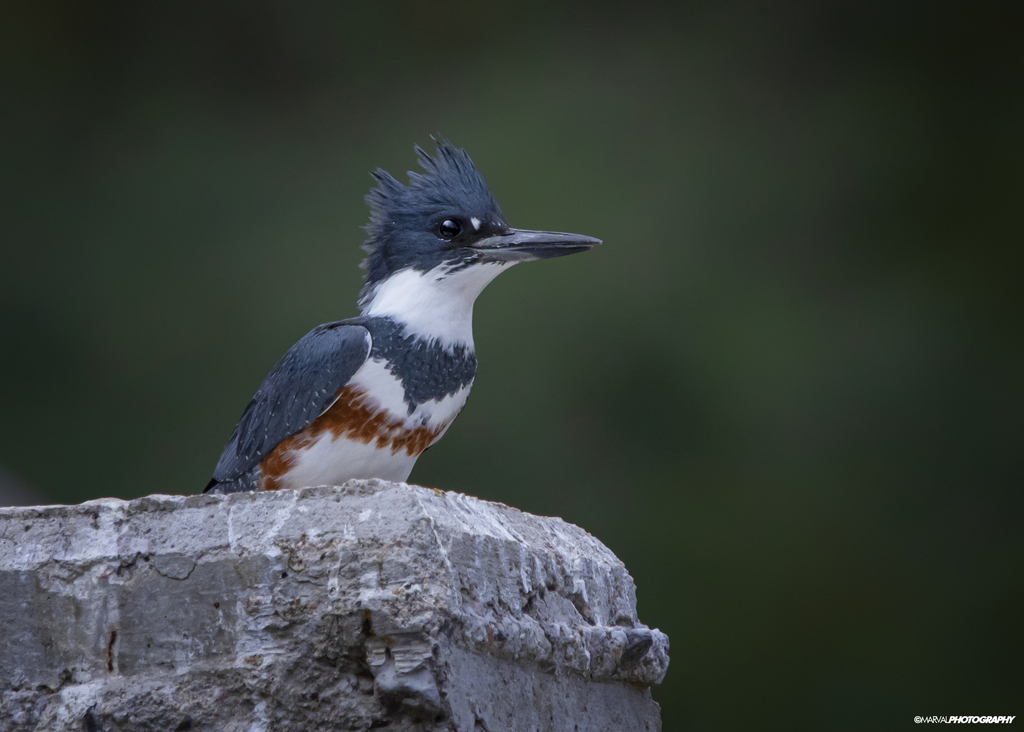
Belted Kingfisher
Photo © MarvalPhotography19
Photo © MarvalPhotography19 — CC BY 4.0 — Source: iNaturalist photo #254141618Identification
The belted kingfisher is a stocky, medium-sized bird measuring 28–35 cm in length with a wingspan of 48–58 cm, weighing between 113 and 178 g. Its most distinctive features are a large head crowned with a shaggy crest and a long, heavy black bill with a grey base. Both sexes display slate-blue heads, a prominent white collar, a large blue band across the breast, and white underparts. The back and wings are slate blue with black feather tips and white dots. The female is notably larger than the male on average and features a striking rufous band across the upper belly extending down the flanks—a marking also present in juveniles, though less pronounced in young males.
Range & Habitat
Native to North America, the belted kingfisher breeds across most of Canada, Alaska, and the United States near inland bodies of water and coasts, making it the only kingfisher species throughout most of its range. Northern populations migrate southward in winter to the southern United States, Mexico, Central America, and the West Indies. The species also appears as a rare visitor to Colombia, Venezuela, and the Guianas, with occasional records from Pacific islands and extremely rare vagrants recorded in Ecuador, Greenland, Ireland, the Netherlands, Portugal, and the United Kingdom.
Behaviour & Diet
The belted kingfisher is often observed perching prominently on trees, posts, and other vantage points near water before plunging headfirst to catch fish. Its diet extends beyond fish to include amphibians, molluscs, small crustaceans, insects, small mammals, small birds, reptiles, and berries. The bird frequently pounds its prey against its perch or the ground to stun and kill it. As it flies, it emits a characteristic rattling call—so distinctive that a group of belted kingfishers is known as a "rattle," "concentration," or "kerfuffle."
Best Time & Places to See It
The belted kingfisher is a permanent resident in warmer areas year-round, but northern populations are seasonal visitors. Breeding habitat encompasses inland waterways and coastal areas throughout North America. In winter, focus your search on the southern United States, Mexico, Central America, and the West Indies. In northern regions, the species will remain if open water persists, even during cold winters, making accessible unfrozen lakes and rivers your best bet for winter sightings.
Photography Tips
Position yourself near water where you can observe the bird's characteristic perching behavior—trees, posts, and rocky outcrops close to the water's edge offer excellent photo opportunities. The bird's prominent white collar and contrasting blue plumage provide strong visual interest. During breeding season, locate nesting sites along river banks or sand banks where you may photograph adults entering and exiting the horizontal tunnel nests. Be prepared for quick action when the bird dives for prey, and listen for its distinctive rattling call to locate individuals in the field.
Tombstone Territorial Park
Acadia National Park
Alaska Maritime National Wildlife Refuge
Algonquin Provincial Park
Alligator River National Wildlife Refuge
Arches National Park
Arenal Volcano National Park
Arrecifes de Cozumel National Park
Badlands National Park
Nothing matches these filters.
No community photos yet. Log in to add the first one.
No community observations of this species yet.