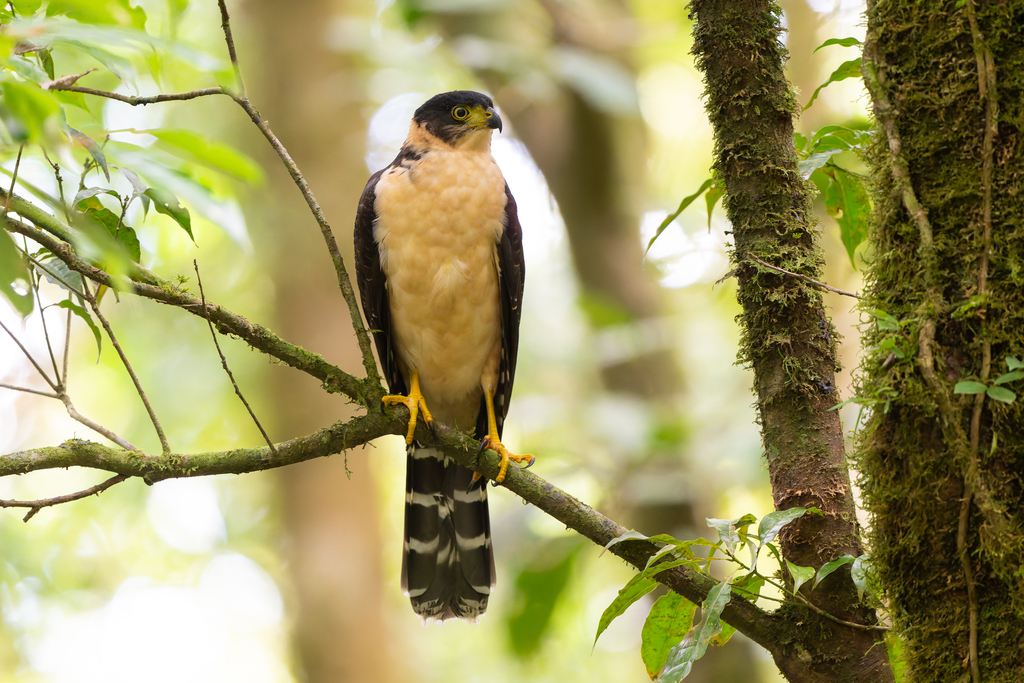
Bicolored Hawk
Photo © Adam Jackson
Photo © Adam Jackson — CC0 1.0 — Source: iNaturalist photo #560697670Identification
The bicolored hawk is a medium-sized raptor measuring 34–45 centimetres in length, with females significantly larger than males. Adults display slate-grey upperparts with a darker crown and distinctly banded tail, while underparts range from dark grey to very pale grey depending on subspecies—southern birds may show rufescent (reddish-brown) tones. A diagnostic feature is the rufous thighs, though these are not always easily visible. The underwing coverts are white in northern populations and rufous in southern ones. Juveniles are highly variable, appearing white, buff, or rufous below, sometimes with dark streaks, and always show browner upperparts than adults.
Among the largest hawks in Central and South America, the bicolored hawk is notably smaller than the northern goshawk but comparable to the Cooper's hawk. Four subspecies are recognized across its range, each with subtle plumage differences—from the dark fidens of Mexico to the extensively spotted guttifer of southern Bolivia and Argentina.
Range & Habitat
This widespread raptor ranges from southeastern Mexico through Central America and across northern and central South America, including the Amazon basin, south to northern Argentina. It does not occur above 2,700 metres elevation. The bicolored hawk inhabits forest, woodland, second growth, plantations, and wooded savanna, showing no particularly specialized habitat preferences. It thrives in rain forest, thinned forest, and palm savanna with gallery forest, though it remains most abundant in primary undisturbed forest and riparian zones.
Forest disturbance significantly impacts populations. The species is rarely present in fragmented habitats with less than 66% forest cover, and numbers decline markedly in logged areas. Despite its wide distribution, the bicolored hawk is generally uncommon and the most frequently encountered Astur species across most of its range.
Behaviour & Diet
The bicolored hawk is notoriously difficult to observe due to its shyness and inconspicuousness—it may actually be more common than field sightings suggest. These stealthy hunters employ two primary hunting strategies: flying through dense vegetation to ambush unsuspecting prey, or watching quietly before pursuing prey aerially. Occasionally they hunt in pairs. The species feeds primarily on smaller birds such as thrushes, mockingbirds, and small doves, but also takes small mammals including bats, reptiles, and large insects. Southern populations and females have been observed hunting Chilean pigeons, and there are documented instances of hawks attacking groups of squirrel monkeys and tamarins. They also follow monkey groups to feed on exposed insects.
Vocalizations are mostly subdued and inconspicuous. Males produce soft, clear whistles, while females emit loud "cac cac cac" calls near nests. Both sexes may give barking "kra-kra-kra" calls, and males utter sharp "kek" sounds upon arriving at the nest with food.
Best Time & Places to See It
Finding the bicolored hawk requires patience and knowledge of undisturbed forest habitats. Primary forests and riparian zones offer the best chances of encounters, particularly in regions with extensive forest cover. The species is widely distributed but nowhere abundant, making it a rewarding find for dedicated birdwatchers. Its range spans from Mexico through the Amazon basin to northern Argentina, so sightings are possible across this vast territory, though observers should focus efforts on well-preserved forest areas rather than fragmented or logged landscapes.
Early morning often provides the best viewing opportunities when hawks are most active. Listen for the distinctive vocalizations—particularly the barking calls—which may alert you to nearby birds despite their typically inconspicuous nature.
Photography Tips
Photographing the bicolored hawk presents significant challenges due to the species' shyness and preference for dense forest vegetation. Success requires patience, keen listening skills, and knowledge of forest habitats. Position yourself along forest edges, clearings, and riparian corridors where these hawks are most likely to perch or hunt. Early morning light is optimal for capturing plumage details, particularly the slate-grey upperparts and subtle banding patterns.
Due to the hawk's inconspicuous nature and tendency to remain hidden in vegetation, telephoto lenses are essential. Listen carefully for vocalizations—particularly the barking calls of both sexes or the sharp "kek" of males—which can help you locate individuals. Exercise extreme caution near nesting birds, as females become vocal and defensive around nests and young. The rufous thighs and underwing coloration are diagnostic features worth capturing, as they vary between subspecies and help document regional variation across this hawk's extensive range.
Arenal Volcano National Park
Peñas Blancas, Costa Rica
+551 birds+21 mammals
Straddling the border between Alajuela and Guanacaste in northwestern Costa Rica, this national park rises dramatically around one of Central America's most active volcanic systems. The…
VIEW NATIONAL PARKCoiba National Park
Montijo, Panama
+260 birds+10 mammals
An archipelago of volcanic and sedimentary islands rises from the Pacific waters off Panama's southwestern coast, its densest rainforest canopy unbroken for millennia. Coiba National Park…
VIEW NATIONAL PARKDarién National Park
Tucutí, Panama
+534 birds+13 mammals
Where the spine of Central America crumbles into wetland and rainforest, Darién National Park sprawls across more than 20,000 square kilometres of some of the tropics'…
VIEW NATIONAL PARKParque Internacional la Amistad
Teribe, Panama
+325 birds+11 mammals
Where the continental divide rises between the Caribbean and Pacific watersheds, a wilderness of extraordinary biological richness unfolds across the Talamanca Range and into lowland rainforest—a…
VIEW NATIONAL PARKEl Palmar National Park
Distrito Sexto, Argentina
+244 birds+14 mammals
Across the Paraná River floodplain in northeastern Argentina, palms rise from wetland and grassland in a landscape shaped by water and time. El Palmar National Park…
VIEW NATIONAL PARKCalilegua National Park
Municipio de Calilegua, Argentina
+288 birds+8 mammals
Where the eastern Andean slopes plunge into northwestern Argentina's humid subtropics, nearly 2,645 square kilometers of steep terrain and luxuriant forest compose one of South America's…
VIEW NATIONAL PARKParque Provincial Pampa del Indio
Laguna Limpia, Argentina
+231 birds+4 mammals
Across the flat horizons of Chaco Province, where the Paraná River system spills into vast wetlands and grasslands, Parque Provincial Pampa del Indio protects one of…
VIEW NATURE RESERVETikal National Park
Tikal, Guatemala
+399 birds+16 mammals
Dense rainforest canopy rises above the limestone plateau of Petén, where archaeological wonder and ecological richness merge seamlessly across one of Central America's most biodiverse landscapes.…
VIEW NATIONAL PARKLaguna del Tigre National Park
Petén, Guatemala
+399 birds+29 mammals
Where the Petén lowlands dissolve into wetland and forest, Laguna del Tigre National Park protects one of Guatemala's most ecologically vital landscapes. This sprawling reserve encompasses…
VIEW NATIONAL PARKTapantí Macizo de la Muerte National Park
Orosi, Costa Rica
+503 birds+18 mammals
Where montane cloud forest rises steeply from the Orosi Valley, Tapantí Macizo de la Muerte National Park enfolds a landscape of perpetual moisture and emerald complexity.…
VIEW NATIONAL PARKNo community photos yet. Log in to add the first one.
No community observations of this species yet.