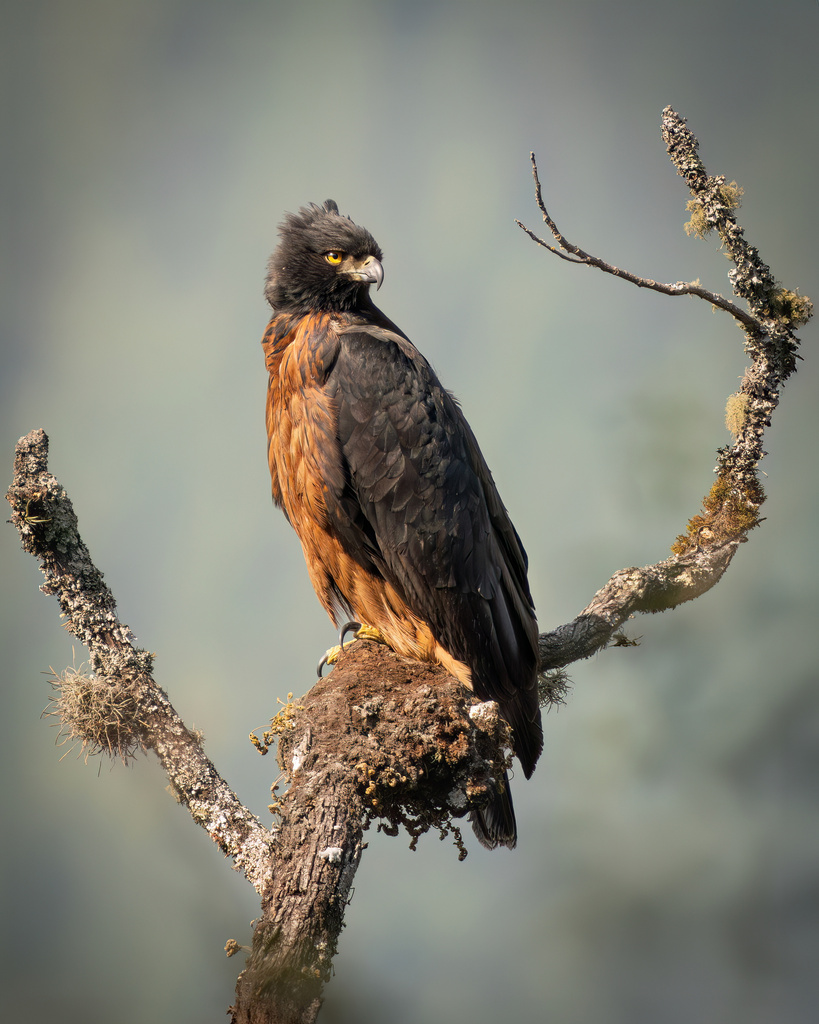
Black-and-chestnut Eagle
Photo © Luciano Massa
Photo © Luciano Massa — CC BY 4.0 — Source: iNaturalist photo #422440970The black-and-chestnut eagle (Spizaetus isidori), also known as Isidor's eagle, is a large South American species of bird of prey in the family Accipitridae. It is often placed in the monotypic genus Oroaetus. However, recent genetic testing indicates that this species is fairly closely related to Spizaetus species and thus the species should be included in that genus. The black-and-chestnut eagle is a typical forest raptor, hunting primarily small to medium-sized mammals and birds and constructing a large nest in a tall tree. Unfortunately, the twin causes of habitat destruction and persecution have caused population declines and the black-and-chestnut eagle is considered to be an Endangered species by the IUCN. == Taxonomy == It's scientific name was chosen in honour of French zoologist, Isidore Geoffroy Saint-Hilaire. == Habitat and status == It is found in humid montane forests, normally at elevations between 1,800 to 2,500 m (5,900 to 8,200 ft), in the Andes from northern Argentina, through Bolivia, Peru, Ecuador, Colombia, to Venezuela, with isolated populations in the Venezuelan Coastal Range, Serranía del Perijá and Sierra Nevada de Santa Marta. It is generally local and rare. Widespread cutting of primary forest in foothills throughout the Andes is the primary cause…
Sangay National Park
Cebadas, Ecuador
+320 birds+10 mammals
High in Ecuador's Andean spine, where the Western Cordillera rises to touch perpetual snow, a landscape of volcanic drama and ecological intensity unfolds across Sangay National…
VIEW NATIONAL PARKPodocarpus National Park
Zamora, Ecuador
+496 birds+6 mammals
Where the Andes descend toward the Amazon basin, Podocarpus National Park sprawls across nearly 2,800 square kilometres of the most biodiverse terrain in Ecuador's southern highlands.…
VIEW NATIONAL PARKSumaco Napo-Galeras National Park
Loreto, Ecuador
+563 birds+4 mammals
Where Ecuador's Amazon transitions into cloud forest, a massive shield volcano rises from the emerald lowlands of Orellana Province, anchoring one of the continent's most biodiverse…
VIEW NATIONAL PARKAntisana National Park
Quijos, Ecuador
+432 birds+21 mammals
Where the eastern Andean slopes descend into the Amazon basin, Antisana National Park sprawls across roughly 2,500 square kilometers of some of South America's most dramatic…
VIEW NATIONAL PARKCotopaxi National Park
Mulaló, Ecuador
+211 birds+6 mammals
High in Ecuador's volcanic corridor, where the páramo transitions into cloud forest along the slopes of Cotopaxi volcano, the national park unfolds across nearly 500 square…
VIEW NATIONAL PARKLlanganates National Park
Tena, Ecuador
+239 birds+8 mammals
Where the eastern slopes of the Andes plunge toward the Amazon basin, Llanganates National Park sprawls across nearly 3,500 square kilometers of montane wilderness, its terrain…
VIEW NATIONAL PARKNatural Chingaza National Park
Junín, Colombia
+285 birds+6 mammals
Where the Andes rise above three thousand metres in the Cundinamarca region, high-altitude grasslands and cloud forests converge in a landscape shaped by both geology and…
VIEW NATIONAL PARKYanachaga–chemillén National Park
Palcazu, Peru
+639 birds+6 mammals
Where the eastern slopes of Peru's central cordillera plunge into cloud forest, Yanachaga–Chemillén National Park protects nearly three thousand square kilometres of montane wilderness that few…
VIEW NATIONAL PARKManu National Park
Manu, Peru
+892 birds+26 mammals
Across the eastern slopes of the Peruvian Andes, tropical rainforest descends into the Amazon basin with a complexity that few terrestrial ecosystems match. Manu National Park…
VIEW NATIONAL PARKCalilegua National Park
Municipio de Calilegua, Argentina
+288 birds+8 mammals
Where the eastern Andean slopes plunge into northwestern Argentina's humid subtropics, nearly 2,645 square kilometers of steep terrain and luxuriant forest compose one of South America's…
VIEW NATIONAL PARKNo community photos yet. Log in to add the first one.
No community observations of this species yet.