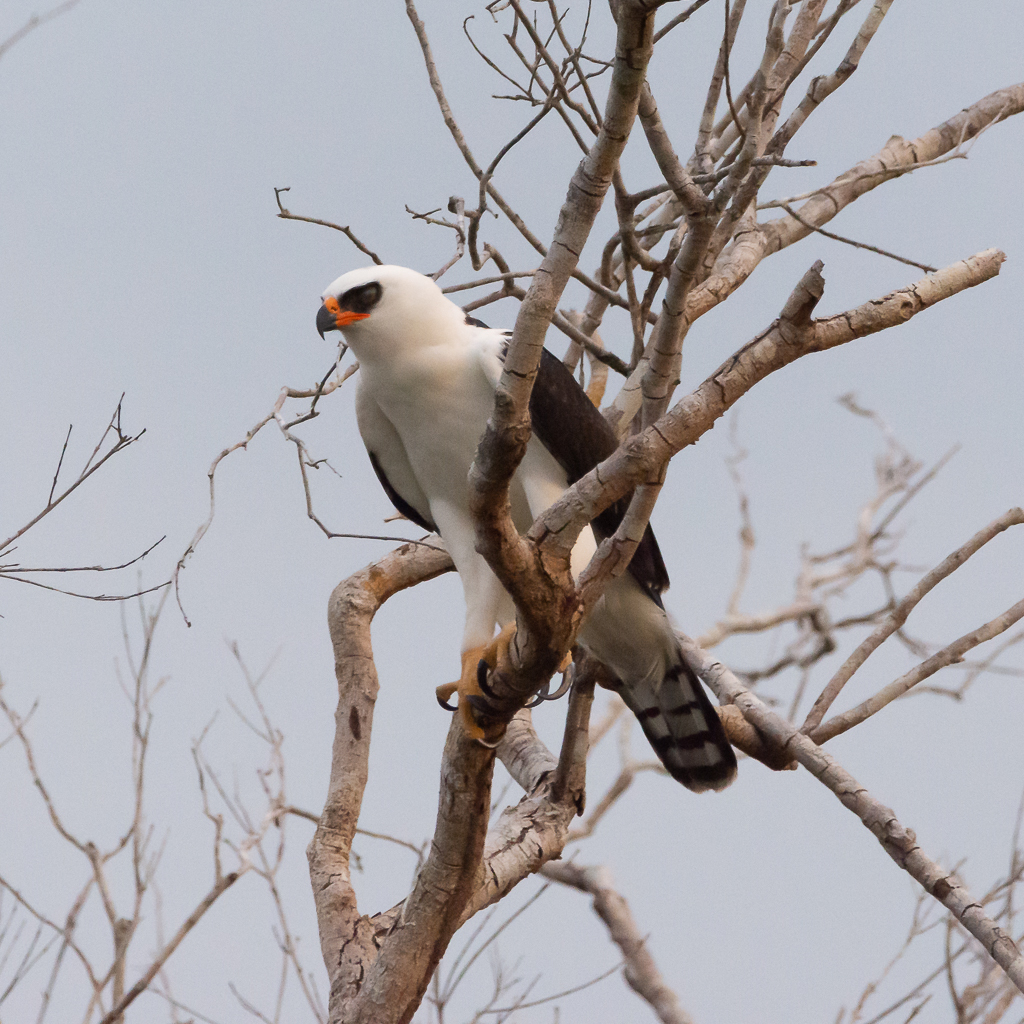
Black-and-white Hawk-Eagle
Photo © NINA WENÓLI
Photo © NINA WENÓLI — CC0 1.0 — Source: iNaturalist photo #137707865Identification
The black-and-white hawk-eagle is a striking raptor measuring 20–24 inches (51–61 cm) long and weighing around 30 ounces (850 g). Its name perfectly describes its appearance: the head, neck, and body are predominantly white, with a small black crest on the crown and a distinctive black face mask around the eyes extending toward the bill. The wings are black with a noticeable white leading edge, while the tail is brownish, barred with black-dark grey and tipped white. Adults have bright orange irises and pale to bright yellow feet with black talons; juveniles show greyish irises and pale edges on the upper wing coverts. Females are noticeably larger than males, though both sexes share identical coloration.
In its range, this species is most easily confused with juvenile Grey-headed Kites, which can mimic hawk-eagle appearance. The smaller black-faced hawk has similar coloration but displays a distinctive black tail with a single bold white bar. Young ornate hawk-eagles resemble this species but show lighter wings, backs, and tails without the characteristic black eye-ring.
Range & Habitat
The black-and-white hawk-eagle inhabits tropical America from southern Mexico (Oaxaca and Veracruz) throughout Central America, extending south along both coasts of the Andes and across the Caribbean slope from northern Colombia and Venezuela to the Guianas, then through eastern Brazil, Paraguay, Uruguay, and into northeastern Argentina, with populations also recorded in northeastern Peru and Bolivia. The species is absent from the western Amazon basin.
This raptor favors lowland forests of mixed composition, preferring diverse habitats combining forest and shrubland with large stands of closed-canopy forest. It typically avoids very dense, humid forest and arid savanna-like habitats. While usually found in lowlands, occasional sightings occur at higher elevations—one bird was recorded at approximately 4,000 feet (1,200 m) in Colombia's Sierra Nevada de Santa Marta, and another at around 7,200 feet (2,200 m) in Ecuador's Tandayapa Valley. The species does not tolerate habitat fragmentation well.
Behaviour & Diet
This carnivorous eagle hunts using a characteristic technique: soaring high overhead until spotting suitable prey, then diving swiftly into the forest canopy. It prefers hunting along ridges and forest edges where it can approach prey obliquely rather than diving vertically, and where ground-dwelling prey is more accessible. It has been observed catching prey mid-air after launching from a perch.
The black-and-white hawk-eagle feeds on a diverse diet of mammals, toads, squamates, and especially birds. It shows a preference for arboreal species such as oropendolas, aracaris, tanagers, and cotingas, but also takes ground- and waterbirds including tinamous, chachalacas, wood quails, and cormorants. It occasionally preys on small monkeys and opossums. Each bird requires a hunting territory of at least 3,500 acres (1,400 hectares). Nesting occurs in the forest canopy on exposed trees on ridges, with the main breeding season in Central America running from March through June.
Best Time & Places to See It
The black-and-white hawk-eagle is apparently rare and local throughout its range, making sightings a prize for dedicated birdwatchers. The species is most likely encountered in well-preserved lowland forests with diverse vegetation structure, particularly in areas with ridges and forest edges. Notable regions include the Caribbean slopes of Central America, the Guiana shield, and Atlantic forests of Brazil.
While specific seasonal patterns remain poorly documented, nesting activity in Central America suggests increased bird activity from March through June. However, the general scarcity of this species means that sightings depend more on finding suitable habitat and persistence than on timing alone. Local guides familiar with the region's raptors significantly increase chances of encounters.
Photography Tips
Photographing this elusive eagle requires patience and knowledge of forest-edge habitat. Position yourself along ridges and at forest margins where the bird is known to hunt, as this is where you have the best chance of capturing it in flight or perched. Early morning hours typically offer the best light and activity levels. A sturdy telephoto lens (500mm or longer) is essential, as these birds often hunt high and may be distant when spotted.
The sharp contrast between black and white plumage provides excellent photographic potential, though expose carefully to preserve detail in both light and dark areas. When the bird soars overhead, its distinctive white leading edges on black wings create striking silhouettes against clear sky. If fortunate enough to observe a hunting dive or mid-air prey capture, these dramatic behaviors make compelling images that capture the raptor's prowess and forest mastery.
Amacayacu National Park
Amazônia National Park
Anavilhanas National Park
Araucárias National Park
Bahuaja Sonene National Park
Baru Volcano National Park
Braulio Carrillo National Park
Calilegua National Park
Carlos Botelho State Park
Nothing matches these filters.
No community photos yet. Log in to add the first one.
No community observations of this species yet.