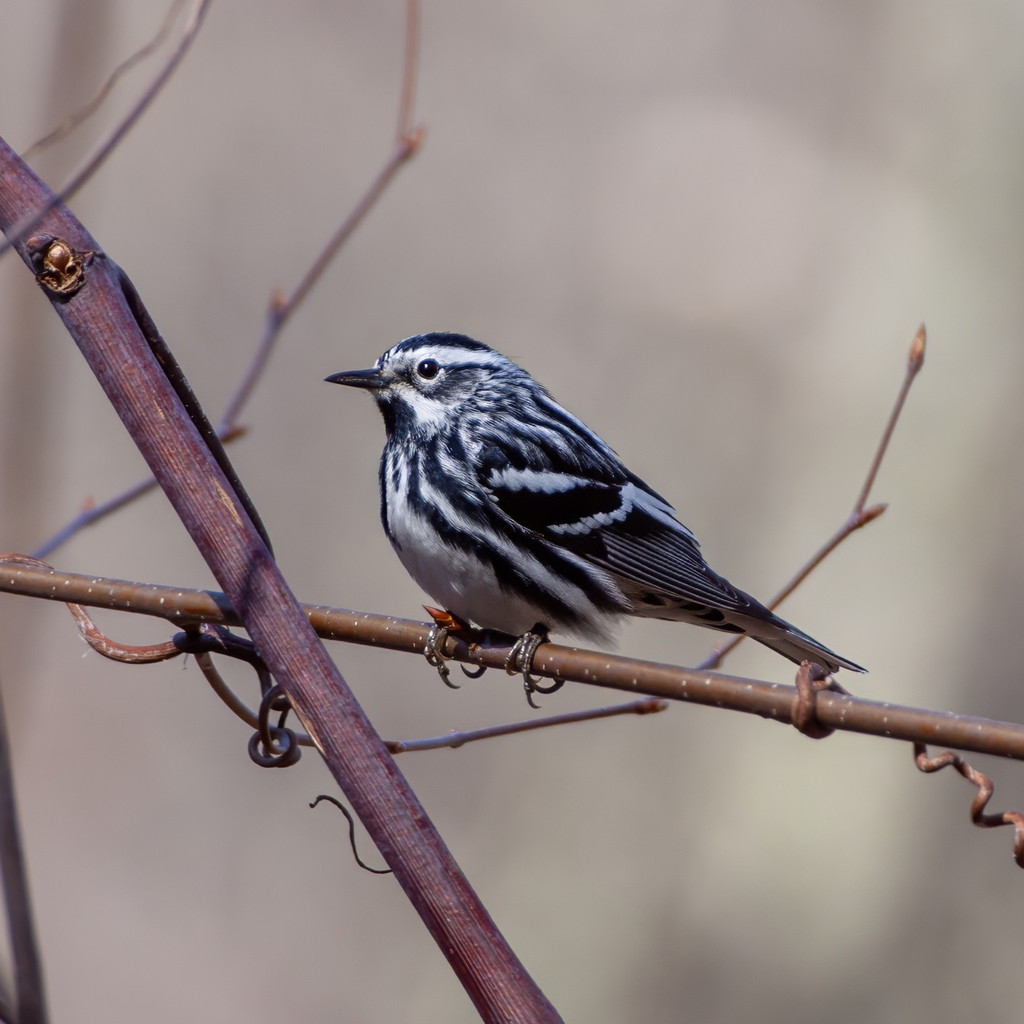
Black-and-white Warbler
Photo © Dan Vickers
Photo © Dan Vickers — CC BY 4.0 — Source: iNaturalist #302751365Identification
The Black-and-white Warbler is a small songbird measuring 11–13 cm in length with a wingspan of 18–22 cm. True to its name, this species displays bold black-and-white plumage that has earned it the descriptive nickname "flying humbug." Both sexes show a black-and-white striped crown, white eyebrow stripe, black wings with two white wing bars, and a black-and-white streaked back. The key difference between sexes lies in the throat and cheek: breeding males display a black-and-white streaked throat and black cheek, while females and non-breeding birds show a grey cheek with a white-cream throat. Females and juveniles are duller and less streaky overall. Beware of confusion with the Blackpoll Warbler, which has a solid black cap rather than striped crown, and with the Pine and Yellow-throated Warblers, which share similar foraging behaviors.
Range & Habitat
This migratory warbler breeds across northern and eastern North America, ranging from the Northwest Territories to Newfoundland and Labrador, south to North Carolina and Texas. It winters in Florida, Central America, the West Indies, and northern South America as far south as Peru. Vagrants occasionally appear in Iceland, Ireland, the Faeroes, and the UK. During breeding season, the species favors mature deciduous and mixed forests but adapts to second-growth and swampy woodland. During migration, it prefers forested areas and riparian zones. In winter quarters, it becomes a habitat generalist, occupying mangroves, wet and dry forests, cloud forest, shade coffee plantations, and gardens. Males maintain territories in both breeding and wintering habitats.
Behaviour & Diet
The Black-and-white Warbler is immediately recognizable by its unique foraging technique: unlike other North American warblers, it creeps along tree trunks and branches like a nuthatch, probing bark for food. Its short legs and elongated hind toe are anatomical adaptations for this specialized behavior. The species feeds primarily on insects and spiders, including lepidopteran larvae, beetles, ants, and spiders. During migration and breeding, it relies heavily on caterpillars. On Caribbean wintering grounds, it occasionally supplements its diet with small anoles. The bird's high-pitched, repeating song is described as "wee-see" repeated at least six times in succession, and it also produces a hard tick call and a soft, thin fsss sound. During migration, it sometimes joins mixed feeding flocks.
Best Time & Places to See It
Black-and-white Warblers are among the first warblers to arrive on their breeding grounds in spring. In North America, they are best observed in deciduous and mixed forests of the eastern and northern regions during breeding season. For winter birding, travelers should visit Florida, Central America, the Caribbean islands, or northern South America, where the species occupies a wide range of forested habitats. Riparian areas and forest edges are particularly productive during migration periods. The bird's tendency to forage visibly on tree trunks makes it relatively easy to locate compared to other warbler species.
Photography Tips
The Black-and-white Warbler's bold striped plumage and active foraging behavior offer excellent photographic opportunities. Position yourself to capture the bird's distinctive nuthatch-like posture as it moves along vertical trunks and branches—this unique behavior is a strong identifying feature and makes for compelling images. The high contrast between black and white plumage photographs well in various lighting conditions. Early morning light in breeding forests will highlight the intricate streaking patterns. When photographing in winter habitats such as mangroves or shade-grown coffee plantations, patience and a stable position will reward you with clear shots of this diminutive warbler engaged in its characteristic bark-foraging behavior.
Cape Breton Highlands National Park
Corcovado National Park
Manuel Antonio National Park
Arenal Volcano National Park
Tortuguero National Park
Chirripó National Park
Braulio Carrillo National Park
Piedras Blancas National Park
Santa Rosa National Park
Guanacaste National Park
Volcán Poás National Park
Frontenac National Park
Banff National Park
L’Île-Bonaventure-Et-Du-Rocher-Percé National Park
Mont-Saint-Bruno National Park
Pointe-Taillon National Park
Mauricie National Park
New River Gorge National Park
Big Bend National Park
Voyageurs National Park
Mammoth Cave National Park
Saguaro National Park
Indiana Dunes National Park
Lassen Volcanic National Park
Pinnacles National Park
Joshua Tree National Park
Carlsbad Caverns National Park
Everglades National Park
Great Smoky Mountains National Park
Yellowstone National Park
Rocky Mountain National Park
Redwood National Park
Kings Canyon National Park
Death Valley National Park
Sumaco Napo-Galeras National Park
Antisana National Park
Natural Utría National Park
Natural Munchique National Park
Natural Serranía de los Yariguíes National Park
Natural Farallones de Cali National Park
Natural Chingaza National Park
Morrocoy National Park
Guácharos Cave National Natural Park
Natural Uramba Bahía Málaga National Park
Natural Sumapaz National Park
El Tamá National Park
Natural Sierra de la Macarena National Park
Monts-Valin National Park
Hautes-Gorges-De-La-Rivière-Malbaie National Park
Grands-Jardins National Park
D’Anticosti National Park
Nahanni National Park
Wood Buffalo National Park
Lac-Témiscouata National Park
Fundy National Park of Canada
Mont-Tremblant National Park
Îles-De-Boucherville National Park
Gros Morne National Park
Bic National Park
Mont-Mégantic National Park
Kouchibouguac National Park of Canada
Forillon National Park
Point Pelee National Park
Coiba National Park
Baru Volcano National Park
General de División Omar Torrijos Herrera National Park
Soberanía National Park
Chagres National Park
Darién National Park
Portobelo National Park
Parque Internacional la Amistad
Marino Golfo de Chiriquí National Park
Dzibilchantún National Park
Lagunas de Montebello National Park
Arrecifes de Cozumel National Park
Sian Ka’an
El Vizcaíno
Sierra de Tamaulipas
Parque Nacional Cerro de la Estrella
Parque Nacional Benito Juárez
Parque Nacional Grutas de Cacahuamilpa
Parque Nacional Arrecife Alacranes
Montes Azules
Tikal National Park
Laguna del Tigre National Park
Sierra del Lacandón National Park
Acadia National Park
Biscayne National Park
Channel Islands National Park
Congaree National Park
Cuyahoga Valley National Park
Dry Tortugas National Park
Glacier National Park
Grand Canyon National Park
Guadalupe Mountains National Park
Hot Springs National Park
Isle Royale National Park
Petrified Forest National Park
Shenandoah National Park
Virgin Islands National Park
Wind Cave National Park
Alaska Maritime National Wildlife Refuge
Bosque del Apache National Wildlife Refuge
J.N. “Ding” Darling National Wildlife Refuge
Merritt Island National Wildlife Refuge
Okefenokee National Wildlife Refuge
Chincoteague National Wildlife Refuge
Wichita Mountains National Wildlife Refuge
Laguna Atascosa National Wildlife Refuge
Santa Ana National Wildlife Refuge
Lower Rio Grande Valley National Wildlife Refuge
Havasu National Wildlife Refuge
Malheur National Wildlife Refuge
Farallon National Wildlife Refuge
Salton Sea National Wildlife Refuge
Wheeler National Wildlife Refuge
Bombay Hook National Wildlife Refuge
Blackwater National Wildlife Refuge
Alligator River National Wildlife Refuge
Pea Island National Wildlife Refuge
Pelican Island National Wildlife Refuge
St. Marks National Wildlife Refuge
Great White Heron National Wildlife Refuge
Cedar Keys National Wildlife Refuge
Chassahowitzka National Wildlife Refuge
Carara National Park
Palo Verde National Park
Los Quetzales National Park
Cahuita National Park
Rincón de la Vieja National Park
Tapantí Macizo de la Muerte National Park
La Amistad International Park
Volcán Tenorio National Park
Marino Ballena National Park
Marino Las Baulas National Park
Caño Negro National Wildlife Refuge
Gandoca-Manzanillo National Wildlife Refuge
Barra del Colorado National Wildlife Refuge
Curú National Wildlife Refuge
No community photos yet. Log in to add the first one.
No community observations of this species yet.