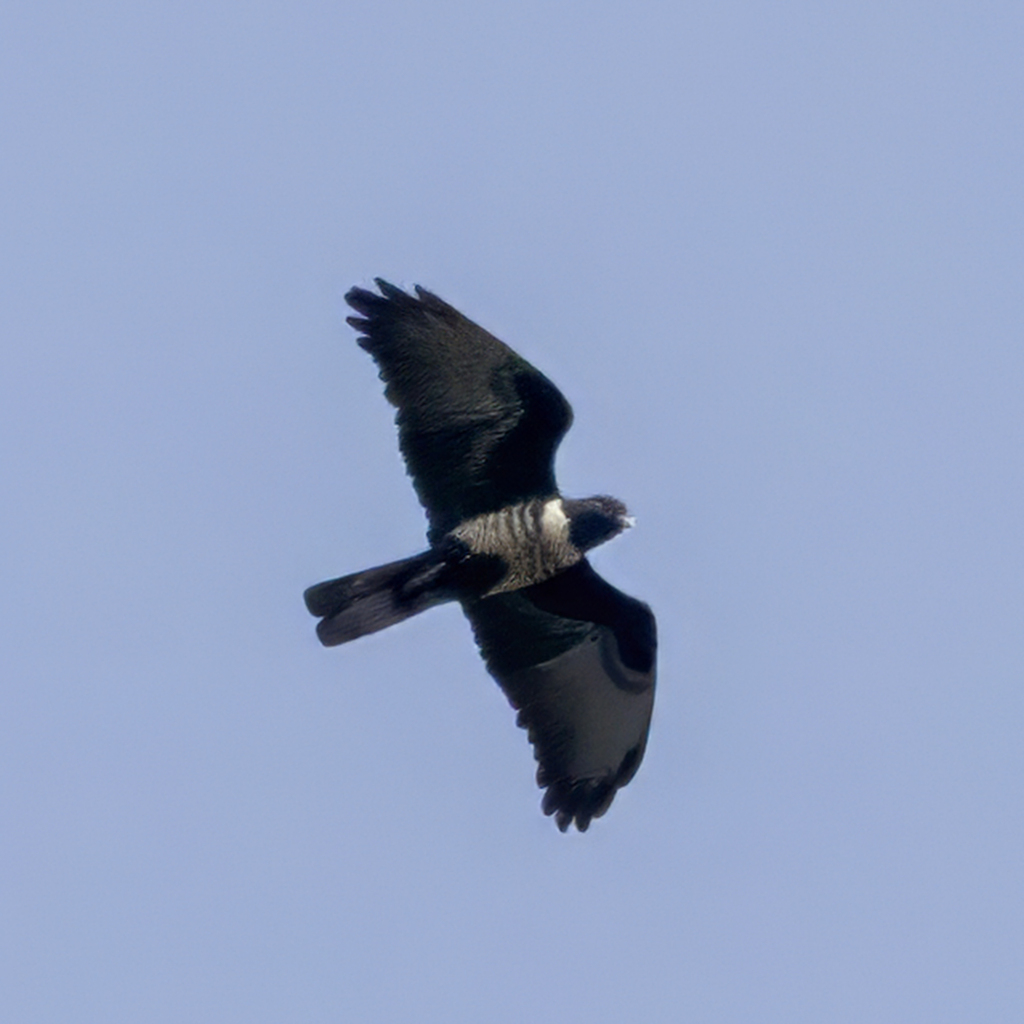
Black Baza
Photo © Dan Vickers
Photo © Dan Vickers — CC BY 4.0 — Source: iNaturalist #347963120Identification
The black baza is a small and distinctively coloured raptor, ranging from 30 to 35 cm in length with a wingspan of 66 to 80 cm and weighing 168 to 224 g. Its most striking feature is a prominent upright crest that, combined with contrasting plumage patterns, makes it difficult to misidentify when perched. The species exhibits sexual dimorphism: males display white scapulars, secondary coverts and secondaries, with few chestnut bands on the underside, while females show white only on the scapulars and considerably more chestnut banding below. Like others in the genus Aviceda, black bazas possess two tooth-like indentations on the edge of the upper bill. In flight, they resemble crows and are often seen in small groups or flocks, particularly during migration.
Range & Habitat
The black baza is found in the forests of Northeast India, the eastern Himalayas, China and Southeast Asia. Many populations are migratory: those in the Indian region winter in the south of the Peninsula and Sri Lanka, while populations in eastern Nepal and northeastern India winter in Indo-China and the Malaya Peninsula. In recent decades, some birds in Hong Kong have shifted from being summer visitors to establishing themselves as year-round residents in small numbers. These raptors inhabit dense forests and are often found perched on bare branches of tall trees rising above the forest canopy, frequently in small groups.
Behaviour & Diet
Black bazas are somewhat crepuscular, showing increased activity at dusk and in overcast weather. They feed mainly on insects, capturing them through aerial sallies or by plucking them from leaves, always seizing prey with their feet. They have been observed attempting to capture small birds such as wagtails by making dashing attacks into flocks, and they regularly join mixed-species foraging flocks. Remarkably, they have also been noted feeding on the fruits of the oil palm. These birds are gregarious at their roosts during migration, sometimes appearing in large numbers at key passage points. Their calls include a distinctive "chu-weep" somewhat similar to large cuckoo-shrikes, along with soft squeals, whistles and shrill gull-like mewing. Unusually for raptors, they are said to emit a disagreeable, "bug-like" odour.
Best Time & Places to See It
In northeastern India, birds begin breeding in April, making spring an excellent time to observe them. Major migration bottlenecks offer spectacular viewing opportunities: the Thai peninsula at Chumphon, for instance, sees black bazas accounting for nearly 40% of raptors on passage. Winter visitors can be found in southern India, particularly in the Western Ghats and Eastern Ghats, with records from locations including Guindy National Park near Chennai, areas near Trivandrum and Bangalore, and Point Calimere. Recent studies suggest the species may be a regular winter visitor across eastern peninsular India rather than merely a passage migrant.
Photography Tips
The black baza's prominent crest and distinctive plumage make it relatively easy to identify once located. Look for them perched on bare branches above the forest canopy, particularly in small groups. Their preference for activity during overcast conditions and at dusk may require faster film speeds or higher ISO settings. During migration, large congregations at roosts provide opportunities for flock photography. Their small size—under 35 cm in length—means a good telephoto lens is essential. Sexual dimorphism offers the chance to document both male and female plumages, with females showing more extensive chestnut banding that creates striking compositional contrast.
Orang National Park
Rangagarapathar, India
+298 birds+1 mammals
Where the Brahmaputra's floodplains meet the foothills of Assam, Orang National Park unfolds across a mosaic of riverine grasslands, forests and wetlands that pulse with the…
VIEW NATIONAL PARKPhou Khao Khouay National Protected Area
Thaphabath District, Thailand
+113 birds
Where the Annamite Mountains descend into central Thailand's monsoon forests, Phou Khao Khouay National Protected Area sprawls across rugged limestone terrain interlaced with river valleys and…
VIEW NATIONAL PARKHat Noppharat Thara-Mu Ko Phi Phi National Park
Ao Nang, Thailand
+253 birds+9 mammals
Where limestone karsts rise dramatically from turquoise waters, Hat Noppharat Thara-Mu Ko Phi Phi National Park unfolds across a mosaic of beach, mangrove forest, and island…
VIEW NATIONAL PARKKhao Yai National Park
Prachantakham District, Thailand
+377 birds+46 mammals
Evergreen dipterocarp forest blankets the rolling terrain of this national park in eastern Thailand, where limestone hills rise abruptly from the forest floor and seasonal streams…
VIEW NATIONAL PARKKhao Laem Ya-Mu Ko Samet National Park
Mueang Rayong District, Thailand
+159 birds+3 mammals
Where limestone hills meet the Gulf of Thailand, Khao Laem Ya–Mu Ko Samet National Park stitches together a mosaic of terrestrial and marine worlds that few…
VIEW NATIONAL PARKKhao Laem National Park
Sangkhla Buri District, Thailand
+197 birds
Where the Vajiralongkorn Reservoir sprawls across the forested valleys of Kanchanaburi's northern borderlands, Khao Laem National Park protects a landscape where limestone ridges rise dramatically from…
VIEW NATIONAL PARKGiant Panda National Park
Mianyang, China
+447 birds+47 mammals
Where the eastern slopes of China's Sichuan plateau descend into cloud-wrapped valleys, one of Asia's most biodiverse landscapes unfolds across more than 350,000 square kilometres. This…
VIEW NATIONAL PARKMount Nanling Forest Park
Ruyang Forest Farm, China
+179 birds+3 mammals
Granite ridges and weathered peaks rise through a canopy of subtropical montane forest where Ruyang Forest Farm anchors one of southern China's most biodiverse landscapes. Across…
VIEW FOREST & JUNGLEKaziranga National Park
Kohora, India
+422 birds+26 mammals
Dawn breaks over the floodplains of the Brahmaputra, where tall grasslands stretch endlessly beneath monsoon-heavy skies. This sprawling wilderness of northeastern Assam is a mosaic of…
VIEW NATIONAL PARKPeriyar National Park
Mlappara, India
+232 birds+4 mammals
Dawn breaks over mist-shrouded ridges where the Western Ghats tumble toward Kerala's spice-scented lowlands. Here, ancient tropical forests envelope a glittering artificial lake, creating a mosaic…
VIEW NATIONAL PARKNagarahole Tiger Reserve
Nalkeri Forest, India
+323 birds+23 mammals
Where granite escarpments rise above dense deciduous forests and the Kabini River carves through pristine wilderness, one of India's most biodiverse landscapes unfolds across the Western…
VIEW NATIONAL PARKTaman Negara National Park
Kampong Samas, Malaysia
+393 birds+48 mammals
Where ancient rainforest meets limestone peaks, one of Southeast Asia's oldest protected wilderness preserves sprawls across 4,343 square kilometers of primordial landscape. Dipterocarp giants tower overhead,…
VIEW NATIONAL PARKTaman Nasional Baluran
Situbondo, Indonesia
+189 birds+9 mammals
Across the northeastern tip of East Java, where monsoon winds sweep down from the Bali Strait, a landscape of contrasts unfolds within 374 square kilometres of…
VIEW NATIONAL PARKWay Kambas National Park
Lampung Timur, Indonesia
+237 birds+20 mammals
Across the low swamplands of eastern Lampung, where freshwater wetlands merge into tidal mangrove forests along the Sunda Strait, sprawls one of Sumatra's most vital sanctuaries.…
VIEW NATIONAL PARKNo community photos yet. Log in to add the first one.
No community observations of this species yet.