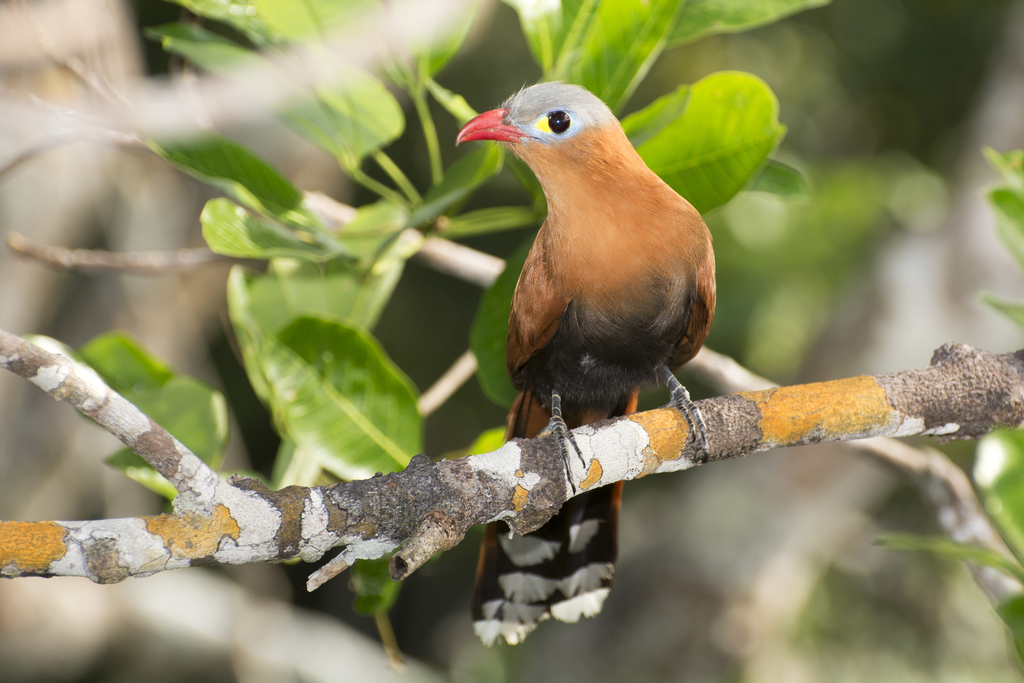
Black-bellied Cuckoo
Photo © Romilson Silva Lopes Junior
Photo © Romilson Silva Lopes Junior — CC BY 4.0 — Source: iNaturalist photo #600504672Identification
The black-bellied cuckoo is a medium-sized bird measuring 38 to 40.5 cm in length. Its most distinctive features include a striking purple-red beak, dark red iris with bright blue orbital skin, and a characteristic yellow mole at the front of each eye. The grey head contrasts sharply with its ruffled back, while the throat and chest display warm brown-reddish and cinnamon tones. The belly and undertail coverts are black—the feature that gives this species its common name—and the black tail is marked with conspicuous white stripes.
Within its range, the black-bellied cuckoo overlaps with the similar squirrel cuckoo. However, the two species are readily distinguished: the black-bellied cuckoo has a dark face and grey crown, whereas the squirrel cuckoo displays exposed yellow-greenish orbital skin, a grey chest, and lacks the black-bellied cuckoo's characteristic hooded appearance. Juveniles resemble adults closely.
Range & Habitat
This Amazonian species occurs across a wide but patchy distribution spanning southern and eastern Guyana, Surinam, French Guiana, eastern Venezuela, northern Bolivia, Colombia, Ecuador, eastern Peru, and Brazil. It is a permanent resident throughout its range, though it remains a low-density species that can be challenging to locate. The bird generally prefers altitudes up to 800 meters above sea level, with specific populations documented in locations such as Kanashen in Guyana, the La Paz department in Bolivia, southern Meta in Colombia, and the Alta Floresta region in northern Mato Grosso, Brazil.
Black-bellied cuckoos inhabit tropical rainforests and scrub, occasionally venturing into wooded savannas, but they notably avoid open areas where the squirrel cuckoo is more comfortable. They remain in the upper levels of the forest canopy. Deforestation poses a significant threat, estimated to reduce suitable habitat by approximately 10 percent every three generations—roughly 13 years.
Behaviour & Diet
The black-bellied cuckoo is arboreal and acrobatic, preferring to hunt and forage in the forest canopy and tall shrubs. It moves by climbing vines, jumping between branches, running along limbs, and making occasional flights through open spaces, characterized by slow, shallow wing beats. These birds are typically solitary or seen in pairs.
Their diet consists primarily of large insects including beetles, grasshoppers, ants, caterpillars (even those with sharp hairs), and cycads, along with small vertebrates such as lizards—all hunted within the forest canopy. Remarkably little is known about their breeding biology, though records indicate reproductive activity in April in the Upper Orinoco region of Venezuela, and nestlings have been observed being fed in French Guiana from July through November. They build tree nests and lay up to two pure white eggs, with an average lifespan of 4.2 years.
Best Time & Places to See It
The black-bellied cuckoo's cryptic nature and low population density make it an elusive target for travellers. Your best opportunities lie in extensive tracts of undisturbed Amazonian rainforest across its range. Key regions include the protected forests of Guyana, the Peruvian and Ecuadorian Amazon lowlands (particularly below 400 meters in Ecuador), the Venezuelan Upper Orinoco, and the Alta Floresta region of Brazil.
Because this species remains motionless in the forest while singing, your best chance of detection is to listen carefully for its characteristic repeated call: "dyerií-dyu, dyerií-dyu, dyerií-dyu…" followed by faint grunts. However, pinpointing the bird's location by sound alone proves difficult. Patient canopy observation during early mornings, when birds are most active, offers the greatest likelihood of an encounter.
Photography Tips
Photographing the black-bellied cuckoo presents significant challenges due to its preference for the forest canopy, cryptic behaviour, and low density. Success requires patience, persistence, and ideally a telephoto lens of at least 300–400 mm to capture distant canopy subjects. Position yourself in areas of dense, tall forest and listen intently for the distinctive song; once located, approach slowly and quietly to avoid flushing the bird.
The species' striking plumage—particularly the black belly, white-striped tail, and vivid facial colouration—offers rewarding photographic subjects when views can be obtained. Early morning light filtering through the canopy provides the best illumination for capturing the subtle gradations between its grey head, cinnamon chest, and black underparts. Given the bird's habit of remaining still while singing, a stationary approach with good light and a stable support will yield the best results.
Yasuní National Park
Aguarico, Ecuador
+601 birds+43 mammals
Where the western Amazon basin converges with Ecuador's Orellana Province, lowland rainforest reaches toward the horizon in an unbroken canopy of staggering botanical density. Yasuní National…
VIEW NATIONAL PARKNatural la Paya National Park
Puerto Leguízamo, Colombia
+262 birds+4 mammals
Where the Amazon's western reaches fold into the Andes foothills, La Paya National Park sprawls across more than 8,500 square kilometers of pristine Amazonian rainforest in…
VIEW NATIONAL PARKAmacayacu National Park
Leticia, Colombia
+567 birds+25 mammals
Where the Rio Amazonas curves through the tri-border region where Colombia, Peru, and Brazil converge, Amacayacu National Park sprawls across more than 5,250 square kilometres of…
VIEW NATIONAL PARKAmazônia National Park
Brazil
+439 birds+6 mammals
Where the Rio Amazonas and its tributaries weave through the heart of Pará state, a vast tapestry of rainforest stretches across 23,611 square kilometers of unbroken…
VIEW NATIONAL PARKMapinguari National Park
Brazil
+354 birds
Vast tracts of western Amazonian rainforest blanket the remote terrain of this 56,827 square kilometre national park in Amazonas state, where seasonal rivers wind through dense…
VIEW NATIONAL PARKJaú National Park
Brazil
+354 birds+3 mammals
Vast floodplain forests and blackwater rivers define this remote corner of western Amazonas, where the Rio Negro and its tributaries have carved an intricate mosaic of…
VIEW NATIONAL PARKPacaás Novos National Park
Brazil
+279 birds+1 mammals
Across the border between Rondônia and Amazonas, vast tracts of humid tropical forest rise and fall in gentle undulations, carved by clear-flowing rivers that feed into…
VIEW NATIONAL PARKAnavilhanas National Park
Brazil
+468 birds+8 mammals
Across the Rio Negro in central Amazonas, an archipelago of over a thousand islands rises from the world's largest rainforest river system, creating a labyrinth of…
VIEW NATIONAL PARKCampos Amazónicos National Park
Amazonas, Brazil
+434 birds+7 mammals
Sprawling across the southwestern Amazon basin in Amazonas state, this 27,263-square-kilometre national park encompasses some of the region's most pristine lowland rainforest, where terra firme forest…
VIEW NATIONAL PARKSerra do Divisor National Park
Brazil
+448 birds+10 mammals
Where the western Amazon meets the Andes foothills, Serra do Divisor National Park sprawls across one of South America's most biodiverse and least accessible frontiers. Spanning…
VIEW NATIONAL PARKYanachaga–chemillén National Park
Palcazu, Peru
+639 birds+6 mammals
Where the eastern slopes of Peru's central cordillera plunge into cloud forest, Yanachaga–Chemillén National Park protects nearly three thousand square kilometres of montane wilderness that few…
VIEW NATIONAL PARKManu National Park
Manu, Peru
+892 birds+26 mammals
Across the eastern slopes of the Peruvian Andes, tropical rainforest descends into the Amazon basin with a complexity that few terrestrial ecosystems match. Manu National Park…
VIEW NATIONAL PARKSierra del Divisor National Park
Alto Tapiche, Peru
+298 birds+2 mammals
Where the western Amazon meets the Andes foothills, nearly 41,000 square kilometres of pristine rainforest rise across Peru's Alto Tapiche region in a landscape of extraordinary…
VIEW NATIONAL PARKBahuaja Sonene National Park
San Pedro de Putina Punco, Peru
+602 birds+8 mammals
Where the Madre de Dios and Heath rivers converge in southeastern Peru rises one of South America's most biodiverse wilderness regions: a vast protected realm of…
VIEW NATIONAL PARKIchigkat Muja – Cordillera del Cóndor National Park
Río Santiago, Peru
+101 birds
Where the Andes descend into the western Amazon, the Río Santiago carves through a landscape of profound biological complexity. Ichigkat Muja – Cordillera del Cóndor National…
VIEW NATIONAL PARKNo community photos yet. Log in to add the first one.
No community observations of this species yet.