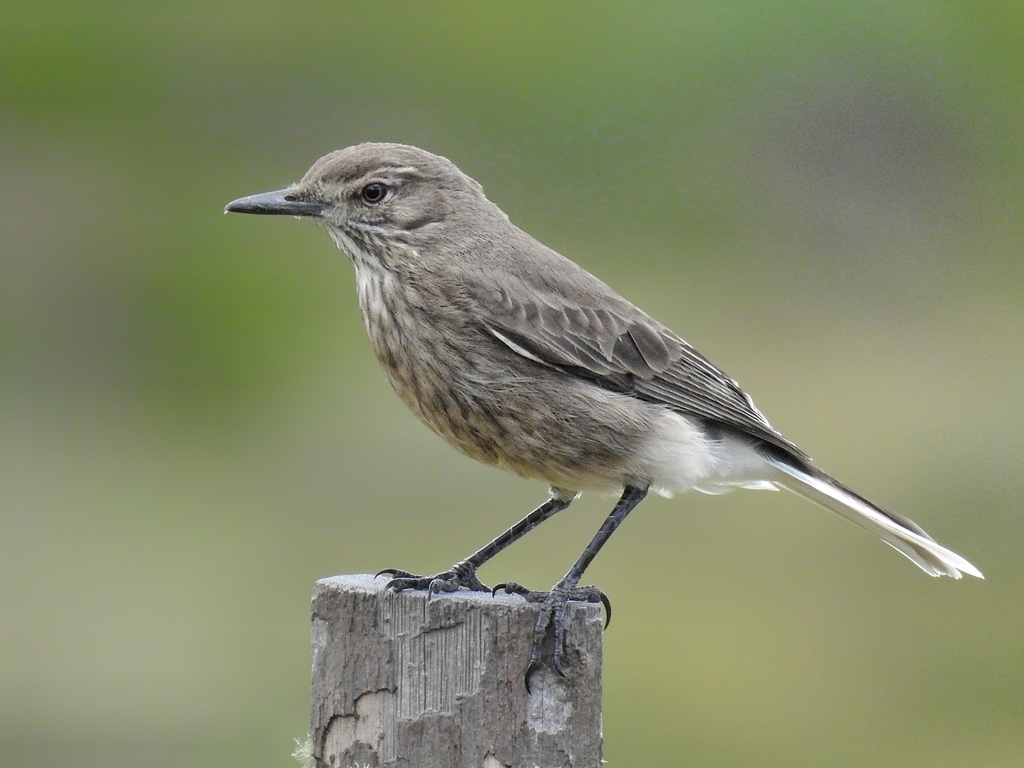
Black-billed Shrike-Tyrant
Photo © Esteban Poveda
Photo © Esteban Poveda — CC BY 4.0 — Source: iNaturalist photo #136379314Identification
The black-billed shrike-tyrant is a medium-sized tyrant flycatcher measuring 22 to 24 cm in length. Both sexes share identical plumage, featuring a distinctive dark grayish-brown crown and upperparts contrasted with a whitish stripe above the lores and a buffish-white broken supercilium. The throat is white with thin blackish streaks, while the breast and flanks are ashy brown. All adults display a characteristic hooked black bill, yellowish to ivory iris, and blackish legs and feet. Plumage varies subtly among the six recognized subspecies, with differences primarily evident in tail patterns and overall coloration intensity.
Range & Habitat
This species is distributed across the high-elevation Andes of South America, occurring in Argentina, Bolivia, Chile, Colombia, Ecuador, and Peru, with possible vagrant records from the Falkland Islands. Six subspecies occupy distinct geographic ranges along the cordillera, from southwestern Colombia south to southern Argentina and Chilean Patagonia.
The black-billed shrike-tyrant favors open, high-elevation landscapes ranging from the upper temperate zone into páramo grasslands. Typical habitats include Andean grasslands and agricultural areas with scattered bushes and trees, Polylepis forest edges, puna grassland, rocky slopes, cliffs, and human settlements. Elevations vary regionally, generally between 3,000 and 4,000 meters throughout most of its range, though it descends to 2,500 meters in some southern areas and rarely to sea level in Chile.
Behaviour & Diet
This shrike-tyrant is primarily a year-round resident throughout most of its range, though southern Patagonian populations migrate northward during the austral winter. The species maintains an remarkably eclectic diet, consuming insects and arthropods, small mammals, reptiles, amphibians, bird eggs and nestlings, and seeds. It typically forages solitarily, perching on rocks, bushes, or fence posts before taking prey from the ground, hawking in mid-air, or hovering before striking downward.
Males perform distinctive aerial courtship displays during which their tail feathers produce a faint, low-pitched whirr. The species builds large, loose, open-cup nests from sticks and grass, lined with wool, placing them in ground vegetation, rock crevices, or structural openings in human buildings. Clutch size is two to three eggs, though breeding seasonality varies geographically across its range.
Best Time & Places to See It
The black-billed shrike-tyrant is a year-round resident across most of the Andes, making it accessible to travellers throughout the year. In high-elevation grasslands and agricultural areas of Colombia, Ecuador, Peru, Bolivia, Chile, and Argentina, look for this species perching conspicuously on fences, rocks, and bushes in open terrain. The species' preference for settled, accessible high-elevation habitats near villages makes it relatively approachable compared to many alpine species. Early morning hours offer the best chance to observe vocal activity.
Photography Tips
The black-billed shrike-tyrant's habit of perching openly on rocks, fences, and low vegetation in barren terrain provides excellent photography opportunities. Its contrasting plumage—dark upperparts against white belly and striped throat—photographs well in the bright, high-altitude sunlight of the Andes. The bird's characteristic posture and frequent perch-hunting behaviour allow photographers to anticipate and capture striking action shots of ground strikes or mid-air hawking. The subdued coloration blends well with rocky slopes, so watch for movement rather than relying on bright plumage to locate subjects.
Sangay National Park
Cebadas, Ecuador
+320 birds+10 mammals
High in Ecuador's Andean spine, where the Western Cordillera rises to touch perpetual snow, a landscape of volcanic drama and ecological intensity unfolds across Sangay National…
VIEW NATIONAL PARKPodocarpus National Park
Zamora, Ecuador
+496 birds+6 mammals
Where the Andes descend toward the Amazon basin, Podocarpus National Park sprawls across nearly 2,800 square kilometres of the most biodiverse terrain in Ecuador's southern highlands.…
VIEW NATIONAL PARKYacuri National Park
Las Juntas, Ecuador
+166 birds+1 mammals
Where the eastern slopes of the Andes descend into Ecuador's southern frontier, Yacuri National Park unfolds across nearly 1,300 square kilometers of montane cloud forest and…
VIEW NATIONAL PARKAntisana National Park
Quijos, Ecuador
+432 birds+21 mammals
Where the eastern Andean slopes descend into the Amazon basin, Antisana National Park sprawls across roughly 2,500 square kilometers of some of South America's most dramatic…
VIEW NATIONAL PARKCotopaxi National Park
Mulaló, Ecuador
+211 birds+6 mammals
High in Ecuador's volcanic corridor, where the páramo transitions into cloud forest along the slopes of Cotopaxi volcano, the national park unfolds across nearly 500 square…
VIEW NATIONAL PARKLlanganates National Park
Tena, Ecuador
+239 birds+8 mammals
Where the eastern slopes of the Andes plunge toward the Amazon basin, Llanganates National Park sprawls across nearly 3,500 square kilometers of montane wilderness, its terrain…
VIEW NATIONAL PARKCajas National Park
Cuenca, Ecuador
+190 birds+7 mammals
High in the Andes above Cuenca, where elevation ranges from 3,100 to 4,200 metres, the páramo landscape dominates—a windswept realm of cushion plants, alpine grasses, and…
VIEW NATIONAL PARKYanachaga–chemillén National Park
Palcazu, Peru
+639 birds+6 mammals
Where the eastern slopes of Peru's central cordillera plunge into cloud forest, Yanachaga–Chemillén National Park protects nearly three thousand square kilometres of montane wilderness that few…
VIEW NATIONAL PARKHuascarán National Park
Independencia, Peru
+201 birds+5 mammals
Where granite peaks pierce the Andean sky above 6,000 metres, Huascarán National Park sprawls across more than 11,500 square kilometres of Peru's Cordillera Blanca, a landscape…
VIEW NATIONAL PARKSalar del Huasco National Park
Pica, Chile
+75 birds+2 mammals
High above the Atacama's shimmering flats, where the Andes grip the sky, lies a landscape of stark geological drama and surprising biological richness. Salar del Huasco…
VIEW NATIONAL PARKPan de Azúcar National Park
Chañaral, Chile
+74 birds+4 mammals
Where the Atacama Desert plunges toward the Pacific, Pan de Azúcar National Park sprawls across 727 square kilometres of one of Earth's most extreme transitions—a landscape…
VIEW NATIONAL PARKTorres del Paine National Park
Torres del Paine, Chile
+143 birds+10 mammals
Where granite spires pierce the Patagonian sky, Torres del Paine commands one of South America's most dramatic landscapes. Across 4,106 square kilometres of southern Chile, jagged…
VIEW NATIONAL PARKLaja National Park Lagoon
Antuco, Chile
+123 birds+1 mammals
Where the Andes descend into the Biobío Region's temperate forests, a vast lagoon fills the caldera of the extinct Antuco volcano, cradled by steep native woodland…
VIEW NATIONAL PARKLauca National Park
Putre, Chile
+139 birds+17 mammals
Where the Andes rise toward the altiplano in Chile's far north, Lauca National Park sprawls across more than 3,000 square kilometres of some of South America's…
VIEW NATIONAL PARKPatagonia National Park
Cochrane, Chile
+133 birds+8 mammals
Where the Andes meet the Patagonian steppe, vast grasslands and shrublands sweep across rolling terrain carved by ancient glaciation, their contours softened by distance and dramatic…
VIEW NATIONAL PARKReserva Nacional las Vicuñas
Putre, Chile
+87 birds+6 mammals
High desert plateaus interlace with volcanic ridges across this 4,204-square-kilometre expanse at the border between Chile and Bolivia, where altitudes exceed 3,500 metres and the climate…
VIEW NATIONAL PARKSalar de Surire Natural Monument
Putre, Chile
+61 birds
High across the Altiplano of northern Chile, where the Andes push toward 4,300 metres and the air thins to a crystalline clarity, lies a vast shallow…
VIEW NATURAL MONUMENTParque Provincial Península de Magallanes
Argentina
+125 birds+4 mammals
Granite peaks and windswept steppe converge across this 415-square-kilometre peninsula jutting into the cold Atlantic waters of southern Patagonia, where the Magallanes landscape embodies the raw,…
VIEW NATIONAL PARKMonte León National Park
Argentina
+100 birds+4 mammals
Where the Patagonian steppe meets the Atlantic, Monte León National Park protects a landscape of windswept coastal cliffs, rocky outcrops, and semi-arid grassland spanning over 1,200…
VIEW NATIONAL PARKLos Glaciares National Park
Argentina
+121 birds+3 mammals
Where granite peaks and sprawling ice fields dominate the landscape, Los Glaciares National Park encompasses over ten thousand square kilometres of Patagonian wilderness in southern Argentina.…
VIEW NATIONAL PARKPerito Moreno National Park
Argentina
+78 birds
Where the Patagonian steppe descends into a landscape carved by ancient ice, Perito Moreno National Park sprawls across nearly 1,590 square kilometres of some of South…
VIEW NATIONAL PARKLos Cardones National Park
Argentina
+193 birds+6 mammals
Where the Andes descend into northwestern Argentina, Los Cardones National Park sprawls across nearly 1,200 square kilometres of one of South America's most distinctive high-altitude desert…
VIEW NATIONAL PARKLanín National Park
Argentina
+128 birds+7 mammals
Where the volcanic spine of the Andes plunges into Patagonian steppe, Lanín National Park sprawls across nearly 4,700 square kilometers of one of Argentina's most visually…
VIEW NATIONAL PARKSierra de las Quijadas National Park
Argentina
+168 birds+5 mammals
Sandstone cliffs and deeply incised canyons define this 1,137-square-kilometre expanse in San Luis Province, where the dry Chacoan landscape of central Argentina reveals an unexpected ecological…
VIEW NATIONAL PARKLago Puelo National Park
Argentina
+109 birds+1 mammals
Where temperate forests descend to crystalline waters in the foothills of the Andes, Lago Puelo National Park sprawls across nearly 300 square kilometers of pristine wilderness…
VIEW NATIONAL PARKNo community photos yet. Log in to add the first one.
No community observations of this species yet.