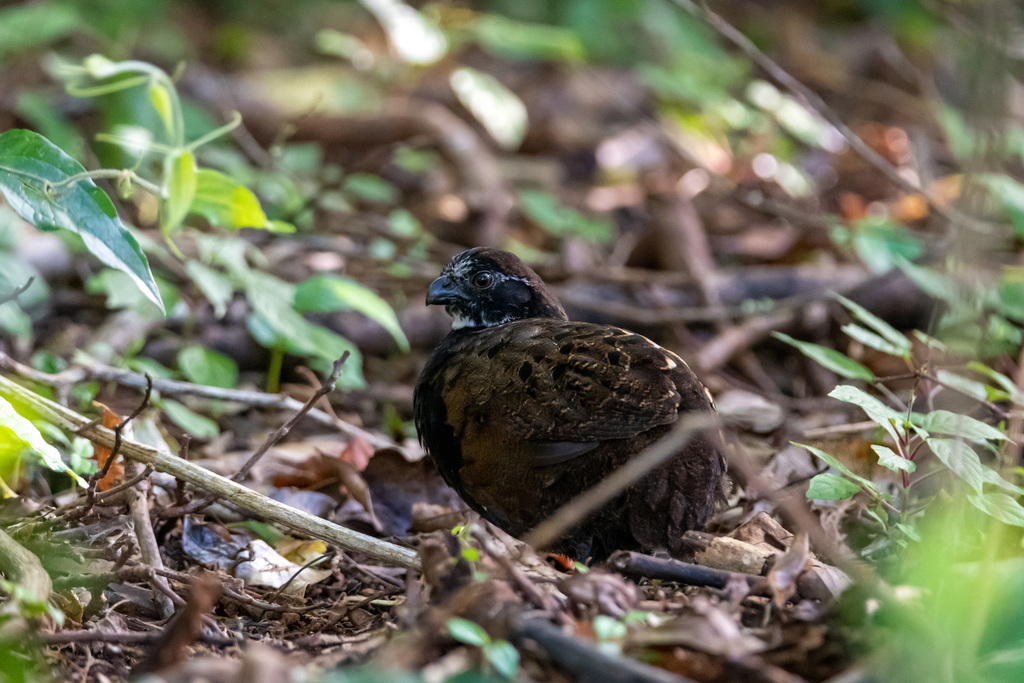
Black-breasted Wood Quail
Photo © Julius Simonelli
Photo © Julius Simonelli — CC BY 4.0 — Source: iNaturalist photo #59474725Identification
The black-breasted wood quail is a medium-sized New World quail, measuring 22–25.5 cm in length and weighing approximately 286 g for females and 300 g for males. Males are slightly larger than females, though the sexes are otherwise visually similar and cannot be reliably distinguished in the field. The species is also known by the alternative name white-throated wood quail, a reference derived from its scientific epithet leucolaemus (from Greek words meaning "white throat"). It belongs to the genus Odontophorus, whose name refers to tooth-bearing structures, though the taxonomic relationships within this genus remain complex, with this species sometimes considered part of a broader dusky wood quail complex.
Range & habitat
The black-breasted wood quail is found in Costa Rica and Panama, though its presence in Panama is now uncertain; it has not been recorded there since 1933 and may be locally extirpated. The species inhabits subtropical and tropical moist montane forests, where it occupies forested slopes at elevation. Its preference for mountainous, humid forest environments makes it a characteristic bird of the region's cloud forest and highland forest zones.
Behaviour & diet
This quail is highly social year-round, traveling in coveys of 10–15 individuals through forest undergrowth. Coveys spend the day feeding together over small territories on forested slopes, then gather at dusk to roost communally in low branches. They defend their group territories through coordinated calling with neighboring coveys, with vocal activity most intense in the early morning hours just after dawn. Unlike some congeners, they remain silent at dusk. When disturbed, the birds are characteristically shy, preferring to walk quietly away through undergrowth rather than flush immediately into flight.
Little is known about their diet, though they likely feed on plant matter supplemented with insects. Breeding habits remain poorly studied, but the species is believed to be monogamous, with some evidence of cooperative breeding. Nesting begins at the onset of the rainy season in May and June, with nests consisting of round hollows in leaf litter, guarded by groups of adults. Clutches typically contain 4–6 white eggs that gradually stain brown during incubation, which lasts 16–17 days.
Best time & places to see it
Costa Rica is the primary destination for observing this species. The period from March to April offers the best opportunities, as vocal activity peaks during these months, making birds easier to locate. The species is most vocal just after dawn, so early morning excursions through montane forest are recommended. Travellers should focus on subtropical and tropical moist montane forests on forested slopes, particularly during the lead-up to the rainy season.
Photography tips
Photographing black-breasted wood quails presents significant challenges due to their shy nature and preference for dense undergrowth. Early morning visits when birds are most vocal will increase encounter opportunities. Patience is essential, as the species typically walks away rather than flushes, allowing for slow, careful approach. Use longer focal lengths to avoid startling birds, and be prepared for low-light conditions typical of forest understory. The monochromatic plumage offers limited contrast, so careful exposure metering will help capture subtle plumage details. Covey behavior means multiple individuals may be present, rewarding persistent observation with opportunities for group photographs.
Arenal Volcano National Park
Peñas Blancas, Costa Rica
+551 birds+21 mammals
Straddling the border between Alajuela and Guanacaste in northwestern Costa Rica, this national park rises dramatically around one of Central America's most active volcanic systems. The…
VIEW NATIONAL PARKBraulio Carrillo National Park
Las Horquetas, Costa Rica
+547 birds+18 mammals
Where the Caribbean slope descends from the central volcanic cordillera toward the humid lowlands of Heredia, Braulio Carrillo National Park preserves one of Costa Rica's most…
VIEW NATIONAL PARKVolcán Poás National Park
Toro Amarillo, Costa Rica
+237 birds+4 mammals
Where volcanic slopes rise sharply from the Central Valley floor, Volcán Poás National Park protects one of Costa Rica's most active and accessible volcanic systems. The…
VIEW NATIONAL PARKBaru Volcano National Park
Cerro Punta, Panama
+402 birds+6 mammals
Where the land rises sharply toward the Caribbean's western spine, Baru Volcano National Park sprawls across roughly 220 square kilometres of southwestern Panama, anchored by the…
VIEW NATIONAL PARKGeneral de División Omar Torrijos Herrera National Park
La Pintada, Panama
+401 birds+2 mammals
Across the highlands of central Panama, where the continental divide funnels moisture-laden trade winds into steep river valleys, the terrain rises and falls in a landscape…
VIEW NATIONAL PARKParque Internacional la Amistad
Teribe, Panama
+325 birds+11 mammals
Where the continental divide rises between the Caribbean and Pacific watersheds, a wilderness of extraordinary biological richness unfolds across the Talamanca Range and into lowland rainforest—a…
VIEW NATIONAL PARKLos Quetzales National Park
Copey, Costa Rica
+232 birds+3 mammals
Cloud forest sweeps across the upper slopes of the Central Valley watershed, where elevation and persistent moisture forge an ecosystem unlike any other in Costa Rica.…
VIEW NATIONAL PARKTapantí Macizo de la Muerte National Park
Orosi, Costa Rica
+503 birds+18 mammals
Where montane cloud forest rises steeply from the Orosi Valley, Tapantí Macizo de la Muerte National Park enfolds a landscape of perpetual moisture and emerald complexity.…
VIEW NATIONAL PARKVolcán Tenorio National Park
Guatuso, Costa Rica
+480 birds+12 mammals
Where volcanic slopes rise through Costa Rica's northwestern borderlands, Volcán Tenorio National Park sprawls across terrain shaped by ancient lava flows and mineral-rich springs. The park's…
VIEW NATIONAL PARKNo community photos yet. Log in to add the first one.
No community observations of this species yet.