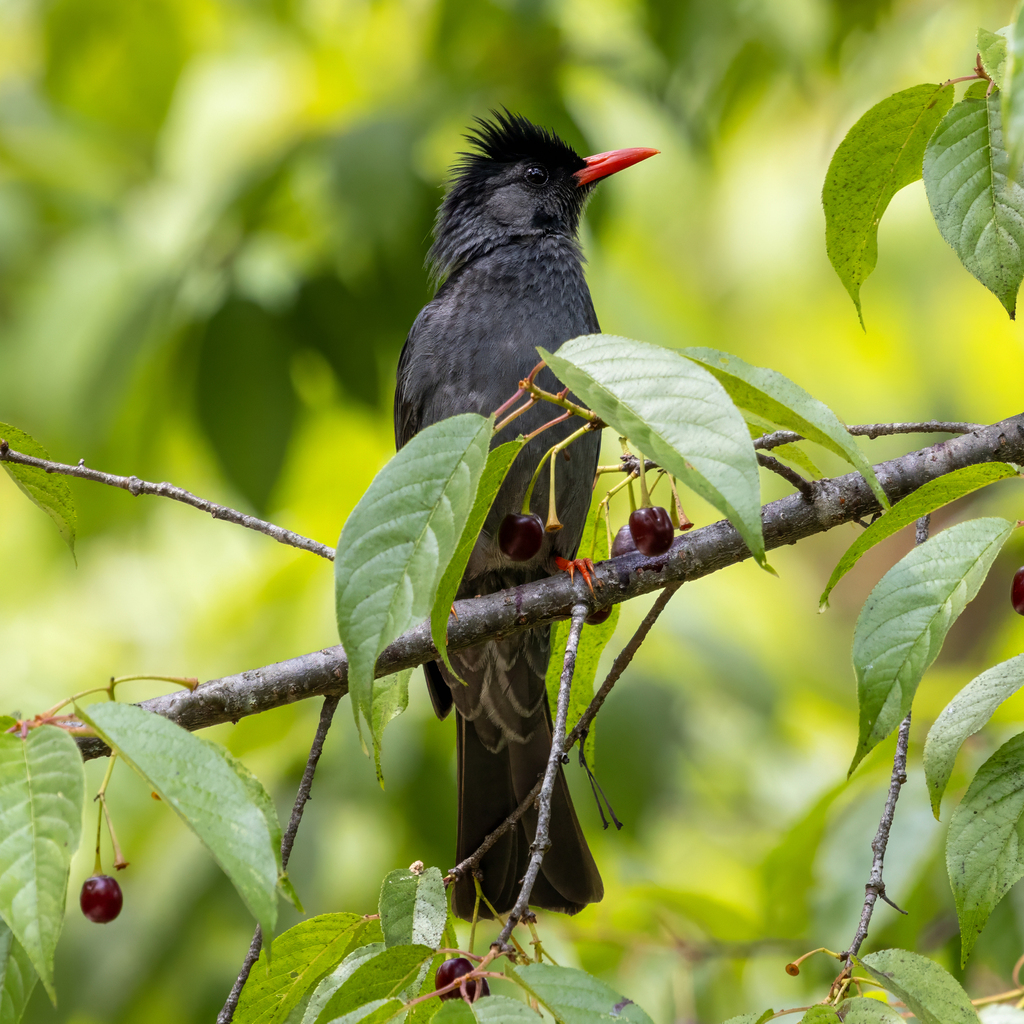
Black Bulbul
Photo © Dan Vickers
Photo © Dan Vickers — CC BY 4.0 — Source: iNaturalist #346055665Identification
The black bulbul is a medium-sized passerine, 24–25 cm in length with a notably long tail. Its most distinctive feature is a prominent black fluffy crest on the head. The body plumage varies by subspecies, ranging from slate grey to shimmering black. All individuals share bright orange-red legs, bill, and feet—a striking feature that distinguishes them in the field. Some subspecies display white-headed morphs, reflecting the species' scientific name, leucocephalus (white-headed). Sexes are similar in appearance to the human eye, though young birds lack the crest, showing whitish underparts with a grey breast band and brownish-tinged upperparts, plus a black streak behind the eye and on the ear coverts.
Range & Habitat
The black bulbul is found primarily in the Himalayas, with its range stretching from Pakistan eastward through Southeast Asia. The genus includes ten recognized subspecies distributed across this vast territory, from the Kunar Valley in north-eastern Afghanistan through India and Myanmar to Taiwan, Hainan Island, and southern China. This species inhabits broad-leaved forests, cultivated areas, and gardens mainly in hilly regions. Himalayan populations occasionally descend into adjacent plains during winter months, demonstrating some altitudinal flexibility.
Behaviour & Diet
Black bulbuls are quite vocal, producing various loud cheeping, mewing, and grating calls; the Himalayan form is reported to make a distinctive sound resembling a young goat. They are typically seen in small groups, either roosting or foraging in search of food. The species feeds mainly on seeds and insects, with a particular fondness for berries. Known berry sources include Celtis, Rosa, Melia, and Ehretia in the Himalayas. They also feed on nectar from Salmalia, Erythrina, Rhododendron, and other flowering plants, and regularly make aerial sallies to catch insects in flight.
Best Time & Places to See It
Black bulbuls are most readily observed in their preferred broad-leaved forest and garden habitats throughout the Himalayan region and Southeast Asia. Birding in hilly forested areas during the breeding season offers good opportunities to observe family groups and hear their distinctive calls. In winter, Himalayan populations move into the plains, expanding viewing opportunities. Early morning is typically the best time for observation, as the birds are more active and vocal during this period.
Photography Tips
The black bulbul's striking orange-red bill and legs provide excellent colour contrast for photography, particularly in bright morning light. The prominent black crest and long tail offer distinctive shapes to frame. Small flocking behaviour means patience and positioning near fruiting trees or flowering plants can yield rewarding shots. The bird's tendency to make aerial sallies presents opportunities for dynamic flight photography. In areas with white-headed morphs, the contrast between the white crown and dark body plumage creates compelling compositional opportunities.
Baima Snow Mountain National Nature Reserve
Bardiya National Park
Chitwan National Park
Doi Inthanon National Park
Gangotri National Park
Gaoligong Mountain National Nature Reserve
Giant Panda National Park
Hainan Tropical Rainforest National Park
Huanglong Scenic and Historic Interest Area
Nothing matches these filters.
No community photos yet. Log in to add the first one.
No community observations of this species yet.